This week I was fortunate to represent the City of Ann Arbor on "Issues of the Environment" on WEMU (89.1 FM.) It aired on the morning of Wednesday, June 5th. I was asked to come on the show to talk about some of the environmental initiatives we are undertaking at Leslie Park and Huron Hills golf courses. There is a common misconception that golf courses are not environmentally friendly and I was excited to showcase some of the practices that we are engaging in at the city, as well as informing the listeners about some of the newest trends in the golf course maintenance industry.
I also touched on the, recently completed, Traver Creek Restoration Project and the benefits the project will have for the Huron River as well as Leslie Park Golf Course.
You can listen to the podcast by clicking HERE (Issues of the Environment).
Showing posts with label golf course maintenance. Show all posts
Showing posts with label golf course maintenance. Show all posts
Friday, June 7, 2013

Monday, April 16, 2012
Deep Tine Aerification
On Tuesday, April 10th, a contractor from the company Deep Roots came and aerified the greens at Leslie Park. This aerification was different from the aerifiying that we do in the fall in that he uses solid tines that reach down 14 inches. In the fall, we use our own equipment to aerify with hollow tines to a depth of about 4 inches. The hollow tines allow us to remove soil and organic matter from the soil profile and replace it with sand. This reduces the build-up of thatch and compaction. The much longer tine from Deep Roots enables us to reach deeper into the green and decrease the stratification of the soil. While we were going to be spreading sand, we decided to hollow-tine aerify the collars and outside edge of the greens. This area often gets neglected in the fall due to the fact that we are trying to do as many of the greens as we can in one day. It also gets a lot of wear due to the mowers turning when they do the clean-up pass around the green.


This is a picture of the topdresser putting down sand on #10 green.

A picture of the outside pass on #8 green. (The deep tine holes are hard to see.)

#5 green, where the holes were not quite filled. The outside pass is toward the bottom of the picture. You can see the deep tine holes better here.

A profile of the hollow tine holes on #8 green.
Friday, March 9, 2012
Opening Day?
As I write this, the temperature is 32 degrees and there is a 24 degree wind chill, so take the following with a grain of salt. We are thinking of opening up sometime next week. I was just out putting bunker rakes in all of the bunkers and setting the times on the tee time clocks. (I had originally set the time yesterday, but was reminded by one of the guys on the crew that this weekend is the start of daylight savings time. Whoops.)
We have rolled the greens once already and plan on rolling again. We would also like to mow them. Other things on the list: changing cups, putting out trash containers, putting out flags and tee markers, raking bunkers and cleaning up the sticks and other debris that has collected over the winter.
Things might be a little rough out there, but last year we opened up on March 31st, so this would be 2+ weeks earlier. I will end with this picture, because I really like it.

We have rolled the greens once already and plan on rolling again. We would also like to mow them. Other things on the list: changing cups, putting out trash containers, putting out flags and tee markers, raking bunkers and cleaning up the sticks and other debris that has collected over the winter.
Things might be a little rough out there, but last year we opened up on March 31st, so this would be 2+ weeks earlier. I will end with this picture, because I really like it.

Wednesday, February 15, 2012
Photos in the dead of winter
Last week, I was driving around with a volunteer who helps me cut down invasive shrubs during the winter. He remarked about how green the course was, for February. Forward to today. I have been organizing the photos on my computer when I took a second look at some of the photos. It struck me just how GREEN things really are in the summer. Right now, things are kind of monochrome. Mostly brown and white. The green that we see is really a greenish-yellow. Here are some photos to brighten your day. Every day is one day closer to opening day!


Lilac Cherry blooms. (Thanks to reader J-Law for pointing it out.)


#4 green, looking back toward the fairway.

#7 green, in the fall of 2011.

#9 fairway, early morning.

The weather station, with native indiangrass in the foreground. I love the blue sky contrasted with the green grass.

Bumble bee on some Joe-pye-weed

Blue-flag iris in the native plant garden on #12

Cherry blooms between #6 green and #5 fairway.

Pear orchard behind #7 green. Native redbud tree in the foreground.

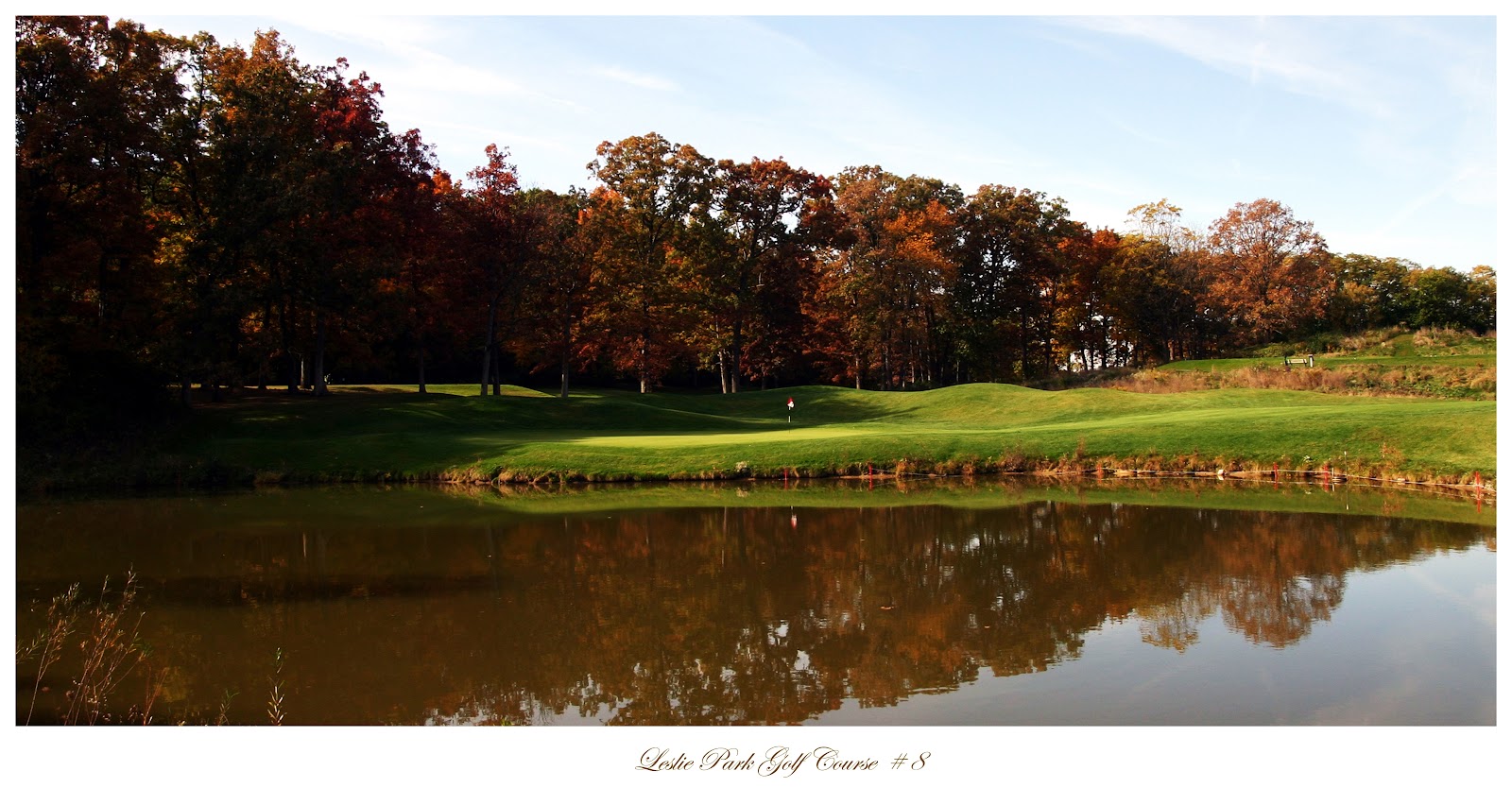
#8 green.

#13 fairway.
Thursday, January 12, 2012
Traver Creek Streambank Stabilization
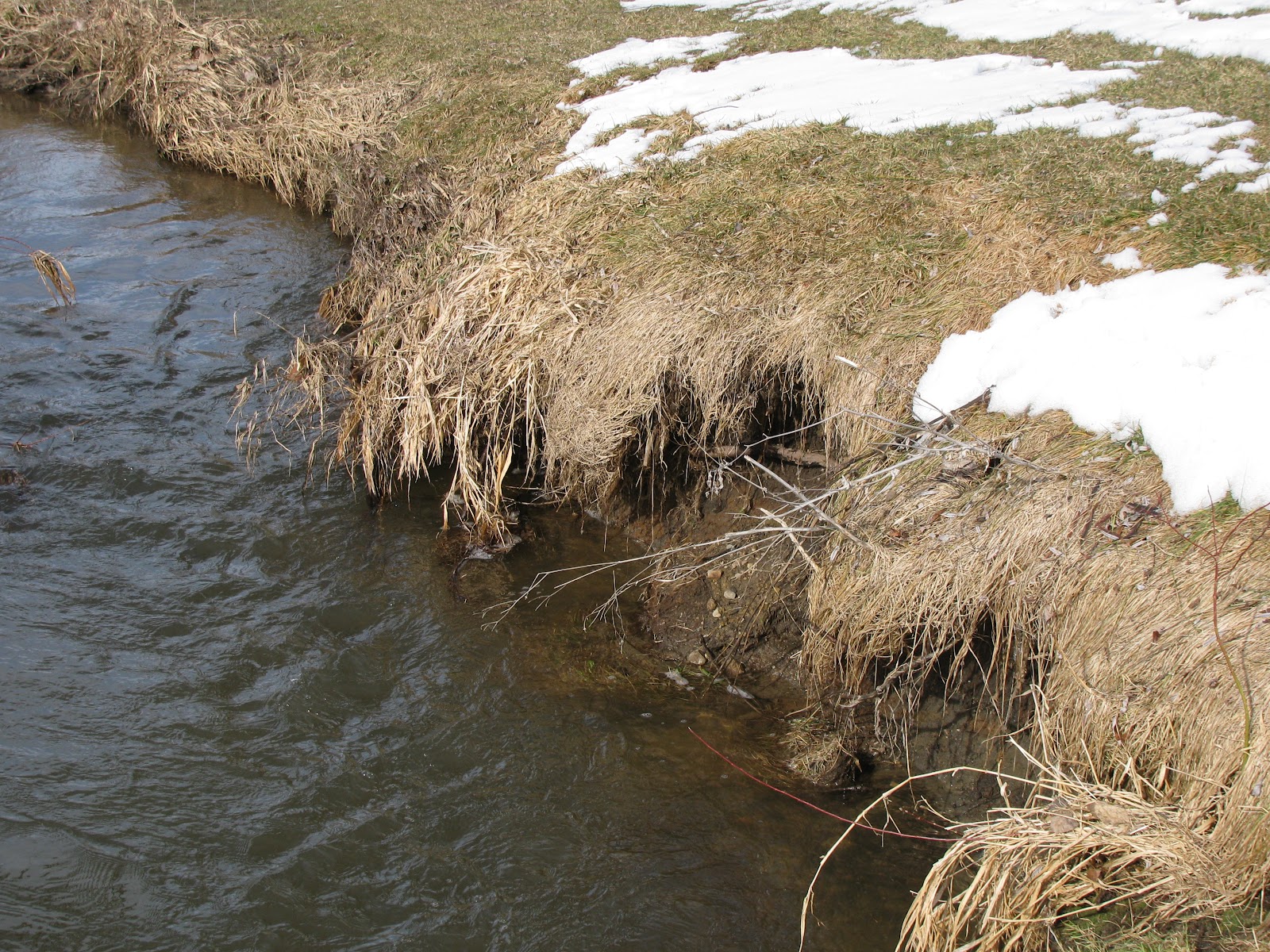
The goals of the project are functional (by improving stormwater infrastructure), ecological (sediment removal, phosphorous reduction and habitat improvement) and recreational (improving aesthetics on the golf course). The golf course will be partnering with the city water quality manager and the county's water resources office as well as Ann Arbor's Natural Areas Preservation Division and the Huron River Watershed Council to make sure that this project meets the environmental goals that have been set forth.
The Spicer Group has been brought aboard to develop a plan and assess the hydrologic, hydraulic and geomorphic conditions that occur on Traver Creek. If all goes according to plan, construction will begin in November 2012, with major construction completed before April 2013. A major consideration for all parties involved is to impact golf as little as possible. Although the construction will be complete, it could take up to two full seasons before Traver Creek and the habitat surrounding the creek areas fully mature. During the first season, most of the banks will be populated by grasses whose primary purpose is to hold the soil in place while the perennial native plants take hold.
It is important to note that at this point, no plans have been finalized, so it is nearly impossible to know what the final project will look like or involve. A write-up of the proposal that was brought before the Ann Arbor Parks Advisory Committee was featured in the Ann Arbor Chronicle.
Below are some photos of the erosion and overflow problems that we have seen. You may remember a similar, though much smaller scale, project from the Summer of 2010. You can find out more HERE. I will keep you updated on this exciting project as we know more.



Thursday, December 1, 2011
November 2011 Weather Summary
I noticed an interesting phenomenon this morning while checking the course. In 90% of the bunkers, the snow had melted except over the underground drainage lines. This allowed me to get a visual on where these lines are located. The nice thing about that is it could allow me to find the beginnings of the drainage lines. When constructing bunkers, the drain lines will often have a "clean-out" at the beginning of the line. These "clean-outs" allow someone to easily flush the sand and silt that accumulates in the drainage over time. This may improve the speed at which these bunkers drain rain away.

Here you can see the herringbone pattern of drains in the bunker on #14.

A similar pattern on #12

On #7, I painted a yellow line on the snow to help me trace the drain to the end.
Speaking of rain, we received 4.77 inches of it in November. This brings our yearly total here at Leslie Park Golf Course to 39.42 inches. We had 10 days with over a trace of rain and 8 days with over a tenth of an inch. We had 2 days with over an inch of rain. Those days were the 22nd and 29th.
The high temperature for the month of November, 2011,was 66.4 (The 8th of November) and the lowest temperature recorded was 18.1 on the 18th. It got below freezing on 7 of the 30 days, but the daily high was always above 32 degrees.
The highest wind gust was 42 mph (Nov 9th.)
Wednesday, November 23, 2011
More Fall Projects
#11 is the scene of most of our projects this fall. You may remember that we built a new tee already. (You can see this tee here)
On the left side of #11 near the green, there has been a continual problem with an area of peat mixed with clay. This area holds water and is impossible to mow and also causes some unfair lies. Here is the area in 2009.


In the spring, we also had a large issue with standing water on the right side of the fairway, about 250 yards from the green. The water would come out of the woods and collect in a hollow near the tree line. We had so much rainfall this spring that the water would overflow and flow across the fairway. This created a huge mess and cart traffic had to be routed through standing water to play the hole. Earlier in the fall, we put in a catch basin in the hollow and we are now working on connecting the catch basin to existing drainage near #13 tee.


On the left side of #11 near the green, there has been a continual problem with an area of peat mixed with clay. This area holds water and is impossible to mow and also causes some unfair lies. Here is the area in 2009.

The area in August of 2011.

I went in and removed the peat and clay areas with a backhoe and replaced it with pea-stone. We put in catch basins connected to existing drainage.


We then covered the pea-stone over with about a foot of soil and graded it out to a gradual slope that forces surface water into the catch basins.


This is after we got 1.27 inches of rain last night, hence the puddles.
In the spring, we also had a large issue with standing water on the right side of the fairway, about 250 yards from the green. The water would come out of the woods and collect in a hollow near the tree line. We had so much rainfall this spring that the water would overflow and flow across the fairway. This created a huge mess and cart traffic had to be routed through standing water to play the hole. Earlier in the fall, we put in a catch basin in the hollow and we are now working on connecting the catch basin to existing drainage near #13 tee.


We will be working on trenching across the fairway next week.
On a different note, today is the last day for golf at Leslie Park for the year. As a reminder, our sister course, Huron Hills will be open until the snow flies. It has been a good year and I hope to see you out on the course in 2012!

Monday, September 19, 2011
Months ending in "ber"
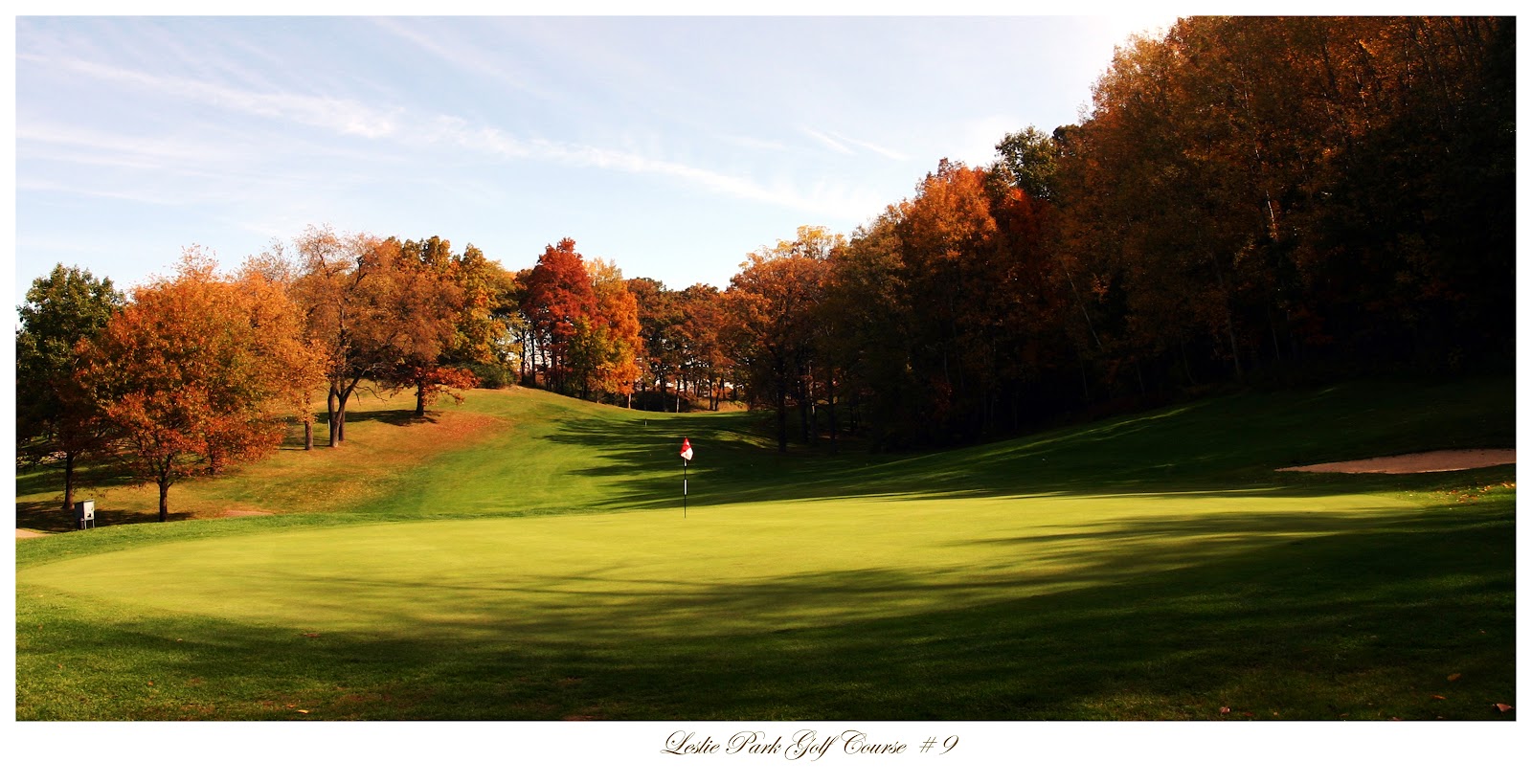
The last four months of the calender year are the beginning of the year for a golf course. I was told this by David Heroian, the Superintendent of the Myopia Hunt Club in South Hamilton, Massachusetts, where I did my internship in the summer of 1998. The thinking behind this is that everything that you do during the Autumn is in preparation for next summer. For some reason, a large portion of the golfers put away their bags after Labor Day. This may be due to football, the kids going back to school or some other reason, but play really drops in the fall. It shouldn't be the weather, because in my opinion, the fall is the best time to play golf. On many days in September and October, the high temperature will be in the upper sixties or seventies with very few clouds. If we are lucky enough to have this type of weather in April or May, golfers will be lining up to get out on the course. Of course, after a long winter, cooped up inside, I don't blame them for wanting to get outside. During the fall, this same weather will be met with open tee times and discounted rates.
This drop in play gives us an opportunity to perform some maintenance that is disruptive to golfers. The biggest one is the dreaded "aerification." When the greens are aerified, the ball roll can be slowed down and if the holes are not properly filled, the greens can be bumpy. If we can get out and aerify while the grass is still actively growing, this disruption will only be about seven to ten days. When it is put off until later in the year (mid to late October in south-east Michigan) this period can last 2 weeks or more. If the weather does not cooperate, the greens might not fully heal until the spring. Last year, we aerified greens on the 16th and 17th of September. Many times in the month of October, I was asked when we were going to aerify our greens. They had no idea that they were already done, due to us taking advantage of the warm weather.
The tees and fairways are also aerified in the fall. This presents less of a problem for golfers. On the tees, the holes do not come into play because the golfer is allowed to choose where he will hit from and will usually put the ball on a tee. The fairways have longer grass and as with greens, if the holes are filled properly, it should be fully healed in a week or so. Most of the disruption will be one the day that we actually are working on the hole. This will usually only be two or three holes, due to the large areas that we are talking about. Most of our fairways are between one and two acres in size.
Fall is also the time when the summer stress is done with for the most part and the grass will start growing roots again. In Michigan, the predominate grasses used on golf courses are "cool-season" grasses. This includes Kentucky Bluegrass, Creeping Bentgrass, Ryegrass and Fescue. These grasses grow best with the temperatures between 60 and 80 degrees. "Warm-season" grasses such as Zoysia and Bermuda (as well as Crabgrass, which isn't a turfgrass, but a weed) don't start to really grow until the temperature reaches 75 degrees and will thrive until it hits 90 or so. When the temperature gets above 80, cool-season grass begins to shut down and go dormant. This is why areas that don't get irrigation will often turn brown in July and August. When this happens, the grass is just trying to survive and often the roots start to retract. At the end of August, we are lucky to have 2 inches of roots on the greens. By the end of October, I hope to have 4-5 inches of roots. The healthier the grass is going into winter, the better it will be in the spring. Aerification allows the roots a nice , friendly place for new roots to grow. It also allows oxygen to get down into the rootzone.
Fall is also a great time to control weeds. Most of the weeds that we have on the golf course are "winter-annuals." This means that the weeds sprout in the summer and then over-winter and really take-off in the spring and set seed for the next generation. Because of this and the fertilizer needs of the grass (the fertilizer that we put on the fairways in the spring is pretty much gone) right now is a great time for a "weed-and-feed." This is a fertilizer that is coated with a broadleaf herbicide. It makes sense from a couple of standpoints. The first is that we accomplish two goals with one application. The second is that we can save money. If I were to buy a granular herbicide, the manufacturer would have to coat something with the herbicide. This is often ground-up corncobs. If you do a weed and feed, the fertilizer is what is coated with the herbicide. As one salesman has told me, it is like you buy the herbicide and you get the fertilizer for free. Of course, you don't get anything in this world for free, but if you compare prices, if fertilizer costs $20 and herbicide costs $25, the combined product would cost $30. (I am totally making these prices up, don't quote me on any of this.)
During the early winter months, the grass stops growing and we start on preventative maintenance on our equipment. We change the engine oil, hydraulic oil, fuel and air filters on all of the mowers. We also change the oil on the golf carts, as well as check the filters and spark plugs on the carts. The tee, green and fairway mowers all have reels and bedknives that need to be ground and sharpened. The rough mowers have blades that need to be sharpened. We also clean up the shop. During the hectic summer months, it can get quite messy.
These are just a few of the reasons that, as a golf course superintendent, you cannot trust the calender. The New Year starts in September.
P.S. A big thank you to Robb Johnston for the title of this post. Robb works for the City of Ann Arbor's Natural Area Preservation Unit. He also is a childrens author. Check out his blog for The Woodcutter and the Most Beautiful Tree


Thursday, August 18, 2011
Wildflowers and sunrise
Some pictures I took the other day in my travels around the golf course.

Honey bees on spotted joe-pye-weed (Eupatoriadelphus maculatus)


Joe-pye-weed (Eupatoriadelphus maculatus)

Blue Vervain (Verbena hastata)

Goldenrod (Solidago spp)

Evening Primrose(Oenothera biennis)

Joe-pye-weed and other plants in the buffer strips along Traver Creek

Irrigation running on #9 at 6:45 AM


Wednesday, August 10, 2011
Regrowth

After the long period of hot and dry weather we had at the end of June and through most of July, a lot of areas in the fairways were turning brown. Most of these spots were patches of Poa annua (Annual Bluegrass) which tends to have a shallow root system and, like the name suggests, acts as an annual plant and dies off when under stress.
We have gotten almost 3 inches of rain in the month of August so far and most of these areas have greened up. Some, like the area above, did not do as well. Last week, we got out the slit seeder and used this as an opportunity to increase the amount of bentgrass in the fairways. We put about 75 lbs of seed into the weak areas in the fairways. This includes all of number 9 fairway, as this was a hole in which we have always had problems due to the high amount of Poa.
As you can see from the pictures, the seed is starting to grow in straight lines where the slit seeder cut a slit and dropped the seed. Because of the nature of Creeping bentgrass, it will spread from those lines and, hopefully, fill in the bare and weak areas.

Friday, August 5, 2011
Halfway there.
We just got the letter from Audubon International telling us that Leslie Park has received certification in 4 of the 6 categories required for full program certification. The categories we have achieved are Water Conservation, Chemical Use Reduction and Safety, Water Quality Management and Environmental Planning. We have to complete Wildlife and Habitat Management and Outreach and Education in order to become a certified Audubon Cooperative Sanctuary.


Subscribe to:
Comments (Atom)