Showing posts with label NAP. Show all posts

Friday, July 7, 2017

Turtle Eggs and Sand Piles

When the Traver Creek Project was started, one of the most interesting parts was the turtle stipulation. In order to begin the creek renovation, a permit was submitted to the Michigan Department of Environmental Quality (MDEQ.) To satisfy the MDEQ permit of the project, turtles and other herptofauna were relocated from the two inline detention basins (AKA ponds on holes #12 and #17) on Traver Creek to the pond on #8. There are at least four large snapping turtles (Chelydra serpentina) and numerous painted turtles(Chrysemys picta) in Traver Creek and there was concern over what would happen to these turtles during and after the project was completed. To help them after the project, four sand piles were created for the turtles to use as nesting areas. 

Last month, a painted turtle nest was discovered at Argo Canoe Livery. The nest was located in a high traffic area and the probability of successful hatching was low, so Natural Area Preservation (NAP) was called in to move the nest to a better location.


Argo and NAP staff locate the eggs.


The eggs after excavation. It is very important to have the eggs remain in the same orientation for proper development.


The eggs were moved to one of the sand piles at Leslie Park and covered with a predator exclusion screen. This makes it difficult for raccoons and other animals to dig up and eat the eggs.


While NAP was working, they discovered a snapping turtle nest in the same pile. The covered that nest with a predator exclusion screen, as well.


NAP also puts signs out so that people know what the screens are for and to leave them where they are.


Monday, December 5, 2016

Turtle Basking Structures

As part of the Traver Creek Restoration Project through the City of Ann Arbor owned Leslie Park Golf Course in 2013, a permit was submitted to the Michigan Department of Environmental Quality (MDEQ.) To satisfy the MDEQ permit of the project, turtles were relocated to avoid  the construction. You can read more about the turtle project HERE and HERE

After the project was complete, turtle habitat was supposed to be improved. One way to do that is to install basking structures. This is a place where the turtle can lay in the sun to warm up, while also having the ability to drop quickly back into the water to escape a predator. If you ever go canoeing along the Huron River, you will see lots of turtles on fallen trees along the river banks. We are trying to replicate this type of basking area in the ponds on #8, #12 and #17.

The first step was to find some suitable branches. An opportunity came in the form of some tree trimming we were planning on doing along #11 tee. In order to frame the shot from the Championship tees, we needed to trim back some Siberian Elm (Ulmus pumila) trees. These trees are non-native and are considered a semi-invasive species.

Once we had the correct size branches, Natural Area Preservation staff started to install the structures.

Positioning the branch in the pond.


Installing lag bolts to hold the anchors.


The "Duckbill" anchor is driven into the ground.


When the drive rod is pulled out, the anchor rotates to lock into the surrounding earth.


Waders were a necessity to place the structure properly on this cold December day.


You can see one of the structures in the pond on #8.


Another basking site near Traver Road on #12.

Tuesday, September 18, 2012

Turtle Relocation


As part of the Traver Creek Restoration Project through the City of Ann Arbor owned Leslie Park Golf Course, a permit was submitted to the Michigan Department of Environmental Quality (MDEQ.) To satisfy the MDEQ permit of the project, turtles and other herptofauna will be relocated from the two inline detention basins (AKA ponds on holes #12 and #17) on Traver Creek in the Golf Course.  This week, barrier fencing was installed around the pond on hole number 8 at the LPGC to receive and retain relocated animals before the construction starts.


The City of Ann Arbor's Natural Area Preservation's (NAP) staff Herpetologist, David Mifsud, will coordinate the relocation efforts with assistance from NAP staff and volunteers. The hope is that we will be able to relocate the majority of the animals from the ponds well within the time needed for them to successfully overwinter in the relocated area.  NAP will document all collected animals and monitor the receiver area(s) in subsequent years to qualitatively assess the results of the relocation.


The turtles will be live trapped with hoop traps baited with sardines. There will be six of each of three different size traps for a total of 18 traps. Here are some pictures of the traps.

The smallest trap. Notice the yellow, foam swim toy (noodle) which will help keep the trap afloat.

Here is the largest size trap.


Putting the traps out.

The traps need to be staked out so they don't float away.

These nets will help direct turtles into the traps. They hit the net and follow it until they get to the trap.


Here is the set up with one of the large nets.

Another perspective of the traps in the water.

This is the pond on #8 where the turtles and other animals will be relocated.

The silt fence will keep the animals from trying to move back to the pond where we are trapping them.


If you have interest in helping with this project please contact Tina Roselle, the Volunteer and Outreach Coordinator for the City of Ann Arbor's Natural Area Preservation at troselle@a2gov.org or call NAP at (734) 794-6627. 

Monday, March 19, 2012

Golf and Burn Season is Underway

With the near-record warmth, we opened the golf course on March 14th.  High temperatures are expected to be in the seventies for the next 7 days or so. Welcome to the golf season! For the record, last year (2011) we opened on March 31st. In 2010, we opened on March 23rd.

Coinciding with this nice weather came low humidity and the first burn day of 2012. We use controlled burns to keep the weed populations low in our naturalized areas that are out of play.


We co-ordinate our burns through the City of Ann Arbor Natural Areas Preservation (NAP)  department. From the NAP websiteOur native Ann Arbor ecosystems are fire-dependent. Until settlers began suppressing fires in the early 1700s, fire enriched the soil and removed dead thatch, allowing diverse native plant and animal communities to thrive. Continued fire suppression has disrupted the natural balance and allowed fire-intolerant, non-native plant species to out-compete the native, fire-adapted plants. By reintroducing fire in our parks, we are reinstating an essential ecosystem process.

Some pictures of burns we have done in the past:

Before burning (2010)

After burning.

2 weeks after burning.

2 months after burning.

As you can see, the grasses come back extremely fast. The invasive shrubs have been set back, but are sprouting back from the root system. In subsequent years, these shoots will be set back even more. It sometimes takes 4 or 5 years of annual burning before a noticeable amount of these invasive shrubs are killed.


Thursday, January 12, 2012

Traver Creek Streambank Stabilization

The City of Ann Arbor (which owns Leslie Park Golf Course), in partnership with the Washtenaw County Water Resources Commissioner's Office, has proposed a streambank stabilization project for Traver Creek, which runs through Leslie Park. This project will be financed through the Michigan Department of Environmental Quality's State Revolving Loan Fund. There is an opportunity for up to 50% of the cost of the project to be forgiven depending on the level of environmentally sound practices utilized during restoration. The funding would come out of the city and county stormwater budgets over the next 20 years. The city of Ann Arbor is at the forefront of municipalities in the state of Michigan in using stormwater funds to proactively manage water courses to positively effect stormwater quality during high-precipitation events. What this means is that the city uses these funds to ecologically manage surface water instead of just fixing broken or damaged sewers.

The goals of the project are functional (by improving stormwater infrastructure), ecological (sediment removal, phosphorous reduction and habitat improvement) and recreational (improving aesthetics on the golf course). The golf course will be partnering with the city water quality manager and the county's water resources office as well as Ann Arbor's Natural Areas Preservation Division and the Huron River Watershed Council to make sure that this project meets the environmental goals that have been set forth.

The Spicer Group has been brought aboard to develop a plan and assess the hydrologic, hydraulic and geomorphic conditions that occur on Traver Creek. If all goes according to plan, construction will begin in November 2012, with major construction completed before April 2013. A major consideration for all parties involved is to impact golf as little as possible. Although the construction will be complete, it could take up to two full seasons before Traver Creek and the habitat surrounding the creek areas fully mature. During the first season, most of the banks will be populated by grasses whose primary purpose is to hold the soil in place while the perennial native plants take hold.

It is important to note that at this point, no plans have been finalized, so it is nearly impossible to know what the final project will look like or involve. A write-up of the proposal that was brought before the Ann Arbor Parks Advisory Committee was featured in the Ann Arbor Chronicle.

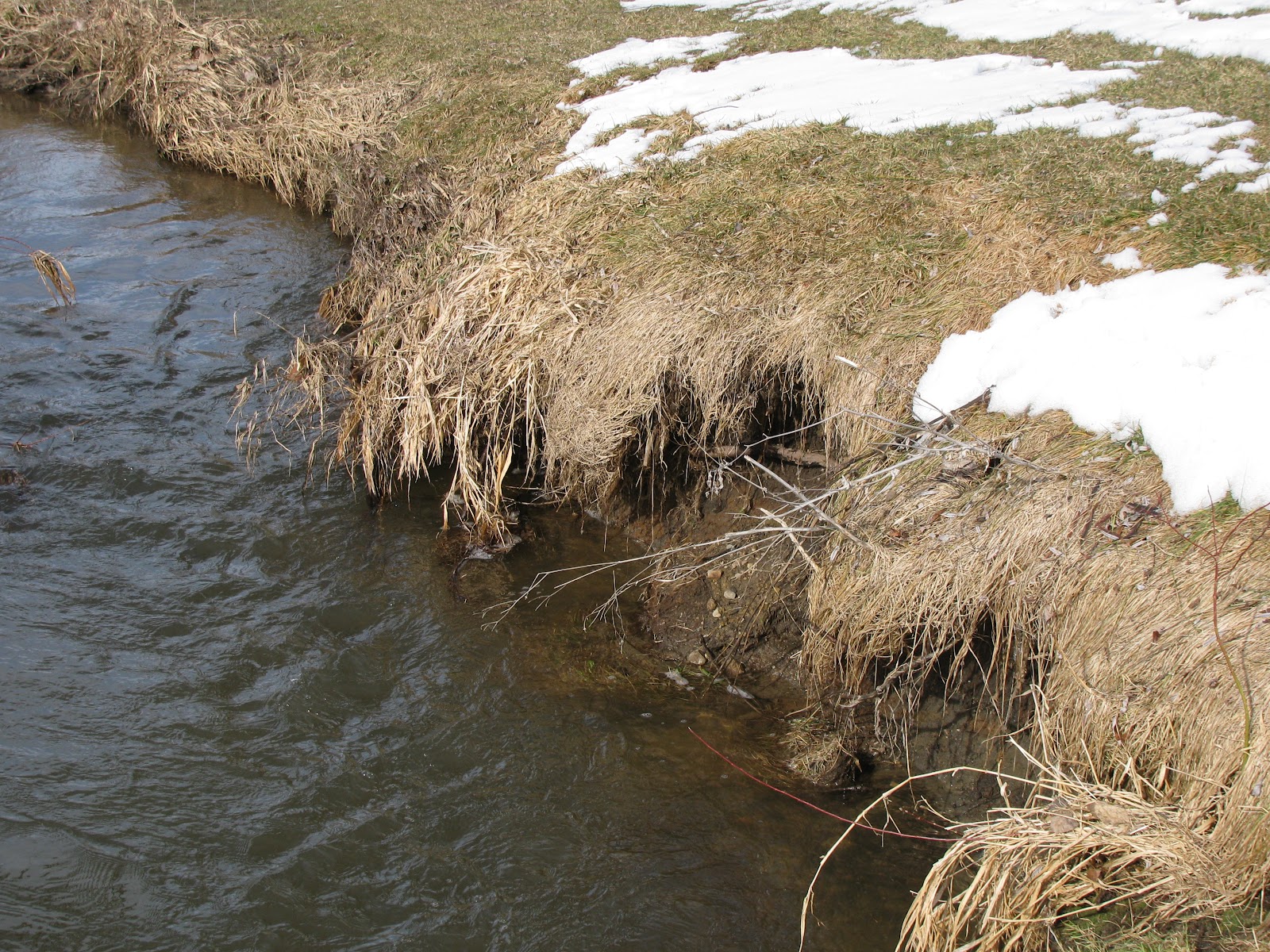
Below are some photos of the erosion and overflow problems that we have seen. You may remember a similar, though much smaller scale, project from the Summer of 2010. You can find out more HERE. I will keep you updated on this exciting project as we know more.


Wednesday, March 30, 2011

Raptors are sexy!/Mailbag

I saw this Red-Tailed Hawk on top of one of our bluebird houses this morning!

He is about to take off, because it took so long for the camera to focus on him.


Here he is in the tree behind the birdhouse.


Mailbag-


From a comment posted to the previous blog entry....

Brian Kuehn  said...

After one of these burns it is common to find a bunch of toasted golf balls left behind.

Well, what do you think?

It took me about 5 mins to find these along #11.

Tuesday, March 29, 2011

Burn Season is Underway!

The City of Ann Arbor's Natural Areas Preservation unit started the 2011 burn season yesterday and one of the first locations chosen was Leslie Park. These controlled burns are used to try and control the spread of invasive plant species. I will have a longer post later that will go into more detail, but here are some pictures and a video taken yesterday (March 28, 2011)


Before

After


Before


During


After


Thursday, March 18, 2010

Burn, baby, burn!

The last couple of days have been very busy here.  With the cooperation of the City of Ann Arbor's Natural Areas Preservation (NAP) division, we have done some prescribed burns of the natural areas on the course.  This allows native, more fire resistant plants to get back a competive advantage over alot of invasive plant species.  These invasive plant are usually not well adapted to fire and burning will control the spread of these plants.  Words are not enough, so here are pictures.
Starting the burn near #14 tee


Behind the clubhouse.


Smoke column (#11)


#14 tee before the burn


#14 tee after the burn