As I write this, the temperature is 32 degrees and there is a 24 degree wind chill, so take the following with a grain of salt. We are thinking of opening up sometime next week. I was just out putting bunker rakes in all of the bunkers and setting the times on the tee time clocks. (I had originally set the time yesterday, but was reminded by one of the guys on the crew that this weekend is the start of daylight savings time. Whoops.)
We have rolled the greens once already and plan on rolling again. We would also like to mow them. Other things on the list: changing cups, putting out trash containers, putting out flags and tee markers, raking bunkers and cleaning up the sticks and other debris that has collected over the winter.
Things might be a little rough out there, but last year we opened up on March 31st, so this would be 2+ weeks earlier. I will end with this picture, because I really like it.
Showing posts with label Ann Arbor. Show all posts
Friday, March 9, 2012
Friday, March 2, 2012
February 2012 Weather Summary
The high temperature for February, 2012 was 51 degrees, on the 1st. The lowest temperature at Leslie Park during the month was 10.5 degrees on the 11th. The average temp was 32.5, just over the freezing point. Only two days had high temperature that was below 32. Let me repeat that, only two days in February did not get above freezing. 25 days had low temps below 32 degrees.
We had 0.06 inches of rain. All of it came on the 27th. This was also the day that saw the highest wind speed recorded (30.0 mph.) The average wind speed was 4.3 mph.
Labels:
Ann Arbor,
Leslie Park,
Michigan,
monthly summary,
weather station
Monday, February 13, 2012
January 2012 Weather Summary
It is the middle of the month and I have forgotten all about my monthly weather summary.
The high temperature for January was 55.1 (Jan 31st.) The low was 0.7 degrees (20th.) The average temperature was 30.9 degrees. Yes, the calender said it was January. there were 10 days where the high temperature did not get above 32 degrees. 27 days had low temps below freezing.
Leslie Park got 1.76 inches of rain. 0.75 inches on the 17th alone. 9 days had a trace of rain and 5 days had at least a tenth of an inch.
The highest windspeed recorded was 33 mph on the first day of the year. Average speed was 4.9 mph.
The high temperature for January was 55.1 (Jan 31st.) The low was 0.7 degrees (20th.) The average temperature was 30.9 degrees. Yes, the calender said it was January. there were 10 days where the high temperature did not get above 32 degrees. 27 days had low temps below freezing.
Leslie Park got 1.76 inches of rain. 0.75 inches on the 17th alone. 9 days had a trace of rain and 5 days had at least a tenth of an inch.
The highest windspeed recorded was 33 mph on the first day of the year. Average speed was 4.9 mph.
Thursday, January 12, 2012
Traver Creek Streambank Stabilization
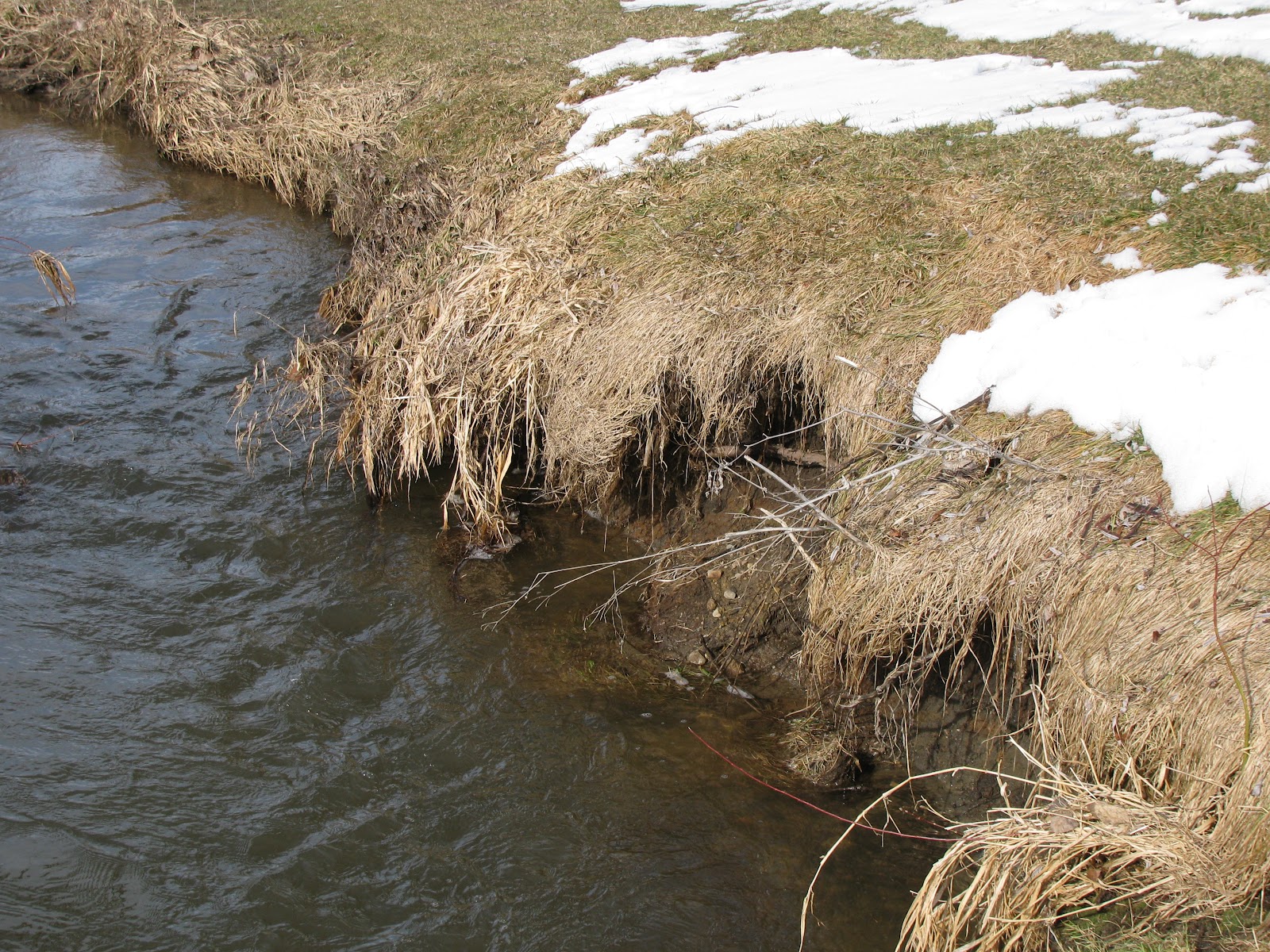
The goals of the project are functional (by improving stormwater infrastructure), ecological (sediment removal, phosphorous reduction and habitat improvement) and recreational (improving aesthetics on the golf course). The golf course will be partnering with the city water quality manager and the county's water resources office as well as Ann Arbor's Natural Areas Preservation Division and the Huron River Watershed Council to make sure that this project meets the environmental goals that have been set forth.
The Spicer Group has been brought aboard to develop a plan and assess the hydrologic, hydraulic and geomorphic conditions that occur on Traver Creek. If all goes according to plan, construction will begin in November 2012, with major construction completed before April 2013. A major consideration for all parties involved is to impact golf as little as possible. Although the construction will be complete, it could take up to two full seasons before Traver Creek and the habitat surrounding the creek areas fully mature. During the first season, most of the banks will be populated by grasses whose primary purpose is to hold the soil in place while the perennial native plants take hold.
It is important to note that at this point, no plans have been finalized, so it is nearly impossible to know what the final project will look like or involve. A write-up of the proposal that was brought before the Ann Arbor Parks Advisory Committee was featured in the Ann Arbor Chronicle.
Below are some photos of the erosion and overflow problems that we have seen. You may remember a similar, though much smaller scale, project from the Summer of 2010. You can find out more HERE. I will keep you updated on this exciting project as we know more.
Labels:
Ann Arbor,
Environment,
golf course maintenance,
HRWC,
Huron River,
Leslie Park,
NAP,
Stewardship,
Traver Creek
Thursday, December 1, 2011
November 2011 Weather Summary
I noticed an interesting phenomenon this morning while checking the course. In 90% of the bunkers, the snow had melted except over the underground drainage lines. This allowed me to get a visual on where these lines are located. The nice thing about that is it could allow me to find the beginnings of the drainage lines. When constructing bunkers, the drain lines will often have a "clean-out" at the beginning of the line. These "clean-outs" allow someone to easily flush the sand and silt that accumulates in the drainage over time. This may improve the speed at which these bunkers drain rain away.
Here you can see the herringbone pattern of drains in the bunker on #14.
A similar pattern on #12
On #7, I painted a yellow line on the snow to help me trace the drain to the end.
Speaking of rain, we received 4.77 inches of it in November. This brings our yearly total here at Leslie Park Golf Course to 39.42 inches. We had 10 days with over a trace of rain and 8 days with over a tenth of an inch. We had 2 days with over an inch of rain. Those days were the 22nd and 29th.
The high temperature for the month of November, 2011,was 66.4 (The 8th of November) and the lowest temperature recorded was 18.1 on the 18th. It got below freezing on 7 of the 30 days, but the daily high was always above 32 degrees.
The highest wind gust was 42 mph (Nov 9th.)
Labels:
Ann Arbor,
bunkers,
drainage,
golf course maintenance,
monthly summary,
rain,
sand,
weather station
Wednesday, July 13, 2011
Tree Update
We had an outside contractor come in to cut down the tree that was hit by lightning on Monday. We opted to just take down the trunk which had all of the bark torn off. The arborist had doubts that the rest of the tree will survive, but we thought it was better to just take down the unsafe portion of the tree at this time and hope for the recovery of the remaining tree.
We had the outside contractor come in, because with the storm that came through, the City's forestry department could not guarantee that they would be able to get to it before the City Championship this weekend. The contractor just took down the damaged limbs and trunk and left it there for us to cleanup. This saves us money and leaves the portion of the job that we feel comfortable with.
The debris on the ground.
Friday, June 24, 2011
Just the tip of the boulder........
The expression "Just the tip of the iceberg" took on a slightly different form for us this week. One of the guys mowed #13 fairway and told me about a "little" rock that was working it's way up through the turf. I sent a couple of guys out to 13 at the end of the day to dig it out and fill in the hole with soil and seed. They came back and told me they could not get the rock out. It was too big. When I saw what they had excavated, I went to get the backhoe because it was VERY big. Here is a picture of it's new home in one of the parking lot medians.
One of the unique (to southeastern Michigan) things about Leslie Park is the change in elevation. This is thanks to the glaciers that came through 10,000 years ago. They deposited whatever they picked up in Canada here. In areas where the glaciers paused, they put more of the sediment (called glacial till)and caused the hills and valleys (kettle and kames) we have here. According to Wikipedia, glacial till is unsorted glacial sediment. Glacial till is that part of glacial drift which was deposited directly by the glacier. Its content may vary from clays to mixtures of clay, sand, gravel and boulders.
Wednesday, June 22, 2011
Phosphorus Reductions in the Huron River Watershed
Phosphorus Reductions in the Huron Get Noticed
In 2007 the Huron River Watershed Council (HRWC) recommended that phosphorous fertilizers not be used within the watershed. The purpose was to cut down on the amount of phosphorous, a major factor in algae blooms, in the Huron River. The City of Ann Arbor adopted this as a city regulation, and as such, Leslie Park has not used any phosphorous fertilizers since. In December 2010 Michigan lawmakers passed legislation (HB-5368) that extended this regulation statewide. The new regulations and limitations will go into effect Jan. 1, 2012.
In 2010 the HRWC conducted a Water Quality Monitoring Program that showed a 28% drop in phosphorus in Ann Arbor tributaries — including Traver Creek, which runs through Leslie Park Golf Course.
I am proud to say that total phosphorus has declined in each of the three survey periods and compares favorably with other tributaries in the Huron watershed. This may be due to the fact that Traver Creek's watershed is not as developed as other tributaries, but it still shows the golf course is not a major contributor to phosphorus in the Huron River.
This is supported by the water sampling we do quarterly. How we do it is detailed in a previous post HERE. In short, we take water tests from the pond on #17 (where Traver Creek enters the property) and from the pond on #12 (where the creek leaves the golf course). These tests, which we have done since 2009, confirm the golf course does not add to the nutrients in the creek. In fact, most of the tests show a decrease of the elements that are sampled. This is a very good sign that the fertilizer and chemicals we use on the golf course are used in a responsible way. We avoid applying fertilizers near water and have buffer strips near the creek to filter runoff that may occur.
In 2007 the Huron River Watershed Council (HRWC) recommended that phosphorous fertilizers not be used within the watershed. The purpose was to cut down on the amount of phosphorous, a major factor in algae blooms, in the Huron River. The City of Ann Arbor adopted this as a city regulation, and as such, Leslie Park has not used any phosphorous fertilizers since. In December 2010 Michigan lawmakers passed legislation (HB-5368) that extended this regulation statewide. The new regulations and limitations will go into effect Jan. 1, 2012.
In 2010 the HRWC conducted a Water Quality Monitoring Program that showed a 28% drop in phosphorus in Ann Arbor tributaries — including Traver Creek, which runs through Leslie Park Golf Course.
I am proud to say that total phosphorus has declined in each of the three survey periods and compares favorably with other tributaries in the Huron watershed. This may be due to the fact that Traver Creek's watershed is not as developed as other tributaries, but it still shows the golf course is not a major contributor to phosphorus in the Huron River.
This is supported by the water sampling we do quarterly. How we do it is detailed in a previous post HERE. In short, we take water tests from the pond on #17 (where Traver Creek enters the property) and from the pond on #12 (where the creek leaves the golf course). These tests, which we have done since 2009, confirm the golf course does not add to the nutrients in the creek. In fact, most of the tests show a decrease of the elements that are sampled. This is a very good sign that the fertilizer and chemicals we use on the golf course are used in a responsible way. We avoid applying fertilizers near water and have buffer strips near the creek to filter runoff that may occur.
Tuesday, May 31, 2011
Ann Arbor Learning Community's Bat House
On February 2nd, 2011, I went to Wendy Nagle's 2nd and 3rd grade classroom at the Ann Arbor Learning Community to give them a short power point presentation on the environmental initiatives that we have implemented here at Leslie Park and receive a bat house that the children had made.
On April 11th, we were finally able to hang the bat house near #3 fairway.
When I let Wendy know that we had hung the house, she told me that they had another one available and that the class would like to come out to the golf course and give it to me. On May 26th, the weather co-operated enough for 18 kids as well as 10 chaperones to come out and present us with our second bat house.
We then took a little stroll out to #3 to look at the original bat house.
Wednesday, May 18, 2011
Poa Seed Heads
Annual bluegrass (Poa annua) is more commonly known as poa, even though one of the most important turfgrasses shares the same genus name (Kentucky bluegrass (Poa pratensis.) Poa is considered a weed by many turf managers due to many factors such as its shallow root system, tendency to die during heat, drought or cold stress and the fact that it is not a grass that is planted on purpose. Most of this stem from poa being a summer annual.
Under normal circumstances, poa germinates in the spring, grows like crazy and dies in the winter. On golf courses throughout the country, it has been so well taken care of, that it will live several years until things get really bad.
Then it will die. This usually happens in the heat of summer, but will also happen during really cold or icy winters.
To make a long story short, bentgrass is better adapted to survive on a putting green at the extreme stress periods but poa out-competes the bentgrass during normal weather. If I could get the poa out of my greens, I would. Instead, turf managers have developed strategies for maintaining the poa at times when the poa would normally die.
Also, being an annual, poa makes a lot of seed. This seed is viable at a very early stage and can persist at very low mowing heights. This can be a problem on greens where we are striving for the smoothest surface possible. Right now is the time of year when poa is producing most of it's seed. Here are a couple of pictures of the seed on a fairway.
Here are some picture I have taken in the two weeks since I last wrote an entry.
Under normal circumstances, poa germinates in the spring, grows like crazy and dies in the winter. On golf courses throughout the country, it has been so well taken care of, that it will live several years until things get really bad.
Then it will die. This usually happens in the heat of summer, but will also happen during really cold or icy winters.
To make a long story short, bentgrass is better adapted to survive on a putting green at the extreme stress periods but poa out-competes the bentgrass during normal weather. If I could get the poa out of my greens, I would. Instead, turf managers have developed strategies for maintaining the poa at times when the poa would normally die.
Also, being an annual, poa makes a lot of seed. This seed is viable at a very early stage and can persist at very low mowing heights. This can be a problem on greens where we are striving for the smoothest surface possible. Right now is the time of year when poa is producing most of it's seed. Here are a couple of pictures of the seed on a fairway.
The light yellow-green spots are poa seed heads.
A close-up shot.
Using Michigan State University's Growing Degree Days Tracker, I used a plant growth regulator called Embark to stop some of the production of the seed on the greens. This is the first time I have tried this and am hopeful that we see an 80 to 90% reduction of seed heads.
Odds and ends.
Here are some picture I have taken in the two weeks since I last wrote an entry.
Labels:
Ann Arbor,
cherry blossoms,
golf course maintenance,
poa,
Poa annua,
spring
Monday, May 2, 2011
Tee Times for Turf
This year Leslie Park is once again participating in a great online golf auction program that benefits turfgrass research at Michigan State University through the Michigan
Turfgrass Foundation. The auction is called Tee Times 4 Turf and can be found at
www.teetimes4turf.com. The online auction is May 1 - May 15. You will find over
200 fantastic golf packages from all over the state of Michigan, including ours,
at unbelievable deals.
All of the money raised will go directly to Michigan State University for
turfgrass research to make the game of golf better and more cost effective. And,
because the money goes through the Michigan Turfgrass Foundation (a Michigan
501(c)3 foundation specifically raising money for turfgrass research at Michigan
State University), there is no overhead or costs taken out. 100% of your bid
price goes to research!
Please join us for the Tee Times 4 Turf Online Auction May 1 - May 15 for
great golf packages at unbelievable pricing and help improve the game of golf
through turfgrass research at Michigan State University.
www.teetimes4turf.com
Turfgrass Foundation. The auction is called Tee Times 4 Turf and can be found at
www.teetimes4turf.com. The online auction is May 1 - May 15. You will find over
200 fantastic golf packages from all over the state of Michigan, including ours,
at unbelievable deals.
All of the money raised will go directly to Michigan State University for
turfgrass research to make the game of golf better and more cost effective. And,
because the money goes through the Michigan Turfgrass Foundation (a Michigan
501(c)3 foundation specifically raising money for turfgrass research at Michigan
State University), there is no overhead or costs taken out. 100% of your bid
price goes to research!
Please join us for the Tee Times 4 Turf Online Auction May 1 - May 15 for
great golf packages at unbelievable pricing and help improve the game of golf
through turfgrass research at Michigan State University.
www.teetimes4turf.com
Labels:
Ann Arbor,
golf course maintenance,
MTF,
Tee Times for Turf
April Weather Summary
April 2011 saw Leslie Park Golf Course get 4.86 inches of rain. 19 days (out of 30) had at least a trace of rain with 13 days having over a tenth of an inch. The average temperature was 46.7 with a high of 82.8 degrees and a low of 24.8. Only 6 days had a low temperature below freezing. The high wind gust was 34 mph on the 17th.
Tuesday, March 29, 2011
Burn Season is Underway!
The City of Ann Arbor's Natural Areas Preservation unit started the 2011 burn season yesterday and one of the first locations chosen was Leslie Park. These controlled burns are used to try and control the spread of invasive plant species. I will have a longer post later that will go into more detail, but here are some pictures and a video taken yesterday (March 28, 2011)
Before
After
Before
During
After
Labels:
Ann Arbor,
Environment,
fire,
golf course maintenance,
invasive,
Leslie Park,
NAP,
spring,
Stewardship
Friday, March 18, 2011
Tuesday, February 1, 2011
Traver Creek Survey
As part of the Audubon Cooperative Sanctuary Program certification process, we are required to do water quality sampling and testing. We have our samples tested by AnaLync. They test for such things as calcium, sodium, nitrate, phosphate, chloride as well as other nutrients. We do this for a number of reasons. One of the biggest is that the stream that runs through the golf golf course, Traver Creek, is part of the Huron River watershed and as such, anything that gets into the water at the golf course will, eventually make it's way into the Huron and from there, into the Great Lakes.
Our water tests are taken from the pond on #17, where Traver Creek enters the property and from the pond on #12, where the creek leaves the golf course. These tests, which we have done since 2009, show that the golf course does not add to the nutrients in the creek. In fact, most of the tests show a decrease of the elements that are sampled. This is a very good sign that the fertilizer and chemicals that we use on the golf course are used in a responsible way. We avoid applying fertilizers near water and have buffer strips near the creek that will filter runoff that may occur.
In 2007 the Huron River Watershed Council recommended that phosphorous fertilizers not be used within the watershed. This was in order to cut down on the amount of phosphorous, a major factor in algae blooms, in the Huron River. The City of Ann Arbor adopted this as a city regulation and as such, Leslie Park has not used any phosphorous fertilizers since. In December 2010, Michigan lawmakers passed legislation (HB-5368) that extend this regulation state-wide. The new regulations and limitations will go into effect on January 1, 2012.
We also have the good fortune of working with Dr. Hannah-Maria Jacques and the Peter G. Meier Water Quality Survey. This is a self-funded study that documents the benthic diversity of Traver Creek and has sampled for macroinvertabrates since 2003. According to Dr. Jacques, the amount of insects and other aquatic animals is greater than previously reported by the Huron River Watershed Council.
Our water tests are taken from the pond on #17, where Traver Creek enters the property and from the pond on #12, where the creek leaves the golf course. These tests, which we have done since 2009, show that the golf course does not add to the nutrients in the creek. In fact, most of the tests show a decrease of the elements that are sampled. This is a very good sign that the fertilizer and chemicals that we use on the golf course are used in a responsible way. We avoid applying fertilizers near water and have buffer strips near the creek that will filter runoff that may occur.
In 2007 the Huron River Watershed Council recommended that phosphorous fertilizers not be used within the watershed. This was in order to cut down on the amount of phosphorous, a major factor in algae blooms, in the Huron River. The City of Ann Arbor adopted this as a city regulation and as such, Leslie Park has not used any phosphorous fertilizers since. In December 2010, Michigan lawmakers passed legislation (HB-5368) that extend this regulation state-wide. The new regulations and limitations will go into effect on January 1, 2012.
We also have the good fortune of working with Dr. Hannah-Maria Jacques and the Peter G. Meier Water Quality Survey. This is a self-funded study that documents the benthic diversity of Traver Creek and has sampled for macroinvertabrates since 2003. According to Dr. Jacques, the amount of insects and other aquatic animals is greater than previously reported by the Huron River Watershed Council.
Labels:
Ann Arbor,
Audubon,
Environment,
golf course maintenance,
HRWC,
Huron River,
Leslie Park
Monday, December 20, 2010
Monday, November 1, 2010
New trees
Due to some of the trees on the course needing to be removed because of the danger they cause.
We had some new trees brought in and moved some of the smaller trees that were already on the course. If you have not seen a tree spade at work, here is a video.
And a picture of the tree on the spade at it's new home.
(It is not actually the same tree, but one of the seven we moved.)
The new trees that we had brought in were from a Christmas tree farm. They were starting to get too big for them to sell. I will get some pictures of the new trees in place and post them soon.
We had some new trees brought in and moved some of the smaller trees that were already on the course. If you have not seen a tree spade at work, here is a video.
And a picture of the tree on the spade at it's new home.
(It is not actually the same tree, but one of the seven we moved.)
The new trees that we had brought in were from a Christmas tree farm. They were starting to get too big for them to sell. I will get some pictures of the new trees in place and post them soon.
Wednesday, February 3, 2010
Beginnings
"A beginning is the time for taking the most delicate care that the balances are correct."
That is the first sentence from the 1965 science fiction classic Dune by Frank Herbert. I thought it was fitting for the beginning of this blog as well.
Let me now take some time to get the balances correct and give you some background.
My name is Scott Spooner and I am the Superintendent of Leslie Park Golf Course in Ann Arbor, Michigan. Leslie Park is owned by the City of Ann Arbor (along with Huron Hills) and as such, is considered a municipal golf course or "Muni." I first came to Leslie Park (LP) nearly one year ago after working for nearly 10 years as a wandering golf course superintendent in south east Michigan.
I have a Bachelors degree from the University of Michigan as well as a two year certificate in Golf Course Management from Michigan State University.
Leslie Park was originally a farm owned by Dr. Leslie, a professor at the University of Michigan. You can see some of this farm genealogy when you see the old orchard located between #6 fairway and #8 tee. The land was donated to the city and turned into a golf course in 1967. A major renovation was undertaken in 1994-95 with the redesign of 5 green complexes (#1, #8, #10, #11 and #17) along with some drainage and bunkers and the dredging of the irrigation pond, located along #17. At this time, the irrigation system was upgraded with new satellite controllers, a central computer control and a new pump house. This was all under the direction of Matt Warba, longtime Superintendent at Leslie Park.
Last year, the city of Ann Arbor rededicated itself to making the golf courses profitable and as such, committed a large amount of money to upgrading some things that had been neglected since that time. The equipment fleet was completely replaced with brand new Toro and Club Car machines. Also, the cart paths were resurfaced and lengthened in some areas while the bridges that cross Traver Creek that runs between #10 and #13 were completely replaced.
On the heels of this, Leslie Park was named the best "Muni" in the State of Michigan by Golf Digest, who was ranking the best Muni's in all 50 states. To put this in perspective, we rank amongst Bethpage Black in New York and Torrey Pines in California while charging around a sixth of what those course will get for a round. Of course, these rankings were based on previous year's conditions and thus, I owe a debt of gratitude to the previous Superintendent, Charlie Gaige. Charlie is now enjoying his retirement but the seven years of hard work he put in before I got here is much appreciated.
That is all I have time for at this time, I will try to update this Blog whenever something of interest pops up or when I can find some time to sit down at the computer. Also, check back for photos of the course that will be coming soon.
Thanks for reading
Scott
That is the first sentence from the 1965 science fiction classic Dune by Frank Herbert. I thought it was fitting for the beginning of this blog as well.
Let me now take some time to get the balances correct and give you some background.
My name is Scott Spooner and I am the Superintendent of Leslie Park Golf Course in Ann Arbor, Michigan. Leslie Park is owned by the City of Ann Arbor (along with Huron Hills) and as such, is considered a municipal golf course or "Muni." I first came to Leslie Park (LP) nearly one year ago after working for nearly 10 years as a wandering golf course superintendent in south east Michigan.
I have a Bachelors degree from the University of Michigan as well as a two year certificate in Golf Course Management from Michigan State University.
Leslie Park was originally a farm owned by Dr. Leslie, a professor at the University of Michigan. You can see some of this farm genealogy when you see the old orchard located between #6 fairway and #8 tee. The land was donated to the city and turned into a golf course in 1967. A major renovation was undertaken in 1994-95 with the redesign of 5 green complexes (#1, #8, #10, #11 and #17) along with some drainage and bunkers and the dredging of the irrigation pond, located along #17. At this time, the irrigation system was upgraded with new satellite controllers, a central computer control and a new pump house. This was all under the direction of Matt Warba, longtime Superintendent at Leslie Park.
Last year, the city of Ann Arbor rededicated itself to making the golf courses profitable and as such, committed a large amount of money to upgrading some things that had been neglected since that time. The equipment fleet was completely replaced with brand new Toro and Club Car machines. Also, the cart paths were resurfaced and lengthened in some areas while the bridges that cross Traver Creek that runs between #10 and #13 were completely replaced.
On the heels of this, Leslie Park was named the best "Muni" in the State of Michigan by Golf Digest, who was ranking the best Muni's in all 50 states. To put this in perspective, we rank amongst Bethpage Black in New York and Torrey Pines in California while charging around a sixth of what those course will get for a round. Of course, these rankings were based on previous year's conditions and thus, I owe a debt of gratitude to the previous Superintendent, Charlie Gaige. Charlie is now enjoying his retirement but the seven years of hard work he put in before I got here is much appreciated.
That is all I have time for at this time, I will try to update this Blog whenever something of interest pops up or when I can find some time to sit down at the computer. Also, check back for photos of the course that will be coming soon.
Thanks for reading
Scott
Labels:
Ann Arbor,
background,
Dune,
golf course maintenance,
Huron Hills,
Leslie Park,
Michigan
Subscribe to:
Comments (Atom)