Showing posts with label HRWC. Show all posts

Thursday, January 12, 2012

Traver Creek Streambank Stabilization

The City of Ann Arbor (which owns Leslie Park Golf Course), in partnership with the Washtenaw County Water Resources Commissioner's Office, has proposed a streambank stabilization project for Traver Creek, which runs through Leslie Park. This project will be financed through the Michigan Department of Environmental Quality's State Revolving Loan Fund. There is an opportunity for up to 50% of the cost of the project to be forgiven depending on the level of environmentally sound practices utilized during restoration. The funding would come out of the city and county stormwater budgets over the next 20 years. The city of Ann Arbor is at the forefront of municipalities in the state of Michigan in using stormwater funds to proactively manage water courses to positively effect stormwater quality during high-precipitation events. What this means is that the city uses these funds to ecologically manage surface water instead of just fixing broken or damaged sewers.

The goals of the project are functional (by improving stormwater infrastructure), ecological (sediment removal, phosphorous reduction and habitat improvement) and recreational (improving aesthetics on the golf course). The golf course will be partnering with the city water quality manager and the county's water resources office as well as Ann Arbor's Natural Areas Preservation Division and the Huron River Watershed Council to make sure that this project meets the environmental goals that have been set forth.

The Spicer Group has been brought aboard to develop a plan and assess the hydrologic, hydraulic and geomorphic conditions that occur on Traver Creek. If all goes according to plan, construction will begin in November 2012, with major construction completed before April 2013. A major consideration for all parties involved is to impact golf as little as possible. Although the construction will be complete, it could take up to two full seasons before Traver Creek and the habitat surrounding the creek areas fully mature. During the first season, most of the banks will be populated by grasses whose primary purpose is to hold the soil in place while the perennial native plants take hold.

It is important to note that at this point, no plans have been finalized, so it is nearly impossible to know what the final project will look like or involve. A write-up of the proposal that was brought before the Ann Arbor Parks Advisory Committee was featured in the Ann Arbor Chronicle.

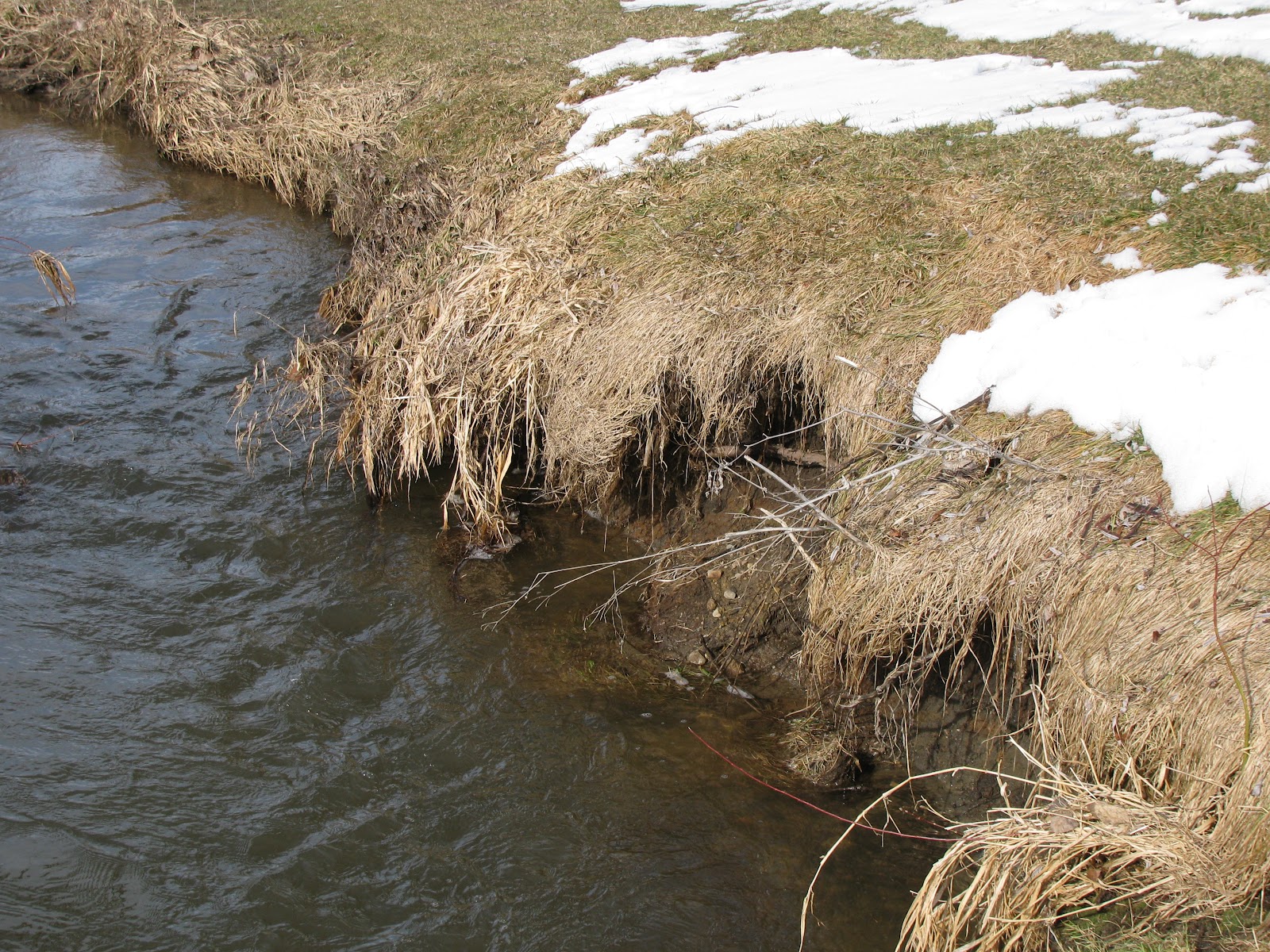
Below are some photos of the erosion and overflow problems that we have seen. You may remember a similar, though much smaller scale, project from the Summer of 2010. You can find out more HERE. I will keep you updated on this exciting project as we know more.


Thursday, June 30, 2011

Traver Creek Bank Stabilization

In conjunction with the Washtenaw County Drain Commissioner's Office, we were able to stabilize the stream bank near #12 green with large chunks of crushed limestone. This is known as "rip-rap." It is able to with stand the erosive forces of the stream better than native soils.

Here is the stream from 2009.


Here it is from this spring. Notice how the stream has broken through it's bank.


Here is the picture after the rip-rap has been added.


We also redirected the stream away from the green in a different ox-bow. This is a place were the stream, at one time, flowed through until it eroded and changed it's course.


Here is another area that we stabilized near the cart path.


You can see Karl putting the geo-textile fabric down that helps hold the soil in place.

Here is a video of the rock being put into place.


Tuesday, February 1, 2011

Traver Creek Survey

As part of the Audubon Cooperative Sanctuary Program certification process, we are required to do water quality sampling and testing.  We have our samples tested by AnaLync.  They test for such things as calcium, sodium, nitrate, phosphate, chloride as well as other nutrients.  We do this for a number of reasons.  One of the biggest is that the stream that runs through the golf golf course, Traver Creek, is part of the Huron River watershed and as such, anything that gets into the water at the golf course will, eventually make it's way into the Huron and from there, into the Great Lakes.

Our water tests are taken from the pond on #17, where Traver Creek enters the property and from the pond on #12, where the creek leaves the golf course. These tests, which we have done since 2009, show that the golf course does not add to the nutrients in the creek. In fact, most of the tests show a decrease of the elements that are sampled. This is a very good sign that the fertilizer and chemicals that we use on the golf course are used in a responsible way.  We avoid applying fertilizers near water and have buffer strips near the creek that will filter runoff that may occur.

In 2007 the Huron River Watershed Council recommended that phosphorous fertilizers not be used within the watershed. This was in order to cut down on the amount of phosphorous, a major factor in algae blooms, in the Huron River. The City of Ann Arbor adopted this as a city regulation and as such, Leslie Park has not used any phosphorous fertilizers since.  In December 2010, Michigan lawmakers passed legislation (HB-5368) that extend this regulation state-wide. The new regulations and limitations will go into effect on January 1, 2012.

We also have the good fortune of working with Dr. Hannah-Maria Jacques and the Peter G. Meier Water Quality Survey. This is a self-funded study that documents the benthic diversity of Traver Creek and has sampled for macroinvertabrates since 2003. According to Dr. Jacques, the amount of insects and other aquatic animals is greater than previously reported by the Huron River Watershed Council.