Showing posts with label Audubon. Show all posts

Friday, May 6, 2016

Killdeer

We had a couple of killdeer (Charadrius vociferus) nests at Leslie Park this spring. The nests for these birds are really hard to spot. The eggs look like rocks and the mother will run away from the nest when you approach.


Source wikipedia, photo by user:Đ’asil

Today, I noticed two sets of babies running around. The video is poor because I could not get too close to them, so my phone was zoomed in all the way.


Friday, March 28, 2014

Chimney Swifts in Washtenaw County

In February, I met with Barbara Lucas, the producer of "In the Green Room" on WEMU (89.1 FM) to talk about the chimney swift tower that was built in the fall at Leslie Park Golf Course. This morning, that segment aired on the radio and is now podcast on the WEMU website. My part is brief and the interview was conducted during the walk up to the tower through the snow. Looking back at my records, the low temperature that day was -10 degrees.

You can listen to the whole segment HERE

You can read more about the Chimney Swift Tower by reading my blog post about it or by going to ChimneySwifts.org.

The Chimney Swift Tower at Leslie Park Golf Course


Wednesday, November 20, 2013

Eagle Scout Project (Chimney Swift Tower)


Chimney Swifts (Chaetura pelagica) are a threatened species of birds that spend summers in the Midwest and winter in South America. They are unable to perch like song birds so they must spiral into their nesting and roosting sites. 

Before European settlement in North America, Chimney Swifts would nest in caves and hollowed out trees. In the last couple of centuries, they have adapted to using house chimneys for nesting. As more energy efficient furnaces become widespread in households, chimneys are being capped and are sometimes are even being eliminated in new construction. Although worldwide population is estimated at 15 million, just a few years ago the population was much higher. In order to keep the Chimney Swift common, various agencies have begun constructing purpose built towers that the swifts can use as nesting and roosting sites. You can find out more by clicking on chimneyswifts.org or Audubon Society of Western Pennsylvania


In the spring of 2013, I was approached by a young man who wanted to come up with a project for completion of his Eagle Scout rank. This rank is supposed to include an extensive service project that the scout plans, organizes, leads and manages. I consulted with the City of Ann Arbor's ornithologist and she suggested the Chimney Swift tower. The golf course supplied the construction materials and a site for the tower (to the left of #14 tee). The labor was all organized by the prospective Eagle Scout.

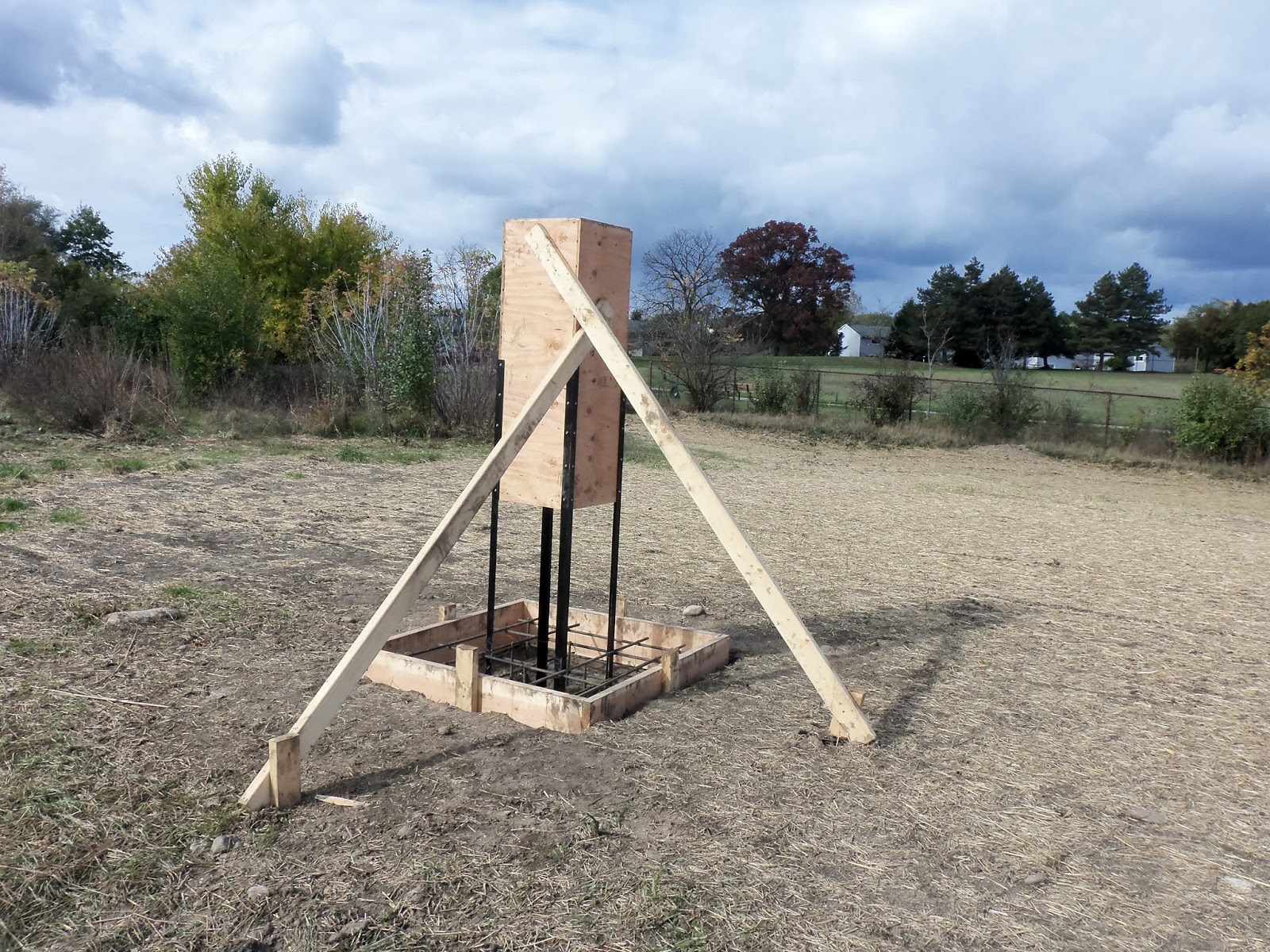
The base of the tower.

The base is about to be set in concrete. 

After the concrete is cured, the rest of the construction is completed.

You can see the completed tower from the clubhouse.  It is the white line in the upper center of the picture.

The completed tower as seen from #14 tee. It is about 14 feet tall and 18 inches on a side.


The sign on the tower explains about chimney swifts and what the tower does.

A closer view of the sign.


Friday, June 7, 2013

Radio Interview on WEMU

 This week I was fortunate to represent the City of Ann Arbor on "Issues of the Environment" on WEMU (89.1 FM.) It aired on the morning of Wednesday, June 5th. I was asked to come on the show to talk about some of the environmental initiatives we are undertaking at Leslie Park and Huron Hills golf courses. There is a common misconception that golf courses are not environmentally friendly and I was excited to showcase some of the practices that we are engaging in at the city, as well as informing the listeners about some of the newest trends in the golf course maintenance industry.

I also touched on the, recently completed, Traver Creek Restoration Project and the benefits the project will have for the Huron River as well as Leslie Park Golf Course.


You can listen to the podcast by clicking HERE (Issues of the Environment).


Thursday, April 18, 2013

Duck Nesting Tubes (Revisited)

In early March, Leslie Park Golf Course hosted some 4th and 5th graders from the Ann Arbor Learning Community to help us build some mallard duck nesting tubes.  Early this April we mounted the tubes on some of the water features here at the golf course.

An early morning canoe paddle.

Attempting to put in the mounting post.

Getting the tube to the post.

One of the tubes from #17 green.

A curious couple looking for a new home. (The female is on top of the tube.)


A video of the two ducks checking out the new digs.


Friday, March 8, 2013

Ann Arbor Learning Commmunity Duck Nests

Earlier this winter, Leslie Park Golf Course was able to help Ann Arbor Learning Community (a local charter school) with Annie's Big Nature Lesson. You can read about Tracey Marchyok and Mr.Dorn's 4th - 5th grade class experience HERE.

On Thursday, March 7th, Wendy Nagle had her class over to the clubhouse to complete the service part of the program. We decided to have the students help build Mallard Duck Nesting Tubes. I got the idea from another golf course blog that I follow, Bear Trace at Harrison Club, in Tennessee.

The tubes are made from 2 inch by 3 inch "chicken wire" rolled into a 12 inch diameter tube. Then some pinestraw is placed around the tube and rolled into a protective barrier for the fledgling ducks. The tubes will be placed in the water to give the ducks a safe place to raise their young.

The kids got into the project with a lot of enthusiasm, as you can see.


When completed, the tubes will be placed on the ponds on #8, #12 and #17. They should look similar to this...


After constructing the tubes, the kids burn off some energy walking back to the science center by rolling and sliding down the hill.


Wednesday, April 4, 2012

CTN Interview

An interview with Doug Kelly, Director of Golf, and myself on the City of Ann Arbor's Cable Television Network for the program FYI. In the interview, we talk about the Audubon International Certification as a Co-operative Sanctuary, as well as the Spring Scramble and changes made over the winter to the clubhouse. The interview starts about 7 minutes into the program.

Thursday, February 2, 2012

Finally!


Today I received word that Leslie Park has completed all of the necessary work and documentation to become Michigan's 11th golf course designated as a Certified Audubon Cooperative Sanctuary.

I began this process when I started at Leslie Park two and a half years ago. Golf courses and environmental principles don’t have to be opposing forces. I hope this certification will demonstrate our daily commitment to environmental stewardship.


The city of Ann Arbor and Leslie Park Golf Course are committed to environmental stewardship every day. We appreciation Audubon International’s recognition of our efforts.


From the press release:

LESLIE PARK GOLF COURSE RECOGNIZED FOR ENVIRONMENTAL EXCELLENCE


ANN ARBOR, MI – Thursday, Feb. 2, 2012 - Ann Arbor Parks & Recreation is proud to announce Leslie Park Golf Course (LPGC) has achieved designation as a “Certified Audubon Cooperative Sanctuary” through the Audubon Cooperative Sanctuary Program for Golf Courses, an Audubon International program. Scott Spooner, LPGC Course Superintendent, has led the effort to obtain sanctuary status on this course and is being recognized for Environmental Stewardship by Audubon International.

“I am extremely proud to add this mark of distinction in the industry to our achievements. Scott has demonstrated an unwavering commitment to the environment and to both the quality and care of Leslie Park Golf Course since he was hired. I am excited we received this honor and commend the staff for their efforts to make this come to fruition over the past two years,” said Ann Arbor Parks & Recreation Manager Colin Smith. Smith also acknowledged the collaborative work of golf course staff and Ann Arbor’s Natural Area Preservation (NAP) Program staff for their cooperative efforts in achieving this status.

“One of my favorite parts of the certification process has been the community outreach. It’s great to be able to show our community that golf courses can be good stewards of the environment,” said Scott Spooner Superintendent, Leslie Park Golf Course.

Leslie Park Golf Course is the 11th course in Michigan and the 960th in the world to receive the honor. Additionally, LPGC is only the 2nd course in the state to be certified in Audubon’s program and the Michigan Turfgrass Environmental Stewardship Program.

“Leslie Park Golf Course has shown a strong commitment to its environmental program. They are to be commended for their efforts to provide a sanctuary for wildlife on the golf course property," said Jim Sluiter, Staff Ecologist for the Audubon Cooperative Sanctuary Programs. “To reach certification, a course must demonstrate that they are maintaining a high degree of environmental quality in a number of areas,” explained Sluiter. These categories include: Environmental Planning, Wildlife & Habitat Management, Outreach and Education, Chemical Use Reduction and Safety, Water Conservation, and Water Quality Management.

The Audubon Cooperative Sanctuary Program for Golf Courses, endorsed by the United States Golf Association, provides information and guidance to help golf courses preserve and enhance wildlife habitat, and protect natural resources. Golf courses from the United States, Africa, Australia, Canada, Central America, Europe, and Southeast Asia have also achieved certification in the program.

For more information on golf and the environment, visit www.golfandenvironment.org. In addition to golf courses, Audubon International also provides programs for businesses, schools, communities, and new developments. For more information, contact Audubon International, 46 Rarick Rd., Selkirk, NY 12158, USA, (518) 767-9051, e-mail them via the Internet at acsp@auduboninternational.org, or visit their website at www.auduboninternational.org.


Ann Arbor has 114,000 residents, spans 27.7 square miles, and is frequently recognized as a foremost place to live, learn, work, thrive and visit (www.a2gov.org/parks). To keep up with City of Ann Arbor Parks and Recreation information, subscribe for e-mail updates (www.a2gov.org/subscribe), follow us on Twitter (http://twitter.com/a2parks) or become a city fan on Facebook (www.facebook.com/annarborparks). The city’s mission statement reads: The city of Ann Arbor is committed to providing excellent municipal services that enhance the quality of life for all through the intelligent use of resources while valuing an open environment that fosters fair, sensitive and respectful treatment of all employees and the community we serve.


.

Thursday, August 18, 2011

Wildflowers and sunrise

Some pictures I took the other day in my travels around the golf course.

Honey bees on spotted joe-pye-weed (Eupatoriadelphus maculatus)


Joe-pye-weed (Eupatoriadelphus maculatus)


Blue Vervain (Verbena hastata)

Goldenrod (Solidago spp)

Evening Primrose(Oenothera biennis)

Joe-pye-weed and other plants in the buffer strips along Traver Creek

Irrigation running on #9 at 6:45 AM


Friday, August 5, 2011

Halfway there.

We just got the letter from Audubon International telling us that Leslie Park has received certification in 4 of the 6 categories required for full program certification. The categories we have achieved are Water Conservation, Chemical Use Reduction and Safety, Water Quality Management and Environmental Planning. We have to complete Wildlife and Habitat Management and Outreach and Education in order to become a certified Audubon Cooperative Sanctuary.

Wednesday, June 22, 2011

Phosphorus Reductions in the Huron River Watershed

Phosphorus Reductions in the Huron Get Noticed

In 2007 the Huron River Watershed Council (HRWC) recommended that phosphorous fertilizers not be used within the watershed. The purpose was to cut down on the amount of phosphorous, a major factor in algae blooms, in the Huron River. The City of Ann Arbor adopted this as a city regulation, and as such, Leslie Park has not used any phosphorous fertilizers since. In December 2010 Michigan lawmakers passed legislation (HB-5368) that extended this regulation statewide. The new regulations and limitations will go into effect Jan. 1, 2012.

In 2010 the HRWC conducted a Water Quality Monitoring Program that showed a 28% drop in phosphorus in Ann Arbor tributaries including Traver Creek, which runs through Leslie Park Golf Course.


I am proud to say that total phosphorus has declined in each of the three survey periods and compares favorably with other tributaries in the Huron watershed. This may be due to the fact that Traver Creek's watershed is not as developed as other tributaries, but it still shows the golf course is not a major contributor to phosphorus in the Huron River.

This is supported by the water sampling we do quarterly. How we do it is detailed in a previous post HERE. In short, we take water tests from the pond on #17 (where Traver Creek enters the property) and from the pond on #12 (where the creek leaves the golf course). These tests, which we have done since 2009, confirm the golf course does not add to the nutrients in the creek. In fact, most of the tests show a decrease of the elements that are sampled. This is a very good sign that the fertilizer and chemicals we use on the golf course are used in a responsible way. We avoid applying fertilizers near water and have buffer strips near the creek to filter runoff that may occur.

Wednesday, April 27, 2011

Rain

3.68 inches!

That is the amount of rain we have had in the month of April, so far. It looks like more is on the way tonight. According to Weather Underground, 1.85 inches (ed: weather.com says 3.3 inches is normal) is normal for the month of April. What this means is that we are wet.

Some other things that have been going on:

We planted 9 cherry trees and 3 apples trees in the orchard. Most of the cherries are at the north end of the orchard, near #7 green. This is just replacing trees that have died over the last forty years since the course was built. This is one of my favorite projects out here. The orchard belonged to the original farm owned and operated by Dr. Eugene Leslie. They would sell apples, pears, cherries and raspberries to the local citizens. The orchard is a signature of holes 6 and 8, as many drives make it into the tightly packed trees. Last year we replaced 10 cherries, 8 apples and 7 pears. I have counted around 40 more spots where trees have been cut down in the past and not replaced. My plan is to fill these areas in so that there is a fruit tree every 15 feet in this section. 10- 15 trees a year should see this plan done in the next 5 years.

We had these little guys drop by for a few days.


They are Bufflehead Ducks (Bucephala albeola) They stopped by on the migration north.


This last picture is my attempt at a close up of some lilac buds getting ready to burst.

Monday, April 4, 2011

Blue Winged Teal

These four ducks were out on the pond on #8 this morning. I believe they are Blue Winged Teal.


Wednesday, March 30, 2011

Raptors are sexy!/Mailbag

I saw this Red-Tailed Hawk on top of one of our bluebird houses this morning!

He is about to take off, because it took so long for the camera to focus on him.


Here he is in the tree behind the birdhouse.


Mailbag-


From a comment posted to the previous blog entry....

Brian Kuehn  said...

After one of these burns it is common to find a bunch of toasted golf balls left behind.

Well, what do you think?

It took me about 5 mins to find these along #11.

Monday, March 7, 2011

Traver Creek Testing with the AALC

Last Wednesday, members of Tracey Marchyok's 4th and 5th grade class from the Ann Arbor Learning Community along with Stefan Szumko from the Leslie Science and Learning Center, came to the golf course to test Traver Creek for various factors, such as pH, nitrogen, phosphorous and temperature. (Edit: A link to an Ann Arbor.com article is here)

I spent some time talking to the class about the things we are doing at Leslie Park to enhance our wildlife habitat and become certified in the Audubon Cooperative Sanctuary Program for Golf Courses.


We then went out and tested the water. Stefan was nice enough to don the waders and pull the water out for the kids and then spent a half an hour searching around for macro-invertebrates in the mud.


The class then walked through Black Pond Woods back to the science center.