Showing posts with label Environment. Show all posts

Friday, March 8, 2013

Ann Arbor Learning Commmunity Duck Nests

Earlier this winter, Leslie Park Golf Course was able to help Ann Arbor Learning Community (a local charter school) with Annie's Big Nature Lesson. You can read about Tracey Marchyok and Mr.Dorn's 4th - 5th grade class experience HERE.

On Thursday, March 7th, Wendy Nagle had her class over to the clubhouse to complete the service part of the program. We decided to have the students help build Mallard Duck Nesting Tubes. I got the idea from another golf course blog that I follow, Bear Trace at Harrison Club, in Tennessee.

The tubes are made from 2 inch by 3 inch "chicken wire" rolled into a 12 inch diameter tube. Then some pinestraw is placed around the tube and rolled into a protective barrier for the fledgling ducks. The tubes will be placed in the water to give the ducks a safe place to raise their young.

The kids got into the project with a lot of enthusiasm, as you can see.


When completed, the tubes will be placed on the ponds on #8, #12 and #17. They should look similar to this...


After constructing the tubes, the kids burn off some energy walking back to the science center by rolling and sliding down the hill.


Monday, March 4, 2013

5 and a half steps to a healthier lawn.

Last week, I gave a small seminar to local homeowners on ways they can improve their lawns. The lecture took place at the Leslie Science and Nature Center. I thought that it would be a natural extension of this to post the lecture notes that i handed out and expand on them, just a little. The outline is in RED.

1) Mowing. Everyone mows, here are some hints to make it easier on your lawn.

      a) Keep mower blades sharp. The mower blade basically hacks the grass off. The sharper the blade, the cleaner the cut. This makes it less likely to be attacked be fungus and keeps moisture loss to a minimum.

      b) Never remove more than 1/3 of the grass blade. The grass uses the leaf to turn sunshine into energy. Removing too much at any one time stresses the plant out unnecessarily.

      c) Set mower at 3-4 inches high.

               i) This promotes a larger, deeper root system.

                      (1) Which in turn makes the grass more drought tolerant.

                      (2) And also more resistant to grubs.

               ii) Provides weed control. By shading the ground, weed seeds do not have the chance to germinate.

2) Do not remove clippings or leaves.

     a) Get a mulching blade kit for a rotary mower.

     b) Returning clippings and leaves means less need for fertilizer.

     c) Unfortunately, you may need to mow more often to keep your lawn looking nice.

     d) Returning clippings to the lawn DOES NOT increase thatch. Studies at Michigan State and other universities have shown that thatch is composed of roots, rhizomes and stolons, not leaf tissue.

3) Get a soil test.

     a) $25.00 from Michigan State Extension Office.

     b) www.msusoiltest.com

     c) The Washtenaw extension office is located at 705 N. Zeeb Road, Ann Arbor, 48107

4) Fertilize in Spring and Fall.

     a) Nitrogen - Phosphate – Potassium These are the three "Macronutrients" in plant science. They are the numbers you see on a bag of fertilizer.

     b) Do not use phosphate unless soil test shows a need. A state law went into effect in 2012 that limits phosphorous usage.

    c) Know the square footage of your yard and use the correct amount. It should say on the bag how much area the bag will treat.

    d) Around 1 pound of Nitrogen per 1,000 square feet at each fertilization. Recommendations range from 2-6 pounds a year. The high range mostly effects appearance, not plant health. Also, over-fertilizing makes the grass grow more. This means more mowing and can also lead to more disease pressure.

5) Water only when needed. Turn off automatic irrigation off after rains.

     a) Pay attention to the weatherman, but only for a couple of days. More than a couple of days out and the weather forecasting gets pretty sporadic.

    b) Leslie Park has a weather station.

             i) Records amounts of rain, solar energy, windspeed and humidity.

            ii) Combines these readings to calculate evapotranspiration rate. (ET) I use this to determine if and how much irrigation to have in a night.

            iii) www.enviroweather.msu.edu This website will estimate ET for your area.

            iv) www.wunderground.com  Our weather station is linked to Weather Underground and provides real-time updates.  (Weather station ID – KMIANNAR33)

      c) Deep, infrequent watering is better than shallow, nightly irrigation. It helps to promote a larger root mass.

      d) Brown grass is not always dead grass. Most grasses will go dormant in the summer.

      e) One indication that your grass needs water is “footprinting.” When you walk on your lawn, if your foot prints don't disappear, the grass needs water.

5.5)Aeration.

       a) Never a bad idea.

       b)Usually not needed on a home lawn. Aeration is used to combat compaction. Most home lawns don't see a lot of traffic.

Thursday, February 2, 2012

Finally!


Today I received word that Leslie Park has completed all of the necessary work and documentation to become Michigan's 11th golf course designated as a Certified Audubon Cooperative Sanctuary.

I began this process when I started at Leslie Park two and a half years ago. Golf courses and environmental principles don’t have to be opposing forces. I hope this certification will demonstrate our daily commitment to environmental stewardship.


The city of Ann Arbor and Leslie Park Golf Course are committed to environmental stewardship every day. We appreciation Audubon International’s recognition of our efforts.


From the press release:

LESLIE PARK GOLF COURSE RECOGNIZED FOR ENVIRONMENTAL EXCELLENCE


ANN ARBOR, MI – Thursday, Feb. 2, 2012 - Ann Arbor Parks & Recreation is proud to announce Leslie Park Golf Course (LPGC) has achieved designation as a “Certified Audubon Cooperative Sanctuary” through the Audubon Cooperative Sanctuary Program for Golf Courses, an Audubon International program. Scott Spooner, LPGC Course Superintendent, has led the effort to obtain sanctuary status on this course and is being recognized for Environmental Stewardship by Audubon International.

“I am extremely proud to add this mark of distinction in the industry to our achievements. Scott has demonstrated an unwavering commitment to the environment and to both the quality and care of Leslie Park Golf Course since he was hired. I am excited we received this honor and commend the staff for their efforts to make this come to fruition over the past two years,” said Ann Arbor Parks & Recreation Manager Colin Smith. Smith also acknowledged the collaborative work of golf course staff and Ann Arbor’s Natural Area Preservation (NAP) Program staff for their cooperative efforts in achieving this status.

“One of my favorite parts of the certification process has been the community outreach. It’s great to be able to show our community that golf courses can be good stewards of the environment,” said Scott Spooner Superintendent, Leslie Park Golf Course.

Leslie Park Golf Course is the 11th course in Michigan and the 960th in the world to receive the honor. Additionally, LPGC is only the 2nd course in the state to be certified in Audubon’s program and the Michigan Turfgrass Environmental Stewardship Program.

“Leslie Park Golf Course has shown a strong commitment to its environmental program. They are to be commended for their efforts to provide a sanctuary for wildlife on the golf course property," said Jim Sluiter, Staff Ecologist for the Audubon Cooperative Sanctuary Programs. “To reach certification, a course must demonstrate that they are maintaining a high degree of environmental quality in a number of areas,” explained Sluiter. These categories include: Environmental Planning, Wildlife & Habitat Management, Outreach and Education, Chemical Use Reduction and Safety, Water Conservation, and Water Quality Management.

The Audubon Cooperative Sanctuary Program for Golf Courses, endorsed by the United States Golf Association, provides information and guidance to help golf courses preserve and enhance wildlife habitat, and protect natural resources. Golf courses from the United States, Africa, Australia, Canada, Central America, Europe, and Southeast Asia have also achieved certification in the program.

For more information on golf and the environment, visit www.golfandenvironment.org. In addition to golf courses, Audubon International also provides programs for businesses, schools, communities, and new developments. For more information, contact Audubon International, 46 Rarick Rd., Selkirk, NY 12158, USA, (518) 767-9051, e-mail them via the Internet at acsp@auduboninternational.org, or visit their website at www.auduboninternational.org.


Ann Arbor has 114,000 residents, spans 27.7 square miles, and is frequently recognized as a foremost place to live, learn, work, thrive and visit (www.a2gov.org/parks). To keep up with City of Ann Arbor Parks and Recreation information, subscribe for e-mail updates (www.a2gov.org/subscribe), follow us on Twitter (http://twitter.com/a2parks) or become a city fan on Facebook (www.facebook.com/annarborparks). The city’s mission statement reads: The city of Ann Arbor is committed to providing excellent municipal services that enhance the quality of life for all through the intelligent use of resources while valuing an open environment that fosters fair, sensitive and respectful treatment of all employees and the community we serve.


.

Thursday, January 12, 2012

Traver Creek Streambank Stabilization

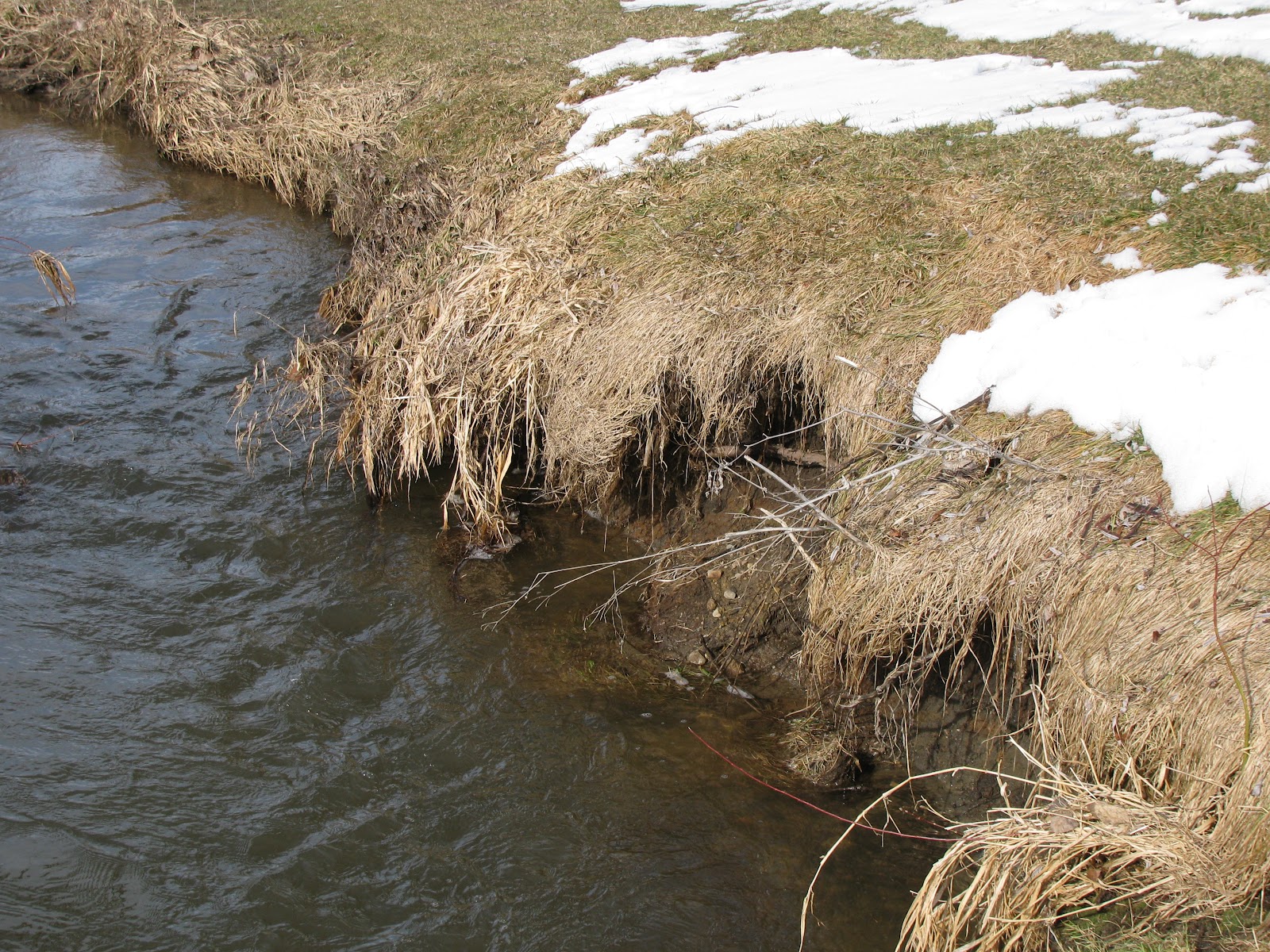
The City of Ann Arbor (which owns Leslie Park Golf Course), in partnership with the Washtenaw County Water Resources Commissioner's Office, has proposed a streambank stabilization project for Traver Creek, which runs through Leslie Park. This project will be financed through the Michigan Department of Environmental Quality's State Revolving Loan Fund. There is an opportunity for up to 50% of the cost of the project to be forgiven depending on the level of environmentally sound practices utilized during restoration. The funding would come out of the city and county stormwater budgets over the next 20 years. The city of Ann Arbor is at the forefront of municipalities in the state of Michigan in using stormwater funds to proactively manage water courses to positively effect stormwater quality during high-precipitation events. What this means is that the city uses these funds to ecologically manage surface water instead of just fixing broken or damaged sewers.

The goals of the project are functional (by improving stormwater infrastructure), ecological (sediment removal, phosphorous reduction and habitat improvement) and recreational (improving aesthetics on the golf course). The golf course will be partnering with the city water quality manager and the county's water resources office as well as Ann Arbor's Natural Areas Preservation Division and the Huron River Watershed Council to make sure that this project meets the environmental goals that have been set forth.

The Spicer Group has been brought aboard to develop a plan and assess the hydrologic, hydraulic and geomorphic conditions that occur on Traver Creek. If all goes according to plan, construction will begin in November 2012, with major construction completed before April 2013. A major consideration for all parties involved is to impact golf as little as possible. Although the construction will be complete, it could take up to two full seasons before Traver Creek and the habitat surrounding the creek areas fully mature. During the first season, most of the banks will be populated by grasses whose primary purpose is to hold the soil in place while the perennial native plants take hold.

It is important to note that at this point, no plans have been finalized, so it is nearly impossible to know what the final project will look like or involve. A write-up of the proposal that was brought before the Ann Arbor Parks Advisory Committee was featured in the Ann Arbor Chronicle.

Below are some photos of the erosion and overflow problems that we have seen. You may remember a similar, though much smaller scale, project from the Summer of 2010. You can find out more HERE. I will keep you updated on this exciting project as we know more.


Tuesday, May 31, 2011

Ann Arbor Learning Community's Bat House


On February 2nd, 2011, I went to Wendy Nagle's 2nd and 3rd grade classroom at the Ann Arbor Learning Community to give them a short power point presentation on the environmental initiatives that we have implemented here at Leslie Park and receive a bat house that the children had made.

On April 11th, we were finally able to hang the bat house near #3 fairway.

When I let Wendy know that we had hung the house, she told me that they had another one available and that the class would like to come out to the golf course and give it to me. On May 26th, the weather co-operated enough for 18 kids as well as 10 chaperones to come out and present us with our second bat house.


We then took a little stroll out to #3 to look at the original bat house.


Wednesday, March 30, 2011

Raptors are sexy!/Mailbag

I saw this Red-Tailed Hawk on top of one of our bluebird houses this morning!

He is about to take off, because it took so long for the camera to focus on him.


Here he is in the tree behind the birdhouse.


Mailbag-


From a comment posted to the previous blog entry....

Brian Kuehn  said...

After one of these burns it is common to find a bunch of toasted golf balls left behind.

Well, what do you think?

It took me about 5 mins to find these along #11.

Tuesday, March 29, 2011

Burn Season is Underway!

The City of Ann Arbor's Natural Areas Preservation unit started the 2011 burn season yesterday and one of the first locations chosen was Leslie Park. These controlled burns are used to try and control the spread of invasive plant species. I will have a longer post later that will go into more detail, but here are some pictures and a video taken yesterday (March 28, 2011)


Before

After


Before


During


After


Monday, March 7, 2011

Traver Creek Testing with the AALC

Last Wednesday, members of Tracey Marchyok's 4th and 5th grade class from the Ann Arbor Learning Community along with Stefan Szumko from the Leslie Science and Learning Center, came to the golf course to test Traver Creek for various factors, such as pH, nitrogen, phosphorous and temperature. (Edit: A link to an Ann Arbor.com article is here)

I spent some time talking to the class about the things we are doing at Leslie Park to enhance our wildlife habitat and become certified in the Audubon Cooperative Sanctuary Program for Golf Courses.


We then went out and tested the water. Stefan was nice enough to don the waders and pull the water out for the kids and then spent a half an hour searching around for macro-invertebrates in the mud.


The class then walked through Black Pond Woods back to the science center.


Tuesday, February 1, 2011

Traver Creek Survey

As part of the Audubon Cooperative Sanctuary Program certification process, we are required to do water quality sampling and testing.  We have our samples tested by AnaLync.  They test for such things as calcium, sodium, nitrate, phosphate, chloride as well as other nutrients.  We do this for a number of reasons.  One of the biggest is that the stream that runs through the golf golf course, Traver Creek, is part of the Huron River watershed and as such, anything that gets into the water at the golf course will, eventually make it's way into the Huron and from there, into the Great Lakes.

Our water tests are taken from the pond on #17, where Traver Creek enters the property and from the pond on #12, where the creek leaves the golf course. These tests, which we have done since 2009, show that the golf course does not add to the nutrients in the creek. In fact, most of the tests show a decrease of the elements that are sampled. This is a very good sign that the fertilizer and chemicals that we use on the golf course are used in a responsible way.  We avoid applying fertilizers near water and have buffer strips near the creek that will filter runoff that may occur.

In 2007 the Huron River Watershed Council recommended that phosphorous fertilizers not be used within the watershed. This was in order to cut down on the amount of phosphorous, a major factor in algae blooms, in the Huron River. The City of Ann Arbor adopted this as a city regulation and as such, Leslie Park has not used any phosphorous fertilizers since.  In December 2010, Michigan lawmakers passed legislation (HB-5368) that extend this regulation state-wide. The new regulations and limitations will go into effect on January 1, 2012.

We also have the good fortune of working with Dr. Hannah-Maria Jacques and the Peter G. Meier Water Quality Survey. This is a self-funded study that documents the benthic diversity of Traver Creek and has sampled for macroinvertabrates since 2003. According to Dr. Jacques, the amount of insects and other aquatic animals is greater than previously reported by the Huron River Watershed Council.

Thursday, June 24, 2010

Certifiable

I just heard from Ron Calhoun, the director of the Michigan Turfgrass Environmental Stewardship Program.  He was letting me know that Leslie Park has completed all of the work necessary to be re-certified in the MTESP.  This is a great program that is trying to bring the entire golf industry up to a certain standard of environmental awareness and stewardship of the land that golf courses are on.  For more information, click on the links to the right.

Friday, June 11, 2010

EPA Testing

I received a call last week from Steve Wood, the Chief Engineer in charge of engines at Toro. It seems that Kubota, one of the chief makers of engines for Toro's mowers, needed to do some in the field testing of it's engines. It just so happened that Leslie Park had some engines that fit Kubota's specifications as far as serial numbers and hours of use. Yesterday, J.J. from Kubota as well as Bill and Clark from Sensors, Inc, came to the golf course to perform some tests.

This involved hooking to exhaust pipe from the mower to a set of instruments that would measure such things as CO2, NOX, particulate matter and other parameters. These sensors were on a utility vehicle that was driven alongside the mower while it was working.

This was all done in order to verify with the Environmental Protection Agency, that Kubota's engines were performing up to the standards that the EPA has set for commercial equipment. This is a recent development, because up until recently, they did not require any testing after the equipment was out in the field. It does seem that much more of this type of testing will be going on, because air quality concerns are rising. This is one of the first times this testing has been done with equipment and engines of this size in a real-world environment. Exciting, to be sure but I would not be surprised if you will see more of this going on in the future.