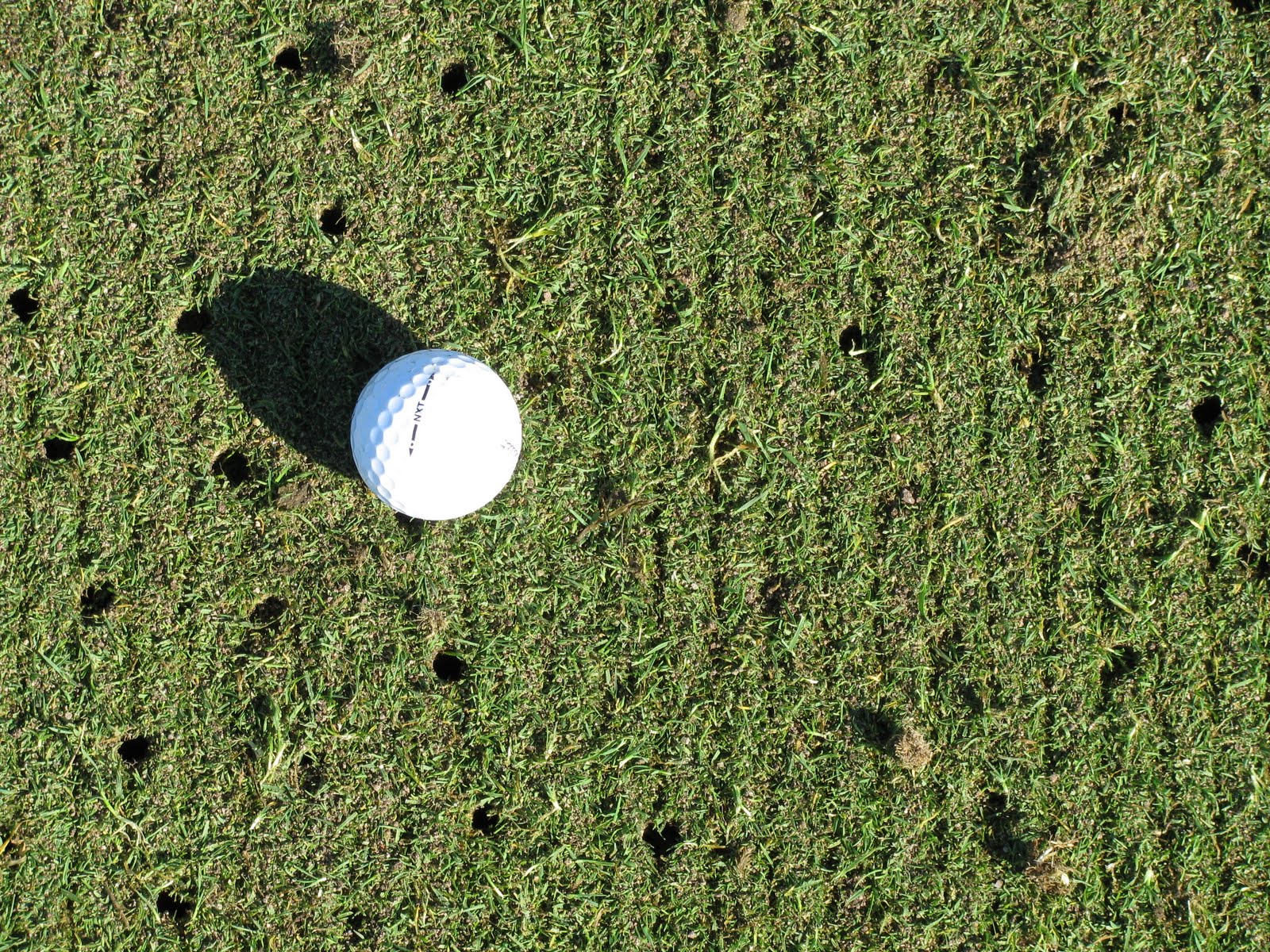
Showing posts with label thatch. Show all posts

Wednesday, September 23, 2015

Autumn: The Season of Driving Around in Circles

The calendar says the new year begins in January. The city's finance department says the new fiscal year starts on July 1st but in the northern golf course industry, Labor Day marks the end of one year and the beginning of the next. Everything that we do from that point until the snow flies is aimed at getting the course ready for next year.

For some reason, a large portion of the golfers put away their bags after Labor Day. This may be due to football, the kids going back to school or some other reason, but play really drops in the fall. It shouldn't be the weather, because in my opinion, the fall is the best time to play golf. On many days in September and October, the high temperature will be in the upper sixties or seventies with very few clouds. If we are lucky enough to have this type of weather in April or May, golfers will be lining up to get out on the course. Of course, after a long winter, cooped up inside, I don't blame them for wanting to get outside. During the fall, this same weather will be met with open tee times and discounted rates.

Aerification cores from a tee.


This drop in play gives us an opportunity to perform some maintenance that is disruptive to golfers. Aerification is the first and most labor intensive of those practices and is why I call Autumn the "Season of Driving Around in Circles." We aerify in order to decrease compaction in the soil and to slow the accumulation of organic matter in the soil. We can do this by either removing the plug created when we "punch holes" or by dragging the plug until all that remains on the surface is the thatch layer. This dragging is done by pulling a plastic mat around on the tee that breaks up and separates the soil from the organic matter and a lot of driving around in circles. Do not eat a big lunch before doing this, motion sickness can be a real problem.

A drag mat. This is one we use on fairways.


Dragging the cores on a fairway.


A tee can make you dizzy.

After dragging, all of the soil is gone and just the thatch and other plant material is left.


The greens at Huron Hills were aerified September 14 through 16th. Leslie Parks greens will be done on the 28-29th. The back 9 tee at Leslie Park have also been aerified. After the greens at leslie are done, we will finish the front 9 tees and the begin work on the tees at Huron. Remember, you cannot trust the calendar. The New Year starts in September.

Thursday, September 25, 2014

Fall Aerification

We have completed the aerification of the greens at both golf courses. Leslie Park was done during the week of September 8th. We just finished Huron Hills yesterday (September 24th.) Completing the process this early will really allow the greens to recover and go into the winter at full strength.

Here is a video about why we aerate.

To review the process, first we use a mechanical aerator, a Toro Procore 648.  It is self-propelled, 48 inches wide and has 30 1/2 inch tines.  The speed we use puts the tines down every 2 inches.  Here is the machine in action.


The plugs of soil, grass and thatch removed from a green.

The playing surface after removing the plugs.


After these plugs are shoveled off the green, we use a mower attachment called a verti-cutter to break up any remaining plugs, as well as groom the playing surface of the green.

The verti-cutting units mounted on a tri-plex mower.


The verti-cuts in action

This is how the green looks after the verti-cutting.


At this point, we need to replace all of the material that we just removed. We do this with sand. Sand is a great medium to grow grass because it drains well and resists compaction. The sand is spread on the greens and then drug into the holes.

The top-dresser putting sand on #12 at Leslie Park a couple of years ago. The willow behind the green fell over during a windstorm in 2012.


Leslie Park's #18 green covered with sand.


A video of #10 green being drug in.

The finished product. Notice how all of the holes are filled with sand. This is the objective.


Wednesday, June 4, 2014

Verticuting Greens

Vertical mowing, or "Verticuting" is a cultural practice used on golf courses for a number of reasons. The first is to sever lateral growth and promote an upright growth habit in the grass. Bentgrass that lies parallel to the putting surface creates "grain." Johnny Miller used to rail against this grain during television broadcasts of PGA tour events. As an aside, the courses the professionals play on do not have grain on the greens. Most of the time his comments Grass that stands upright will promote a faster, truer green. It also improves the quality of cut for the mowers. Depending on how deep the mowers are set, it can also remove a large amount of thatch and organic matter. It is a practice that I would like to implement three or four times a year.

Here is Jim verticutting #3 green at Leslie Park.


Here is the putting surface after vertical mowing. Not the organic matter and thatch.


After the mowing, we blow off the organic matter and thatch that is brought to the surface. We then spread a very light layer of sand over the green and brush it in. This brushing also has the benefit of standing up some of the blades of grass that the machine cut but did not lift. Then we mow the green. After a few days, you will not see the lines any more, but you will hopefully notice a smoother ball roll.


Wednesday, October 2, 2013

Fall Aerification

We have begun the Fall projects at both Leslie Park and Huron Hills. We aerify in order to decrease compaction in the soil and to slow the accumulation of organic matter in the soil. We can do this by either removing the plug created when we "punch holes" or by dragging the plug until all that remains on the surface is the thatch layer.

We use the first method on greens. We remove the plug and then put down a layer of sand. This sand is then worked into the holes left on the surface.

The plugs of soil, grass and thatch removed from a green.

Spreading sand on #12 green at Leslie Park.

The finished product.

On the tees and fairways, we will drag the cores around to mechanically break them up. The soil will go back into the holes while the plant material will not and be able to be removed, usually by blowing it off the playing surface into the rough where it will be mulched into the grass.


Here we are using a tractor mounted aerifier on #8 tee at Huron Hills.


Fairway plugs. Notice the larger diameter. We use 3/4 inch tines on fairways and tees and 3/8 inch tines on greens.

A turf vehicle getting ready to drag the cores on a fairway.

All that remains after dragging is the grass and thatch.


Blowing the thatch off of a fairway.

Since Labor Day, we have completed hollow tine aerification on all of the greens at Leslie Park except #8, #9, #11, #12 and #18. We elected not to do those greens until later in the fall in order to minimize disruption to golf play. We have completed all of the tees at both Huron Hills and Leslie Park as well as a number of fairways at Huron Hills. We are now working on the fairways at Leslie Park. We have also done a solid tine aerification of the greens at Huron Hills. This is done by an outside contractor with a specialized machine. It uses 14 inch long, 1/2 inch diameter tines. This allows for air and water to infiltrate much deeper into the soil than the 4 inch long tines on the aerifers that we have. We plan on hollow tine aerifying the greens at Huron Hills next week.

We know that disrupting the playing surface, especially on the greens, is one of the least favorite things for golfers. That being said, it is necessary to do this in order that the golf courses can handle the number of rounds we enjoy at Leslie Park and Huron Hills. A small inconvenience at this time of year will allow the turf to survive during the long, hot summer months.

Monday, March 4, 2013

5 and a half steps to a healthier lawn.

Last week, I gave a small seminar to local homeowners on ways they can improve their lawns. The lecture took place at the Leslie Science and Nature Center. I thought that it would be a natural extension of this to post the lecture notes that i handed out and expand on them, just a little. The outline is in RED.

1) Mowing. Everyone mows, here are some hints to make it easier on your lawn.

      a) Keep mower blades sharp. The mower blade basically hacks the grass off. The sharper the blade, the cleaner the cut. This makes it less likely to be attacked be fungus and keeps moisture loss to a minimum.

      b) Never remove more than 1/3 of the grass blade. The grass uses the leaf to turn sunshine into energy. Removing too much at any one time stresses the plant out unnecessarily.

      c) Set mower at 3-4 inches high.

               i) This promotes a larger, deeper root system.

                      (1) Which in turn makes the grass more drought tolerant.

                      (2) And also more resistant to grubs.

               ii) Provides weed control. By shading the ground, weed seeds do not have the chance to germinate.

2) Do not remove clippings or leaves.

     a) Get a mulching blade kit for a rotary mower.

     b) Returning clippings and leaves means less need for fertilizer.

     c) Unfortunately, you may need to mow more often to keep your lawn looking nice.

     d) Returning clippings to the lawn DOES NOT increase thatch. Studies at Michigan State and other universities have shown that thatch is composed of roots, rhizomes and stolons, not leaf tissue.

3) Get a soil test.

     a) $25.00 from Michigan State Extension Office.

     b) www.msusoiltest.com

     c) The Washtenaw extension office is located at 705 N. Zeeb Road, Ann Arbor, 48107

4) Fertilize in Spring and Fall.

     a) Nitrogen - Phosphate – Potassium These are the three "Macronutrients" in plant science. They are the numbers you see on a bag of fertilizer.

     b) Do not use phosphate unless soil test shows a need. A state law went into effect in 2012 that limits phosphorous usage.

    c) Know the square footage of your yard and use the correct amount. It should say on the bag how much area the bag will treat.

    d) Around 1 pound of Nitrogen per 1,000 square feet at each fertilization. Recommendations range from 2-6 pounds a year. The high range mostly effects appearance, not plant health. Also, over-fertilizing makes the grass grow more. This means more mowing and can also lead to more disease pressure.

5) Water only when needed. Turn off automatic irrigation off after rains.

     a) Pay attention to the weatherman, but only for a couple of days. More than a couple of days out and the weather forecasting gets pretty sporadic.

    b) Leslie Park has a weather station.

             i) Records amounts of rain, solar energy, windspeed and humidity.

            ii) Combines these readings to calculate evapotranspiration rate. (ET) I use this to determine if and how much irrigation to have in a night.

            iii) www.enviroweather.msu.edu This website will estimate ET for your area.

            iv) www.wunderground.com  Our weather station is linked to Weather Underground and provides real-time updates.  (Weather station ID – KMIANNAR33)

      c) Deep, infrequent watering is better than shallow, nightly irrigation. It helps to promote a larger root mass.

      d) Brown grass is not always dead grass. Most grasses will go dormant in the summer.

      e) One indication that your grass needs water is “footprinting.” When you walk on your lawn, if your foot prints don't disappear, the grass needs water.

5.5)Aeration.

       a) Never a bad idea.

       b)Usually not needed on a home lawn. Aeration is used to combat compaction. Most home lawns don't see a lot of traffic.

Monday, April 16, 2012

Deep Tine Aerification

On Tuesday, April 10th, a contractor from the company Deep Roots came and aerified the greens at Leslie Park. This aerification was different from the aerifiying that we do in the fall in that he uses solid tines that reach down 14 inches. In the fall, we use our own equipment to aerify with hollow tines to a depth of about 4 inches. The hollow tines allow us to remove soil and organic matter from the soil profile and replace it with sand. This reduces the build-up of thatch and compaction. The much longer tine from Deep Roots enables us to reach deeper into the green and decrease the stratification of the soil. While we were going to be spreading sand, we decided to hollow-tine aerify the collars and outside edge of the greens. This area often gets neglected in the fall due to the fact that we are trying to do as many of the greens as we can in one day. It also gets a lot of wear due to the mowers turning when they do the clean-up pass around the green.

 This is a picture of the topdresser putting down sand on #10 green.

A picture of the outside pass on #8 green. (The deep tine holes are hard to see.)

#5 green, where the holes were not quite filled. The outside pass is toward the bottom of the picture. You can see the deep tine holes better here.

A profile of the hollow tine holes on #8 green.


Wednesday, October 13, 2010

Aeration of the fairways

For the most part, aerifing the fairways is the same as the way we do the greens. The changes are that we use a bigger machine, mounted on a tractor.  We also use a larger, stronger tine.  This is because the soil in the fairways has more rocks than the greens and the larger size holds up better.  The bigger holes are also less noticeable on a fairway, where we cut the grass higher (9/16 inch as opposed to 1/8 inch on the greens.)


Here are the bigger plugs.


Then, instead of removeing the plugs and replacing it with sand, we drag the plugs back into the turf. This is due to economics, with 22 acres of fairways, we could not afford to put down new sand.  We have three drag mats, a heavy, plastic model


and two smaller, metal mats.


We spend a long time driving around in circles in order to break up the plugs.


This is what we end up with.


All that is left is the thatch and leaf tissue, which we blow off the fairway and into the rough,


where we mulch up the plugs with our rough mowers.


Wednesday, September 29, 2010

Why do we aerate?

I have gotten more than a few questions on the reasons behind aeration of the greens and, to a lesser extent, the tees and fairways.  The following video does a great job of explaining the reasons.


The main takeaways from this video are:

1) Relieve compaction.

2) Reduce organic matter build-up.

3) Provide passageways for water and oxygen to move through the soil.

The sand top dressing also has the added benefit of smoothing the putting surface.

Tuesday, September 21, 2010

Aerification of greens

We have completed the aerification of the greens.  Leslie Park did the front 9 greens on Tuesday, September 14th and the back 9 on Wednesday.  If you are curious about the process we use, you can check some of the videos and pictures that I have.

First is the aerator, a Toro Procore 648.  It is self-propelled, 48 inches wide and has 30 3/8 inch tines.  The speed we use puts the tines down every 2 inches.  Here is the machine in action.

Here are the plugs that result


We then blow the plugs into the center of the green to make picking up the plugs easier.


We then pick up the plugs.  We pile the plugs up in our storage area and keep the pile turned over so the grass doesn't grow.  In the spring, we will use the material as we would use topsoil.


Here is a close of the green after we have picked up the plugs.


We then take a greens mower with special cutting units called "verticutters" installed.  These special units vertically mow the grass and basically cut grooves in the playing surface.  This stops the grass from growing along the ground and creates a  more upright plant.  This increases the speed the ball will roll along the green.


Here is a close up of the vericut units.


And a picture of the green after verticutting.


We then spread sand on the green with a machine called a topdresser.  The sand replaces the plugs that we have taken off. 


A picture of the green after the sand is put down.


We then use a large brush to move the sand into the holes.


After we are all done, the holes should be filled and the green should look like this.


A picture is worth a thousand words, so I wonder how many words video has saved me?

Wednesday, May 5, 2010

Topdressing Greens

This week, we began topdressing the greens.  This means that we put a light coat of sand on the top of the playing surface and then drag it into the turf canopy. This achieves two things: 1) it smooths out any bumps or dips that might be on the green and 2) it dilutes any thatch that might be on the green.

Smoothing the green out makes the greens "faster" and a ball will roll further when putted.  It will also make the ball roll more "true", meaning that the ball will roll where you intend it to go.

Thatch is a build-up of organic matter between the soil and the grass leaves.  Thatch is mostly comprised of decaying stolons and rhizomes and not leaf blades.  Despite popular misconception, removing the grass after cutting has no effect on thatch build-up.  A little thatch is a good thing for the grass, as it will protect the crown of the plant from traffic, ie, being stepped on. Too much thatch, however, will harbor insect and fungal pests as well as prevent water from reaching the soil.

Before topdressing, we also ran a verticutting unit over the greens before putting down the sand.  This is a rotating blade that digs down into the thatch and brings up some of that organic matter, as well as cuts any grass blade that might be laying over.  Because of this, we can incorperate some of the sand into the thatch layer and we can also eliminate any grain that develops on the playing surface.

After putting down the sand, we drag a brush over the green to work the sand into the turf.  After we are done, the green will be slightly "slower" than normal, but once the grass starts to grow back through the sand, it will be back to normal and hopefully, even faster.