And a couple of videos.
Showing posts with label Traver Creek. Show all posts
Friday, September 8, 2017
Baby Turtles
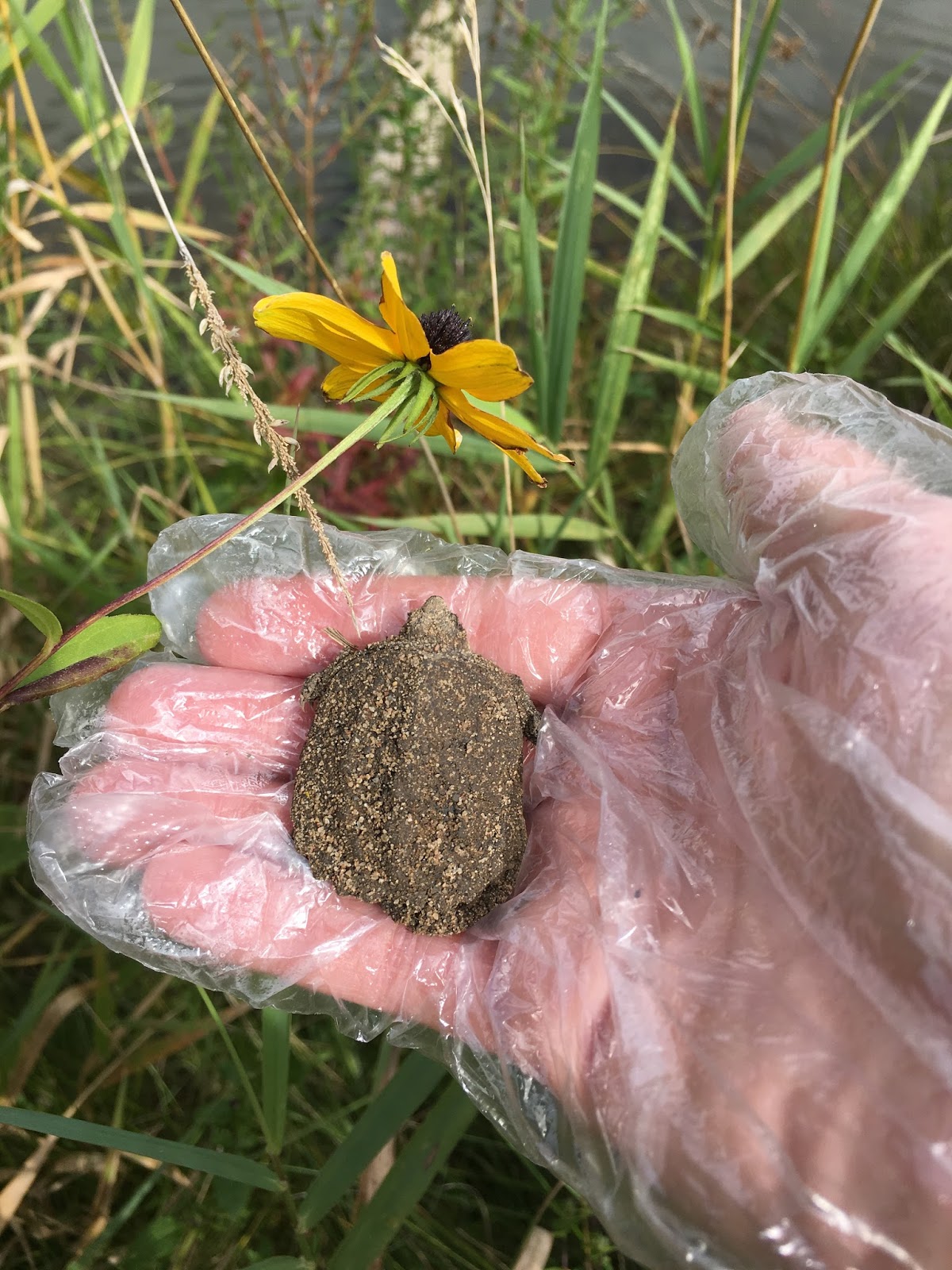
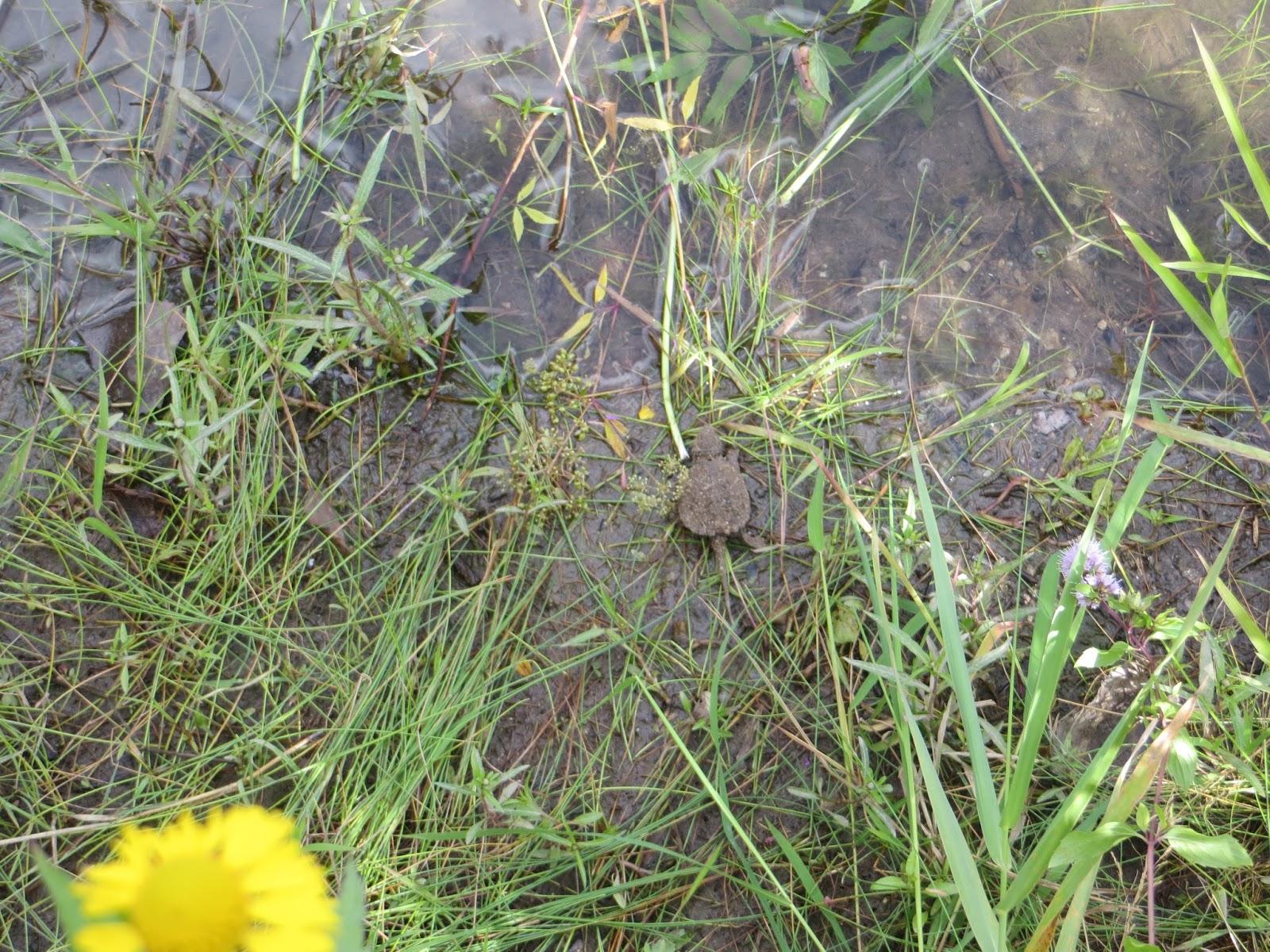
Yesterday, one of the Natural Area Preservation crew noticed that the turtle eggs they had moved to our turtle nesting mounds (Read more HERE) were hatching. Here are some pictures of the little guys.
Friday, July 7, 2017
Turtle Eggs and Sand Piles
When the Traver Creek Project was started, one of the most interesting parts was the turtle stipulation. In order to begin the creek renovation, a permit was submitted to the Michigan Department of Environmental Quality (MDEQ.) To satisfy the MDEQ permit of the project, turtles and other herptofauna were relocated from the two inline detention basins (AKA ponds on holes #12 and #17) on Traver Creek to the pond on #8. There are at least four large snapping turtles (Chelydra serpentina) and numerous painted turtles(Chrysemys picta) in Traver Creek and there was concern over what would happen to these turtles during and after the project was completed. To help them after the project, four sand piles were created for the turtles to use as nesting areas.
Last month, a painted turtle nest was discovered at Argo Canoe Livery. The nest was located in a high traffic area and the probability of successful hatching was low, so Natural Area Preservation (NAP) was called in to move the nest to a better location.
Argo and NAP staff locate the eggs.
The eggs after excavation. It is very important to have the eggs remain in the same orientation for proper development.
The eggs were moved to one of the sand piles at Leslie Park and covered with a predator exclusion screen. This makes it difficult for raccoons and other animals to dig up and eat the eggs.
While NAP was working, they discovered a snapping turtle nest in the same pile. The covered that nest with a predator exclusion screen, as well.
NAP also puts signs out so that people know what the screens are for and to leave them where they are.
Monday, December 5, 2016
Turtle Basking Structures
After the project was complete, turtle habitat was supposed to be improved. One way to do that is to install basking structures. This is a place where the turtle can lay in the sun to warm up, while also having the ability to drop quickly back into the water to escape a predator. If you ever go canoeing along the Huron River, you will see lots of turtles on fallen trees along the river banks. We are trying to replicate this type of basking area in the ponds on #8, #12 and #17.
The first step was to find some suitable branches. An opportunity came in the form of some tree trimming we were planning on doing along #11 tee. In order to frame the shot from the Championship tees, we needed to trim back some Siberian Elm (Ulmus pumila) trees. These trees are non-native and are considered a semi-invasive species.
Once we had the correct size branches, Natural Area Preservation staff started to install the structures.
Positioning the branch in the pond.
Installing lag bolts to hold the anchors.
The "Duckbill" anchor is driven into the ground.
When the drive rod is pulled out, the anchor rotates to lock into the surrounding earth.
Waders were a necessity to place the structure properly on this cold December day.
You can see one of the structures in the pond on #8.
Another basking site near Traver Road on #12.
Wednesday, June 17, 2015
Traver Creek and High Rains
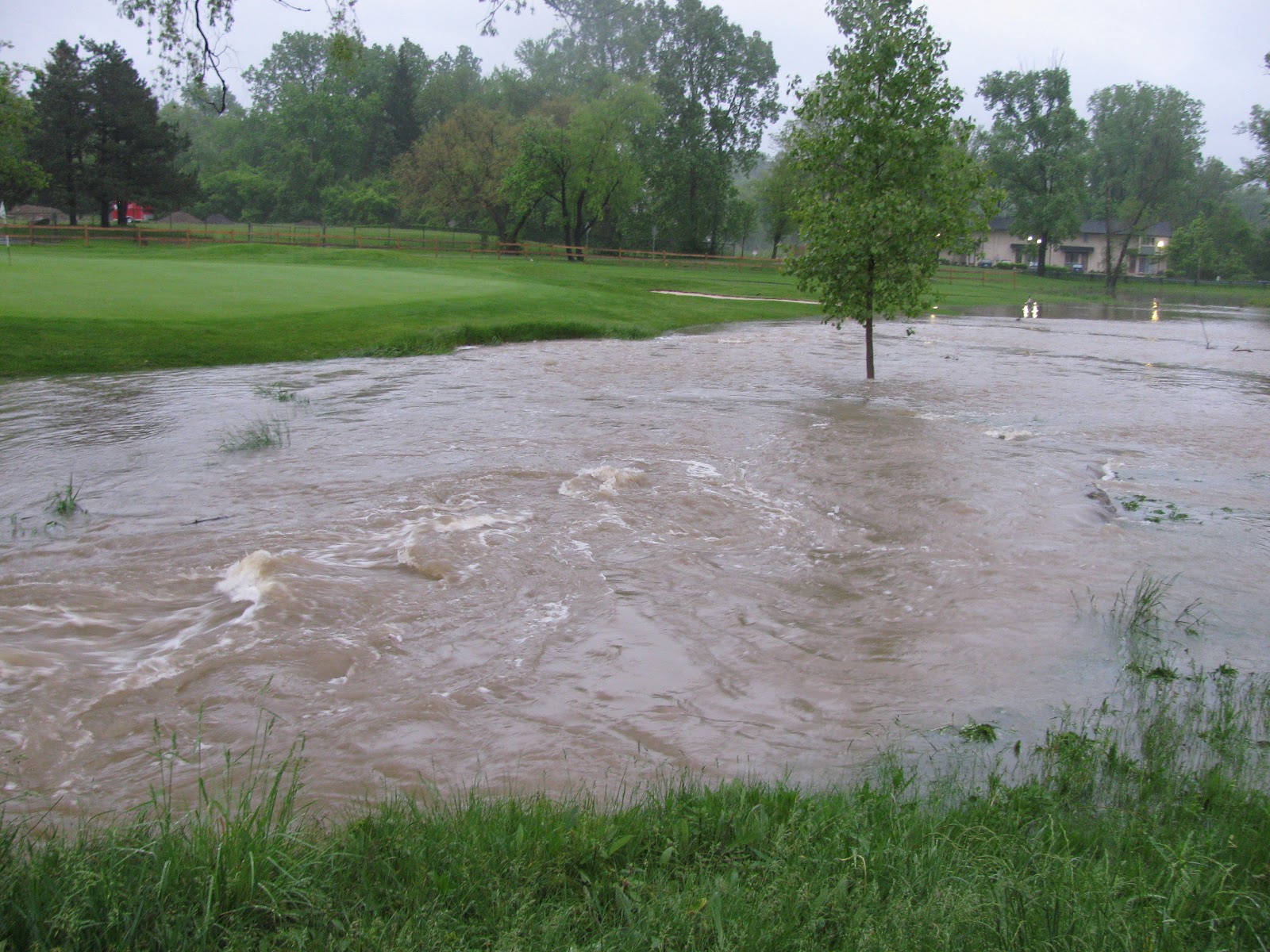
The Traver Creek Project was started back in 2012 with multiple goals in mind. One of these was allowing Traver Creek to take high amounts of precipitation and slow down the time it takes for the water to reach the Huron River. This helps to alleviate flooding and allows some of the sediment to drop out. With almost 3 inches of rain in the past two days, we got a chance to compare how the creek handles high rain events. The following pictures compare current water levels with a storm that happened May 25-26, 2011, when 3.25 inches of rain fell and Nov 22nd, 2011 when 1.75 inches fell.
The bridge near #10 green in May 2011.
The same bridge in 2015.
#10 green (Nov 2011)
#10 green (2015)
Traver Creek from #13 green (Nov 2011)
Traver Creek in 2015.
#11 fairway in Nov 2011 (Now the location of the Arrowood Branch)
The Arrowood Branch in 2015 (Looking in the other direction.
#12 Green (May 2011)
#12 green (2015)
#12 green (May 2011)
#12 green and created wetland (2015)
Bridge to #18 (May 2011)
Bridge to #18 (2015)
#10 Tee (May 2011)
#10 Tee (2015)
Tuesday, June 2, 2015
Relocating Turtle Nests
When the Traver Creek Project was started, one of the most interesting parts was the turtle stipulation. In order to begin the creek renovation, a permit was submitted to the Michigan Department of Environmental Quality (MDEQ.) To satisfy the MDEQ permit of the project, turtles and other herptofauna were relocated from the two inline detention basins (AKA ponds on holes #12 and #17) on Traver Creek to the pond on #8. There are at least four large snapping turtles (Chelydra serpentina) and numerous painted turtles(Chrysemys picta) in Traver Creek and there was concern over what would happen to these turtles during and after the project was completed. To help them after the project, four sand piles were created for the turtles to use as nesting areas.
The mother laying her eggs.
Last week, a City employee noticed a painted turtle laying eggs in the lawn area of an apartment complex. These eggs would have had very little chance of hatching and those eggs that hatched would have had a hard time getting to the relative safety of the water. The employee notified Natural Area Preservation (NAP) and the staff herpetologist came out to examine the nest. He determined that the eggs would not survive and removed them. He marked the eggs because they an air bubble grows at the top. If the eggs are inverted, the embryos inside will not develop.
The eggs in the nest.
Nine eggs were marked and removed. This is a typical amount of eggs per nest.
The eggs were taken to the pond near #12 at Leslie. A shallow hole was excavated and the eggs placed inside. After covering the eggs with soil, a predator exclusion box was placed over the nest. This will keep raccoons and other small animals from eating them until they hatch in September.
One of the turtle nesting mounds.
The predator exclusion box, along with an explanation of what it is and a phone number for questions.
Over the weekend, a golfer noticed a snapping turtle doing the same thing in one of the bunkers at Huron Hills.
The turtles go into a trance when laying eggs and do not respond. Please stay away from them during this process.
These eggs were removed to another location, closer to the south pond of the Huron River.
Thursday, June 12, 2014
Turtles come back to Leslie Park
In the last couple of days, we have seen an increase in turtles. You may recall that one of the big objectives of the Traver Creek Project was to minimize the impact on turtle populations in the creek and ponds on the golf course. You can read more about this program HERE and HERE.
Here is a snapping turtle laying eggs near the creek.
Turtles have been laying eggs on this stream bank.
This turtle was laying eggs near #6 at Huron Hills.
Labels:
Huron Hills,
Leslie Park,
snapping turtle,
Traver Creek
Tuesday, January 21, 2014
Golf Course Management Magazine Article
The Traver Creek Project was featured in the January issue of Golf Course Management Magazine, the monthly magazine from The Golf Course Superintendent's Association of America (GCSAA.) The article, written by GCM's managing editor Bunny Smith, is available by visiting Gently Down the Stream. A photograph of Hole #12 is also on the table of contents page. Below is the text of the article.
You obviously can also follow my blog at www.treetownturfguy.blogspot.com.
Sometimes, a plan comes together, as Scott Spooner, the superintendent at Leslie Park Golf Course in Ann Arbor, Mich., can tell you.
Even when the plan involves city, state and federal stakeholders, cooperation can grease the wheels, free up the backhoe and get the work done. A comprehensive stream restoration of Traver Creek, a tributary of the Huron River that traverses much of Leslie Park GC’s back nine, broke ground in October 2012; by the time the golf season got into full swing in June 2013, the job was largely complete.
The Huron River and its tributaries are within the contributing area of Ford Lake in Ypsilanti, Mich., which had been identified as impaired under Section 303(d) of the federal Clean Water Act. The pollutants of concern were sediment and phosphorus that led to annual algae blooms in this important recreational waterway.
The irrigation pond formed by the impoundment where the stream enters city owned Leslie Park GC had become so filled with sediment since its construction in 1964 that the irrigation intake was accessing only 6 inches of water, says Spooner, a 15-year member of GCSAA. “Stretching out” the pond in the mid-’90s had only postponed the problem, not solved it.
Working with the Washtenaw County Water Resources Commission and with grants and loans from the Michigan Department of Environmental Quality, Spooner oversaw construction of maintainable sediment forebays, a two-stage channel design that reconnects the floodplain and several acres of water-quality treatment wetlands. Harry Sheehan, the county water commission’s environmental manager, says that dredging removed 30,000 yards of sediment. According to Sheehan, the $1.7 million project will reduce sediment by 685 tons and phosphorus by 611 pounds a year. Such large-scale reductions are possible, he adds, because the pollution control practices at Leslie Park GC occur in the downstream portion of the 4,600-acre Traver Creek watershed.
The stream bed was stabilized using a series of grade-control structures that arrest erosive down-cutting and habitat loss. These native stone structures allow the energy of a 9-foot vertical drop within the golf course property to be dissipated without damage to the channel, Sheehan says. In total, he adds,3,300 linear feet of channel was either daylighted or restored; 6.5 acres of water-quality treatment wetland have been created; and 10.2 acres have been planted with 50 different native species, including 79 native trees and 347 shrubs. Spooner says the native species include blue flag iris, switchgrass, swamp milkweed, asters, black-eyed Susan, blue fox sedge and Joe-Pye weed.
The wetlands have been created in five different areas of the golf course and form an especially attractive view for golfers as they tee off from the 11th and 13th tees, Spooner says. Aesthetics aside, the wetlands also create habitat and movement corridors for wildlife, including a species of butterfly that is on the state endangered species list.
The material that was dredged from the irrigation pond was used to raise the No. 10 fairway and tee by about a foot.
“We now have a fairway that stays dry,” Spooner says.
For more details and photos of the Traver Creek restoration project, visit Spooner’s blog at www.travercreekproject.blogspot.com.
You obviously can also follow my blog at www.treetownturfguy.blogspot.com.
Thursday, October 24, 2013
Then and Now
Last year at this time, we started the Traver Creek Project. The transformation of the golf course is the previous 12 months is amazing.
Below is the view from #10 tee last summer.
Notice the tree to the left of the tee box.
Below is the view from #10 tee last summer.
Notice the tree to the left of the tee box.
This spring before the tee is rebuilt. You can see the ballwasher and tee sign.
Laying the sod.
The rough starting to come in this summer.
October 1st.
Number twelve shows a more drastic transformation.
The view from the tee in July 2012.
The view in December.
May 2013.
Today.
Number eleven.
Before.
After construction.
Now
Number thirteen.
Before.
Now.
Number ten green.
View of the green from the fairway before construction.
After.
Number seventeen.
This photo is from 2010.
November 2012.
Spring 2013.
Summer 2013
Subscribe to:
Posts (Atom)