Wednesday, September 4, 2013

The Months That End in "Ber"


I am re-running this column from two years ago. The first reason is that golfers need to be reminded of some of the reasons we do the things that we do to maintain the golf course. Secondly, we have started aerifying the greens at Leslie Park and will be deep-tine aerifying the greens at Huron Hills next week. The third reason is that I just really like this post.

The last four months of the calender year are the beginning of the year for a golf course. I was told this by David Heroian, the Superintendent of the Myopia Hunt Club in South Hamilton, Massachusetts, where I did my internship in the summer of 1998. The thinking behind this is that everything that you do during the Autumn is in preparation for next summer. For some reason, a large portion of the golfers put away their bags after Labor Day. This may be due to football, the kids going back to school or some other reason, but play really drops in the fall. It shouldn't be the weather, because in my opinion, the fall is the best time to play golf. On many days in September and October, the high temperature will be in the upper sixties or seventies with very few clouds. If we are lucky enough to have this type of weather in April or May, golfers will be lining up to get out on the course. Of course, after a long winter, cooped up inside, I don't blame them for wanting to get outside. During the fall, this same weather will be met with open tee times and discounted rates.

This drop in play gives us an opportunity to perform some maintenance that is disruptive to golfers. The biggest one is the dreaded "aerification." When the greens are aerified, the ball roll can be slowed down and if the holes are not properly filled, the greens can be bumpy. If we can get out and aerify while the grass is still actively growing, this disruption will only be about seven to ten days. When it is put off until later in the year (mid to late October in south-east Michigan) this period can last 2 weeks or more. If the weather does not cooperate, the greens might not fully heal until the spring. Last year, we aerified greens on the 16th and 17th of September. Many times in the month of October, I was asked when we were going to aerify our greens. They had no idea that they were already done, due to us taking advantage of the warm weather.

This is a video I took of us aerifying #17 green at Leslie Park. It has gotten almost 200,000 views on YouTube.

The tees and fairways are also aerified in the fall. This presents less of a problem for golfers. On the tees, the holes do not come into play because the golfer is allowed to choose where he will hit from and will usually put the ball on a tee. The fairways have longer grass and as with greens, if the holes are filled properly, it should be fully healed in a week or so. Most of the disruption will be one the day that we actually are working on the hole. This will usually only be two or three holes, due to the large areas that we are talking about. Most of our fairways are between one and two acres in size.

Fall is also the time when the summer stress is done with for the most part and the grass will start growing roots again. In Michigan, the predominate grasses used on golf courses are "cool-season" grasses. This includes Kentucky Bluegrass, Creeping Bentgrass, Ryegrass and Fescue. These grasses grow best with the temperatures between 60 and 80 degrees. "Warm-season" grasses such as Zoysia and Bermuda (as well as Crabgrass, which isn't a turfgrass, but a weed) don't start to really grow until the temperature reaches 75 degrees and will thrive until it hits 90 or so. When the temperature gets above 80, cool-season grass begins to shut down and go dormant. This is why areas that don't get irrigation will often turn brown in July and August. When this happens, the grass is just trying to survive and often the roots start to retract. At the end of August, we are lucky to have 2 inches of roots on the greens. By the end of October, I hope to have 4-5 inches of roots. The healthier the grass is going into winter, the better it will be in the spring.  Aerification allows the roots a nice , friendly place for new roots to grow. It also allows oxygen to get down into the rootzone.

Fall is also a great time to control weeds. Most of the weeds that we have on the golf course are "winter-annuals." This means that the weeds sprout in the summer and then over-winter and really take-off in the spring and set seed for the next generation. Because of this and the fertilizer needs of the grass (the fertilizer that we put on the fairways in the spring is pretty much gone) right now is a great time for a "weed-and-feed." This is a fertilizer that is coated with a broadleaf herbicide. It makes sense from a couple of standpoints. The first is that we accomplish two goals with one application. The second is that we can save money. If I were to buy a granular herbicide, the manufacturer would have to coat something with the herbicide. This is often ground-up corncobs. If you do a weed and feed, the fertilizer is what is coated with the herbicide. As one salesman has told me, it is like you buy the herbicide and you get the fertilizer for free. Of course, you don't get anything in this world for free, but if you compare prices, if fertilizer costs $20 and herbicide costs $25, the combined product would cost $30. (I am totally making these prices up, don't quote me on any of this.)

During the early winter months, the grass stops growing and we start on preventative maintenance on our equipment. We change the engine oil, hydraulic oil, fuel and air filters on all of the mowers. We also change the oil on the golf carts, as well as check the filters and spark plugs on the carts. The tee, green and fairway mowers all have reels and bedknives that need to be ground and sharpened. The rough mowers have blades that need to be sharpened. We also clean up the shop. During the hectic summer months, it can get quite messy.


These are just a few of the reasons that, as a golf course superintendent, you cannot trust the calender. The New Year starts in September.

P.S. A big thank you to Robb Johnston for the title of this post. Robb works for the City of Ann Arbor's Natural Area Preservation Unit.  He also is a childrens author. Check out his blog for The Woodcutter and the Most Beautiful Tree

Tuesday, September 3, 2013

August 2013 Weather Summary

August 2013 saw 2.88 inches of rain at Leslie Park Golf Course. There were only 5 days with rain and only 3 rain events. This happened because on two of those rain events, the rain started at night and carried over to the next day. The largest rain event happened on the 12th and totaled 1.97 inches of rain. The total for the year is now 21.48 inches of precipitation.

The highest temperature recorded during the month was 86.9 (August 28th) and the lowest was 47.3 (August 15th.)  The average temperature for the month was 69.3 degrees. There was a ten day stretch where the high temperature only got above 80 once, from the 8th until the 17th. The high temperature only got above 80 twice during the first 17 days of the month. Not what you think of as typical August temperatures.

The highest sustained windspeed recorded was 20.0 mph (August 2nd.) The average windspeed was just 1.3 mph.


Thursday, August 29, 2013

Brown Grass in Newly Seeded Areas

If you have been paying close attention, you may have noticed some of the grass in the newly seeded areas (mostly on #10, #11, #13 and #18) is turning brown. Since the past week has been dry, your first thought might be that some of the grass seedlings are drying out. That is not the primary culprit. Two weeks ago, we noticed that a lot of the plants coming in were either crabgrass (Digitaria sanguinalis) or Yellow Nutsedge (Cyperus esculentus.) These weeds would die off at the first hard frost but would germinate from seeds(crabgrass and nutsedge) and/or tubers (nutsedge) in subsequent years. Luckily, there are herbicides that can kill the weeds and hopefully, prevent that from happening. It is hoped that by spraying this product now, when the areas are first growing in and populations are not high, we can avoid having these weeds in later seasons. What you are seeing as brown grass is the weeds starting to die off. We go at low rates of the herbicide and do multiple applications in order to minimize the risk to the desirable turfgrasses and to prevent herbicide runoff.

Along #18, you can see patches of the brown "grass."

More patches between #10 tee (foreground) and the fairway. Most of this area was Yellow Nutsedge.

The left side of #13 fairway. You can see a greener line to the left of the cart path. This was an area where the contractor had a problem with the irrigation line. They had to dig it up after it was originally seeded and hand spread the seed after fixing the irrigation. This meant they put down more seed per square foot. The resulting turfgrasses came in thick enough to discourage the weeds from germinating.

A closer picture. The brown, spider-like clumps are crabgrass. This form is how it got it's common name.


Here is a much closer image. You can see the turfgrasses are growing amongst the dying crabgrass and are looking very healthy.

The brown clumps here are sedges. The common name for the herbicide we used for sedges is "Sedgehammer" which I think is an awesome and well chosen marketing ploy.


Thursday, August 22, 2013

Huron Hills Flagpole.

The flagpole at Huron Hills had fallen into disuse in recent years because the crab apple trees flanking the pole had grown over into the space were a flag would fly.

The old flagpole.

Looking up from near the base of the pole.

Originally, we had thought about many options to remedy this situation. We would need to prune to much of the trees to make the flagpole usable again. We also thought about completely removing one of the trees. Neither of these options were suitable.

The next option was to pull the old flagpole out and move it to another location. This would have been feasible, but upon closer inspection, the old pole was in need of some scrapping and new paint. We then began researching how much a new pole would cost. During this investigation, I found a company in Rochester Hills that makes flagpoles. Because they are local (more or less) the cost of them delivering and installing the pole was not much more than just getting a new flagpole from another company. We opted to have them install a 30 foot tall, anodized aluminum flagpole in between the clubhouse and practice green.
The American flag with the Huron Hills flag beneath it.


Here you can see the old flagpole embedded in the trees on the left, near the parking lot.


Tuesday, August 20, 2013

Huron Rain Shelters

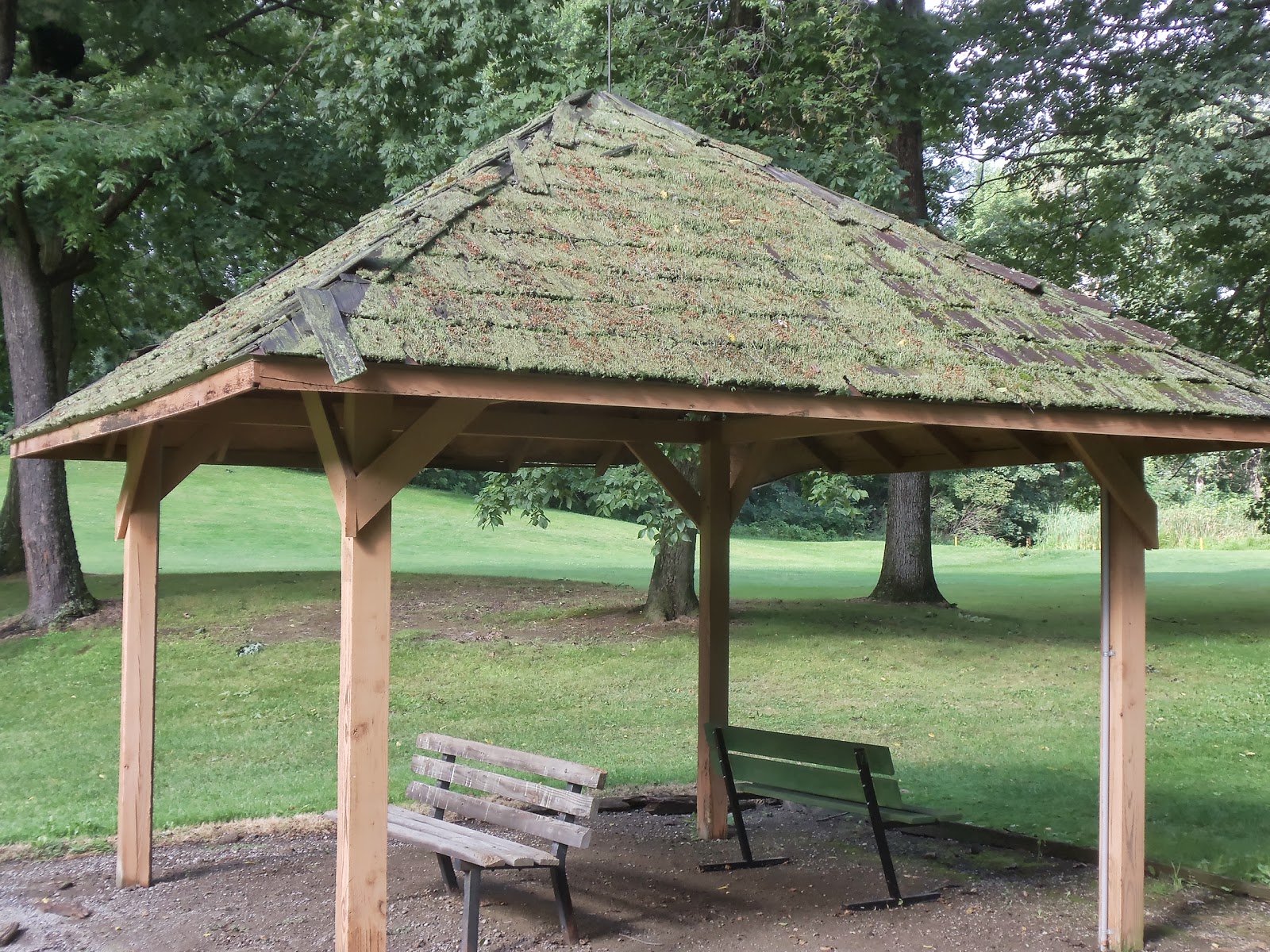
The rain shelters at Huron Hills were in desperate need of new roofing. In addition, the shelter near #13 green had been hit by a falling tree limb and needed some repair. Last week, we had a contractor come in to take off the old cedar shakes and put modern shingles on them.

The shelter near #13 green. Notice the moss growing on the wooden roof.

This corner needs repair due to a tree limb.


Workers remove the old cedar roof near #6 tee.

The shelter on #6 tee looks almost as good as new.

#13 shelter before.

#13 shelter after.

The damaged corner before.

The repaired corner.


The damaged corner from inside the shelter.

The corner after repair.


Tuesday, August 6, 2013

July 2013 Weather Summary

July was interesting. It started out warm and wet, turned hot and dry and then ended cool (for July) and wet. We had four straight days with high temperatures above 90 degrees (July 16-19.) This happened during the week leading up to the City of Ann Arbor Golf Championship. The low temperature during those four days was 71.1 degrees. The 19th had the highest temperature for the month at 92.5 degrees, while the lowest temperature recorded was 48.4 (July 25th.) The average temperature was 71.7 degrees.  From the 24th until the end of the month, the high temperature did not get above 78 degrees and lowest daily high temperature (65.5) occurred on the 28th. Certainly not typical July temperatures.

For the month, Leslie Park Golf Course recorded 2.93 inches of rain. The ninth had the largest single rain event at 1.25 inches. From that day until the 20th, we had no rain. This was also the hottest stretch of weather during the month. Ten days is not a long time to go without rain during the summer. Just last year, we went 21 days without rain during July. Thirteen days had a measurable amount of rain and six days had over a tenth of an inch.

The highest wind gust recorded was 39 mph (July 9th) and the average wind speed was 1.4 mph.

Sunday, July 21, 2013

Tree Update

Last week, I wrote about some storm damage that occurred on July 9th and June 27th. This past week, we replaced the large cherry tree on the dogleg of #4 with two 4 inch diameter maple trees. Usually, the city of Ann Arbor does not plant many maples due to almost 50% of the mature canopy within the city limits already being maple. Leslie Park Golf Course, however, is situated in a predominately Oak/Hickory Forest. In conjunction for the need for fast replacement of the cherry tree due to the strategic location on the hole and the upcoming City Championship, it was decided to plant maple trees. We chose a vareity of sugar maple called "Legacy" and a red maple called "Autumn Blaze."
The Autumn Blaze is nearest to the former location of the cherry.

In this view looking back toward the tee, you can see both of the new trees. They have the thick bed of mulch under them.

The cherry that fell was in the roped off area in front of the new tree. The stump was dug out and the hole filled with soil, then seeded