Friday, July 27, 2012

Photo Quiz

Can you guess what is going on in this picture?


Time's up. If you think that some weird disease is affecting that oak tree, you would be wrong. Here is another picture, taken from a slightly different perspective.


The orange cone behind the tree is sitting on an irrigation head.The green grass receives irrigation, while the tree blocks the brown grass from getting any water. Here is another picture.


You can see a nice green circle that extends 70 feet from the irrigation head. That is because this head stuck on one night about 2 weeks ago. Instead of running for about 10 minutes, this head ran water for about 6 hours.

While I am on the topic of water, we are still experiencing a substantial drought.While areas near Ann Arbor have been getting more rain over the past couple of days, Leslie Park has missed out, for the most part. On July 18th we got 0.08 inches of rain, while just to the south of Ann Arbor got up to 0.75 inches. On July 26th, while some areas north of Ann Arbor got over a inch of rain, we recorded 0.27 inches. I will take whatever I can get, but at this point, it is estimated that we will need between 6 and 9 inches of rain to come out of the drought. For the month, we have gotten 1.25 inches of rain. That seems like a lot, but 60% of that rain came on the 6th in about a half an hour. Most of this water ran into the streams and storm sewer system due to the speed at which it came down. For the year, we have gotten just under 10 inches of rain. In 2011, we got almost that much in July and August alone.

Here are some pictures from previous years. Compare them with pictures from this year. All pictures were taken in July.
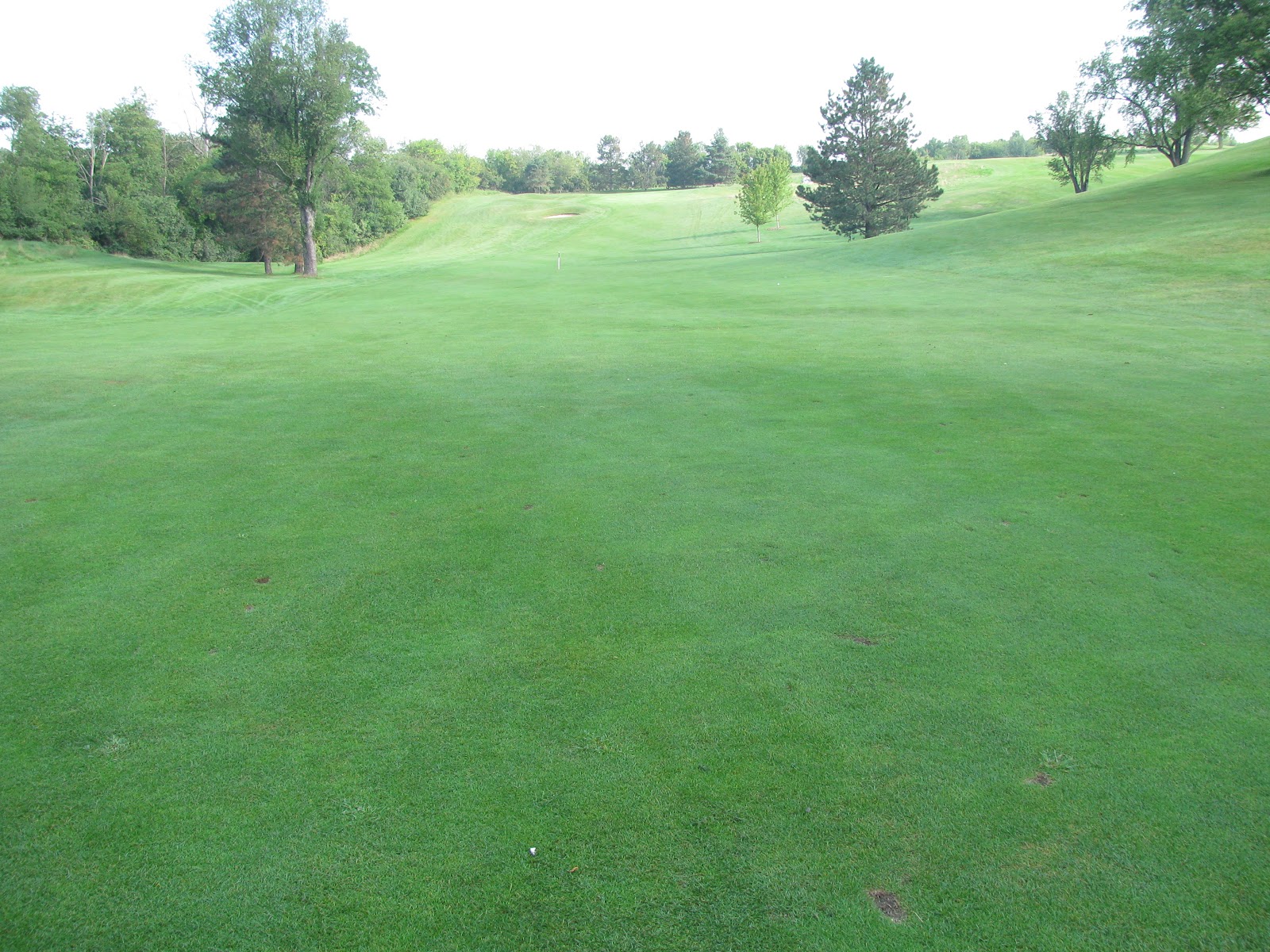
#4 in July 2011.

#4 in July 2012.

#15 in July 2010.

#15 in July 2012.

#16 in July 2009.

#16 in July 2012.


Tuesday, July 17, 2012

Traver Creek Water Testing

As a matter of keeping up with Leslie Park's Audubon International Co-Operative Sanctuary Program, we take water samples from Traver Creek on a quarterly basis. We also work with the Leslie Science and Nature Center on many projects. Today, we were able to blend those two things into one learning experience for some 3rd and 4th grade students.

 LSNC hosts summer camps for elementary school students and we have been trying to encourage the instructors to utilize  the golf course as a giant laboratory. Recently, Stefan Szumko joined Ric Lawson from the Huron River Watershed Council to have Stefan's summer campers do some testing near the pond on #12. Ric and the HRWC have agreed to do more monitoring of Traver Creek in preparation for the streambank stabilization project that will happen this winter and thought it would be a great idea to have some of the young kids assist in the data gathering.

Ric addresses the students before going down to stream level.

Stefan gets his feet wet to do some temperature readings.

Stefan uses a meter to test pH.


Thursday, July 5, 2012

Going Viral

I was slightly astounded and shocked to look at one of my old YouTube videos and see that it had over 23,000 views. Thanks to my post detailing how to aerify greens (you can find it HERE) my video of the greens aerifier working on #17 green has gone viral. The worker in the video, Brian, has since left Leslie Park for a "real" job instead of a seasonal job at a golf course but I am sure he would be proud of his "fame." Here it is in all of it's glory.


The post is also one of my most viewed posts. It has even been linked to by the Turfgrass Information File at Michigan State University. Just something I wanted to share with people on a rainy Thursday morning. Soon, I will be out on the course, checking for wind and storm damage.

Monday, July 2, 2012

June 2012 Weather Summary

It is beginning to sound like a broken record. It has been dry. Luckily, according to the USDA, we are not in a drought, just "abnormally dry." We are on the verge of being in a moderate drought. We got 1.33 inches of rain in June. That brings our yearly total to 8.55 inches. That puts us 9.5 inches behind the normal total of 18.08 inches in the Ann Arbor area. We had four days of rain with the maximum amount coming on the 18th. (0.56 inches)

The highest temperature was 98.3 degrees. Many places in southeastern Michigan recorded triple digits on the 28th of June, but the golf course micro climate kept the temps out of the 100's. We did see five days with a high temperature above 90 degrees. The lowest temperature was 44.6 degrees (June 6th.) The average temperature for the month was 70.3.

The highest wind speed was 28 mph (June 3rd) and the average wind speed was 2.9 mph.

Thursday, June 28, 2012

Pond Drama

If you have played recently, you may have noticed that the pond on #8 is really low. Upon inspection, we discovered a 4 inch hole in the overflow drain. This drain takes any excess water to Traver Creek. Unfortunately, the leak was about 18 inches below where we would normally want the pond. We got the new plastic drain pipe the other day an d that enabled us to replace the faulty pipe.

Here you can see how much the pond level had dropped (and the new elbow)

After we dug around the old pipe...

we had to cut it.

The old section. You can see the hole, right where the two sections were joined together.

Overflow fixed and waiting for rain to fill the pond back up.


Wednesday, June 20, 2012

Summer Solstice

Today is the longest day of the year. It marks the official start of summer. As I type this, it is 87 degrees with a heat index of 90. Today's high temperature is expected to be 93. The lowest temperature over the last two days was 69, while the dew point is hovering around the mid-sixties.

It is summer and also time to watch out for turf diseases. The most damaging disease when it is hot and humid is pythium blight (Pythium aphanidermatum.) According to Michigan State University Turf Diseases ID site, pythium first appears as circular reddish brown spots in the turf, ranging in diameter from 1 to 6 in. In the morning dew, infected leaf blades appear water soaked and dark and may feel slimy. When spots are wet with dew, purplish gray or white cottony fungal mycelia can be seen on the outer margins of the spots. Infected grass plants collapse quickly, and when conditions are conducive, spots may coalesce and large areas of turf can be lost in a short period of time (overnight). Pythium blight is a good saprophyte, and survives in the thatch and soil as a water mold until proper conditions occur for it to become pathogenic. As a warm-weather disease of cool season grasses, the disease is most destructive when temperatures are between 85° and 95° F (29.4° - 35° C). When evening temperatures average 68° F or higher, outbreaks will typically first appear in low areas, or poorly drained areas where soil moisture is maintained. Humid periods further favor disease development.


Because of the possibility of this disease, night time watering is on hold until the weather breaks. This will allow me to check the areas to be watered for pythium. We are trying to keep the humidity down as much as possible in the turf canopy in order to keep disease at bay. Also, you may notice us dragging the fairways in the mornings. This is to clear the turf of dew, which can help discourage the dollar spot fungus (Sclerotinia homeocarpa.)


On a totally different note, here are some monarch butterfly caterpillars that I saw on some common milkweed the other day. They are Monarch Butterfly (Danaus plexippus) larvae.


Notice the large hole that has been chewed in the milkweed leaf.

There are several caterpillars on this plant.

Monday, June 11, 2012

Bank Pin Monitoring for the Traver Creek Project


As part of the Traver Creek (See Here) project scheduled to happen this winter, bank pins were installed along the creek.

These pins are intended to monitor erosion along Traver Creek.  They were installed on April 24th, 2012. Last week, I went out to check on the pins and take some pictures. As some background, the pins are 3/8 inch diameter rebar that was pounded into the banks at select areas along the creek. The pins were placed at 1 foot intervals above the water level. If the banks start to erode, the pins become more exposed.

The measurements showed no erosion. This is not unexpected at this point, since we have only had 1.9 inches of precipitation since they were installed. The maximum rainfall event was 0.52 inches. Over a six-week period, this is not a lot of rain and most erosion would be expected to occur after large (over 1.0 inches in 24 hours) rain events. In non-golf course areas, these types of bank pins are monitored quarterly, so it is not surprising to not see any erosion at this point.

Here are some pictures.

The rebar is tipped with yellow plastic caps.

A better picture of the caps.

Another area with three pins above the water line.


For more information on the Traver Creek project, visit http://travercreekproject.blogspot.com