At the end of last month's weather summary, I said that the month of June was boring. I promise to never say anything like that again.
July 2017 had an average temperature of 72.2 degrees, up about 3 degrees from June. The high temperature was 88.8 (July 19th) and the lowest recorded temperature was 50.3 (July 25th.)
What really gets interesting is when you start to look at the rain we got in July. We got 4.13 inches of rain, which is just above the 3.47 inches we have gotten in the last seven years. Unfortunately, 98% of that came within one seven day period, between July 7 and July 13. You might also remember that this is right before the City Championship at Leslie Park. Then the precipitation stopped. Technically, we got 0.06 inches of rain for the rest of the month, but that came over three different days. Eighteen days with appreciable rainfall. There were only 3 days where the high temperature was below 80 degrees during that time span, and one of those days was 79.2 degrees. The maximum amount of rain on one day was 2.07 inches. (July 7th.) There were seven total days of rain and two of those were over an inch. July 10th saw 1.01 inches fall.
Average windspeed was 1.1 mph. The highest recorded sustained windspeed was 33 mph, on the 12th, although these numbers are suspect, because we had an electrical surge at the barn during one of the storms. Along with frying the COM ports on the irrigation computer, it did something to the weather station. Now it only seems to record windspeed and humidity during daylight hours. I tried changing the battery, but that did not work, so must contact support at Davis instruments for some help with this issue.
Showing posts with label drought. Show all posts
Showing posts with label drought. Show all posts
Thursday, August 3, 2017

Wednesday, August 10, 2016
July 2016 Weather Summary
Lack of precipitation is again at the top of the weather worries. The month of July had 10 days of rain but that rain only totaled 2.38 inches, with the highest daily total falling on the 30th. (0.70 inches) For the year, we have gotten 15.42 inches of rain, which is about 4.5 inches below normal. According to the U.S. Drought Monitor, we are abnormally dry in Ann Arbor, but other parts of Southeastern Michigan have lapsed into a moderate drought. Ann Arbor is not included in this area due to a couple of nice rainfall events in the early spring. There were 10 days with at least a trace of rain and seven with over a tenth of an inch. There were also only seven rain "events," as three times the rain started before midnight and continued into the morning. The weather station records the rainfall for each day, starting at 12:01 AM, thus that number can sometimes be inflated.
The high temperature for the month of July was 93.0 degrees, on July 23rd. There were 3 days were the high temperature got above 90, bringing the total for the year to 5. Each of the last two years had only one day above 90 each. I should note that this is not what the TV weather people think. The official weather for Detroit is taken at Metro Airport. The golf course is away for all of the buildings and concrete. The grass and trees help moderate the temperatures and keep those high temps lower than official. The low temperature for the month was 49.0 degrees (July 2nd.) The average temperature for the month was 73.8 degrees.
The average windspeed for the month was 1.6 mph. The highest sustained windspeed was 32 mph, on the 21st.
The high temperature for the month of July was 93.0 degrees, on July 23rd. There were 3 days were the high temperature got above 90, bringing the total for the year to 5. Each of the last two years had only one day above 90 each. I should note that this is not what the TV weather people think. The official weather for Detroit is taken at Metro Airport. The golf course is away for all of the buildings and concrete. The grass and trees help moderate the temperatures and keep those high temps lower than official. The low temperature for the month was 49.0 degrees (July 2nd.) The average temperature for the month was 73.8 degrees.
The average windspeed for the month was 1.6 mph. The highest sustained windspeed was 32 mph, on the 21st.
Thursday, July 28, 2016
Irrigation Design Class 101
Here in the Midwest, irrigation is designed to supplement natural rainfall. It is not meant to supply all of the water that the golf course needs for a prolonged period. Unfortunately, we are in a prolonged period without a lot of natural rainfall. We are currently about three and a half inches behind the amount of rain we should have to this point of the year. Because of this, some of the deficiencies of our irrigation systems start to show.
At Huron Hills, the irrigation runs down the middle of the fairways. This is called "single-row" spacing. We have two choices with this type of system, we can over water the middle in order to get the edges of the fairway adequate moisture. The other option is to water the center to the optimum moisture level. This leaves scallops of grass that receive much less water. As long as we still get occasional rainfall, these areas will turn brown, but they should not die.
A single row system is pictured below.
 Each circle would have an irrigation head in the center. These heads are designed to throw water to the next head in the row, thus giving a more uniform spread of irrigation. The lighter green areas only get water from one head, and thus get only half the water they should get.
Most of the greens at Huron Hills have a "triangle spacing." This means that three heads cover the green. The benefit of this is redundancy, if one head is not working properly, the other two will still cover most of the green. It also evens out the edges separating the irrigated areas from the non-irrigated areas.
This is an example of triangle spacing. (Ed: I noticed that my picture has a small error. The labels on this should be: No Water, 33% Water, 67% Water and 100% Water.)
 With this type of system, you need more irrigation heads as well as twice as much underground piping, but the distribution is much more even. Keep in mind that the irrigation heads we use on the golf courses throw about 70 feet, so you can have the heads on each side of the fairway and keep most of the shorter grass under the dark green area in the picture above.
Most of what we have at Leslie Park Golf Course is "square spacing." In this system, the heads are set out in a square. This gives the most even distribution in between the heads, as you can see in the illustration below.

In order to make the picture more understandable, I exaggerated the space that gets 75% water in the middle of the fairway, in general, this will give a even distribution of water between the irrigation heads. Also, this is under perfect conditions with brand new equipment. The irrigation at Leslie was put in during the 90's. In all honesty, I do not know when the irrigation at Huron Hills was put in, but it is considerably older than that. As such, we have to keep track of any problems we find and fix them as soon as they crop up. That means keeping an eye on about 600 irrigation heads at Leslie and 200 at Huron.

At Huron Hills, the irrigation runs down the middle of the fairways. This is called "single-row" spacing. We have two choices with this type of system, we can over water the middle in order to get the edges of the fairway adequate moisture. The other option is to water the center to the optimum moisture level. This leaves scallops of grass that receive much less water. As long as we still get occasional rainfall, these areas will turn brown, but they should not die.
A single row system is pictured below.

Most of the greens at Huron Hills have a "triangle spacing." This means that three heads cover the green. The benefit of this is redundancy, if one head is not working properly, the other two will still cover most of the green. It also evens out the edges separating the irrigated areas from the non-irrigated areas.
This is an example of triangle spacing. (Ed: I noticed that my picture has a small error. The labels on this should be: No Water, 33% Water, 67% Water and 100% Water.)

Most of what we have at Leslie Park Golf Course is "square spacing." In this system, the heads are set out in a square. This gives the most even distribution in between the heads, as you can see in the illustration below.

In order to make the picture more understandable, I exaggerated the space that gets 75% water in the middle of the fairway, in general, this will give a even distribution of water between the irrigation heads. Also, this is under perfect conditions with brand new equipment. The irrigation at Leslie was put in during the 90's. In all honesty, I do not know when the irrigation at Huron Hills was put in, but it is considerably older than that. As such, we have to keep track of any problems we find and fix them as soon as they crop up. That means keeping an eye on about 600 irrigation heads at Leslie and 200 at Huron.

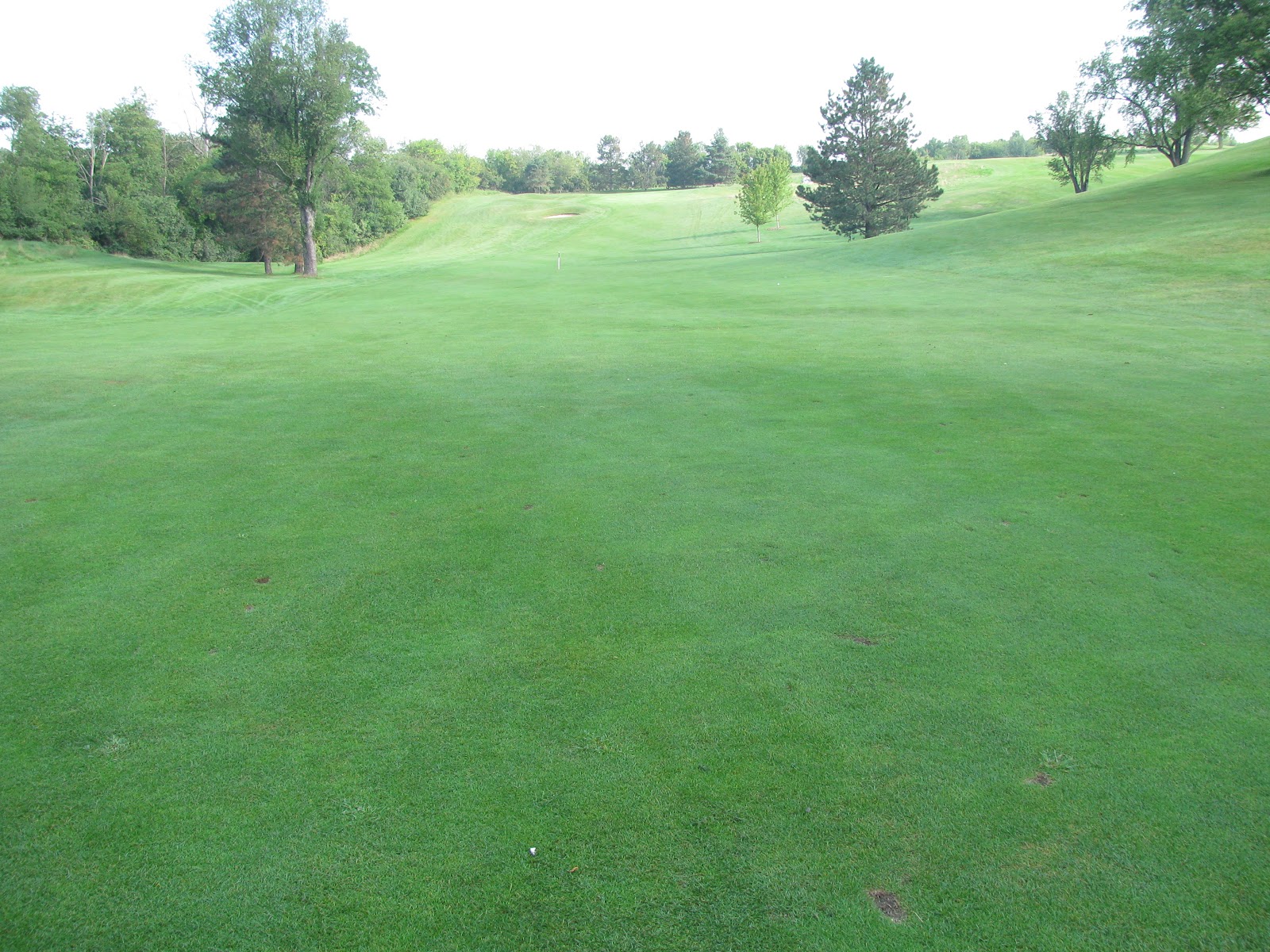
In this photo, taken in 2012 of #4 fairway at Leslie, you can see a spot in the middle of the fairway where a single head was not operating properly. The other three head covered that spot to around 75% of what the grass needed. You can also see how the rough, which is outside of the square spacing of our irrigation, has turned brown and dormant.
Tuesday, July 5, 2016
June 2016 Weather Summary
The high temperature for the month of June was 90.6 degrees, on June 11th, with the 27th also reaching 90 degrees (actually, 90.1.)The low temperature for the month was 45.1 degrees (9th.) The average temperature for the month was 69.1 degrees.
The month of June had just 5 days of rain that totaled 2.97 inches, with the highest daily total falling on the 4th.(1.18inches) Four days saw precipitation of over a tenth of an inch. For the year, we have gotten 13.44 inches of rain. This is drier than the past three years have been up to this point, but still nearly 5 inches more precipitation than we had in 2012 to the beginning of July.
The average windspeed for the month was 1.6 mph. The highest sustained windspeed was 26 mph, on the 20th.
Here are some pictures from July of 2012 to show what we looked like then.


The month of June had just 5 days of rain that totaled 2.97 inches, with the highest daily total falling on the 4th.(1.18inches) Four days saw precipitation of over a tenth of an inch. For the year, we have gotten 13.44 inches of rain. This is drier than the past three years have been up to this point, but still nearly 5 inches more precipitation than we had in 2012 to the beginning of July.
The average windspeed for the month was 1.6 mph. The highest sustained windspeed was 26 mph, on the 20th.
Here are some pictures from July of 2012 to show what we looked like then.

Looking toward #5 green from the orchard near #8 fairway.

#16 green and fairway.

The irrigation pond has since been dredged and hold significantly more water.

#4 fairway.
Friday, July 27, 2012
Photo Quiz

Time's up. If you think that some weird disease is affecting that oak tree, you would be wrong. Here is another picture, taken from a slightly different perspective.

The orange cone behind the tree is sitting on an irrigation head.The green grass receives irrigation, while the tree blocks the brown grass from getting any water. Here is another picture.

You can see a nice green circle that extends 70 feet from the irrigation head. That is because this head stuck on one night about 2 weeks ago. Instead of running for about 10 minutes, this head ran water for about 6 hours.
While I am on the topic of water, we are still experiencing a substantial drought.While areas near Ann Arbor have been getting more rain over the past couple of days, Leslie Park has missed out, for the most part. On July 18th we got 0.08 inches of rain, while just to the south of Ann Arbor got up to 0.75 inches. On July 26th, while some areas north of Ann Arbor got over a inch of rain, we recorded 0.27 inches. I will take whatever I can get, but at this point, it is estimated that we will need between 6 and 9 inches of rain to come out of the drought. For the month, we have gotten 1.25 inches of rain. That seems like a lot, but 60% of that rain came on the 6th in about a half an hour. Most of this water ran into the streams and storm sewer system due to the speed at which it came down. For the year, we have gotten just under 10 inches of rain. In 2011, we got almost that much in July and August alone.
Here are some pictures from previous years. Compare them with pictures from this year. All pictures were taken in July.
#4 in July 2011.

#4 in July 2012.

#15 in July 2010.

#15 in July 2012.

#16 in July 2009.

#16 in July 2012.
Monday, July 2, 2012
June 2012 Weather Summary
It is beginning to sound like a broken record. It has been dry. Luckily, according to the USDA, we are not in a drought, just "abnormally dry." We are on the verge of being in a moderate drought. We got 1.33 inches of rain in June. That brings our yearly total to 8.55 inches. That puts us 9.5 inches behind the normal total of 18.08 inches in the Ann Arbor area. We had four days of rain with the maximum amount coming on the 18th. (0.56 inches)
The highest temperature was 98.3 degrees. Many places in southeastern Michigan recorded triple digits on the 28th of June, but the golf course micro climate kept the temps out of the 100's. We did see five days with a high temperature above 90 degrees. The lowest temperature was 44.6 degrees (June 6th.) The average temperature for the month was 70.3.
The highest wind speed was 28 mph (June 3rd) and the average wind speed was 2.9 mph.
The highest temperature was 98.3 degrees. Many places in southeastern Michigan recorded triple digits on the 28th of June, but the golf course micro climate kept the temps out of the 100's. We did see five days with a high temperature above 90 degrees. The lowest temperature was 44.6 degrees (June 6th.) The average temperature for the month was 70.3.
The highest wind speed was 28 mph (June 3rd) and the average wind speed was 2.9 mph.
Subscribe to:
Posts (Atom)