Tuesday, January 21, 2014

Golf Course Management Magazine Article

The Traver Creek Project was featured in the January issue of Golf Course Management Magazine, the monthly magazine from The Golf Course Superintendent's Association of America (GCSAA.) The article, written by GCM's managing editor Bunny Smith, is available by visiting Gently Down the Stream. A photograph of Hole #12 is also on the table of contents page. Below is the text of the article.


Sometimes, a plan comes together, as Scott Spooner, the superintendent at Leslie Park Golf Course in Ann Arbor, Mich., can tell you.
Even when the plan involves city, state and federal stakeholders, cooperation can grease the wheels, free up the backhoe and get the work done. A comprehensive stream restoration of Traver Creek, a tributary of the Huron River that traverses much of Leslie Park GC’s back nine, broke ground in October 2012; by the time the golf season got into full swing in June 2013, the job was largely complete.
The Huron River and its tributaries are within the contributing area of Ford Lake in Ypsilanti, Mich., which had been identified as impaired under Section 303(d) of the federal Clean Water Act. The pollutants of concern were sediment and phosphorus that led to annual algae blooms in this important recreational waterway.
The irrigation pond formed by the impoundment where the stream enters city owned Leslie Park GC had become so filled with sediment since its construction in 1964 that the irrigation intake was accessing only 6 inches of water, says Spooner, a 15-year member of GCSAA. “Stretching out” the pond in the mid-’90s had only postponed the problem, not solved it.
Working with the Washtenaw County Water Resources Commission and with grants and loans from the Michigan Department of Environmental Quality, Spooner oversaw construction of maintainable sediment forebays, a two-stage channel design that reconnects the floodplain and several acres of water-quality treatment wetlands. Harry Sheehan, the county water commission’s environmental manager, says that dredging removed 30,000 yards of sediment. According to Sheehan, the $1.7 million project will reduce sediment by 685 tons and phosphorus by 611 pounds a year. Such large-scale reductions are possible, he adds, because the pollution control practices at Leslie Park GC occur in the downstream portion of the 4,600-acre Traver Creek watershed.
The stream bed was stabilized using a series of grade-control structures that arrest erosive down-cutting and habitat loss. These native stone structures allow the energy of a 9-foot vertical drop within the golf course property to be dissipated without damage to the channel, Sheehan says. In total, he adds,3,300 linear feet of channel was either daylighted or restored; 6.5 acres of water-quality treatment wetland have been created; and 10.2 acres have been planted with 50 different native species, including 79 native trees and 347 shrubs. Spooner says the native species include blue flag iris, switchgrass, swamp milkweed, asters, black-eyed Susan, blue fox sedge and Joe-Pye weed.
The wetlands have been created in five different areas of the golf course and form an especially attractive view for golfers as they tee off from the 11th and 13th tees, Spooner says. Aesthetics aside, the wetlands also create habitat and movement corridors for wildlife, including a species of butterfly that is on the state endangered species list.
The material that was dredged from the irrigation pond was used to raise the No. 10 fairway and tee by about a foot.
“We now have a fairway that stays dry,” Spooner says.
For more details and photos of the Traver Creek restoration project, visit Spooner’s blog at www.travercreekproject.blogspot.com.

You obviously can also follow my blog at www.treetownturfguy.blogspot.com.


Wednesday, January 1, 2014

2013 Yearly Weather Summary

The highest temperature recorded at Leslie Park Golf Course during 2013 was 92.5 degrees on July 19th. The lowest temperature was just - 1.2 degrees on January 22nd. There were six days where the high temperature was above 90 degrees. On 52 days, the high temperature did not get above freezing. The low temperature reached below 32 degrees on 134 days for the year, or nearly 37% of the time. Two days had low temperature below zero. The average temperature for the year was 48.8 degrees.

For the year, the golf course received 30.58 inches of rain. The most rain in a single day was 1.97 inches on August 12th. April was the month with the most rain at 5.41 inches. There were 122 days with at least a trace of rain, while six days had over an inch in a 24 hour period.

The average wind speed for the year was 3.3 mph. The highest sustained wind speed was 43.0 mph on November 17th.

December 2013 Weather Summary

The highest temperature in the month of December was 58.6 degrees, on the 4th. The lowest temperature recorded at the golf course was 2.0 degrees (12th.) The average temperature for the month was 27.4 degrees. There were 18 days where the high temperature did not reach the 32 degrees. Twenty-six days had low temperatures below the freezing point.

Leslie Park Golf Course saw 1.74 inches of rain during the month, with 0.76 inches of that falling on the 21st.  Most of the rain for the month fell during a four day span between December 19th and 22nd, when 1.57 inches of rain fell. There were only 7 days during the whole month where more than a trace of rain fell.

The highest sustained wind speed was recorded on the 5th (27 mph) while the average wind speed was 3.2 mph.


Saturday, December 21, 2013

The Shortest Day of the Year

December 21st at 5:11 PM (EST), the tilt of the earth's axis reaches the farthest away from the sun (for the northern hemisphere) and the point of least solar radiation for the year. This is called the winter solsitce and marks the begining of winter. It is also the shortest day of the year. Sunrise today comes at 8:01 AM and sunset occurs at 5:06 PM, giving us just 9 hours and 5 minutes of sunlight in Ann Arbor. After this point, the days get longer and the weather, eventually, starts to warm up. From this point, we can start looking forward to spring and a new golf season.

Spring 2013

(Technically) Fall 2013


Thursday, December 19, 2013

Happy Holidays

Things here at the golf courses have slowed down. The golf course in winter is something a lot of golfers don't see, but skiers, sledders and people out for a walk still utilize the land. Here is a picture of #3 tee at Leslie I took the other day near sunset (which means it was about 4:30 in the afternoon.) Notice the cross country ski tracks in the foreground.


Tuesday, December 3, 2013

November 2013 Weather Summary

The highest temperature recorded at Leslie Park during the month of November was 63.5 degrees on the 17th. The lowest temperature was 13.5 degrees (24th.) The average temperature was 37.8. Although the calender says the winter doesn't start until late December, the temperatures feel like it has started already. There were 5 days were the maximum temperature never reached above the freezing mark. Eighteen days had low temperatures below 32 degrees.

The total rain for the month was 1.83 inches. That brings the total for the year to 28.86 inches. The largest rain event was when the golf course received 0.73 inches on the 17th. Just five days saw more than a tenth of an inch and 8 days had more than a trace of rain.

The highest sustained windspeed was 43 mph on the 17th. (If you haven't been paying attention, the 17th was warm, rainy and windy. The average windspeed for the day was 11.6 mph. Looking at daily records for almost 3 years, you rarely see an average windspeed for a day that is above 5, yet alone into double digits.) That high wind speed is the highest ever recorded at the weather station at the golf course. It beat the 42 mph set back in November of 2011. Average windspeed for the month was 4.3 mph.

Wednesday, November 20, 2013

Eagle Scout Project (Chimney Swift Tower)


Chimney Swifts (Chaetura pelagica) are a threatened species of birds that spend summers in the Midwest and winter in South America. They are unable to perch like song birds so they must spiral into their nesting and roosting sites. 

Before European settlement in North America, Chimney Swifts would nest in caves and hollowed out trees. In the last couple of centuries, they have adapted to using house chimneys for nesting. As more energy efficient furnaces become widespread in households, chimneys are being capped and are sometimes are even being eliminated in new construction. Although worldwide population is estimated at 15 million, just a few years ago the population was much higher. In order to keep the Chimney Swift common, various agencies have begun constructing purpose built towers that the swifts can use as nesting and roosting sites. You can find out more by clicking on chimneyswifts.org or Audubon Society of Western Pennsylvania


In the spring of 2013, I was approached by a young man who wanted to come up with a project for completion of his Eagle Scout rank. This rank is supposed to include an extensive service project that the scout plans, organizes, leads and manages. I consulted with the City of Ann Arbor's ornithologist and she suggested the Chimney Swift tower. The golf course supplied the construction materials and a site for the tower (to the left of #14 tee). The labor was all organized by the prospective Eagle Scout.

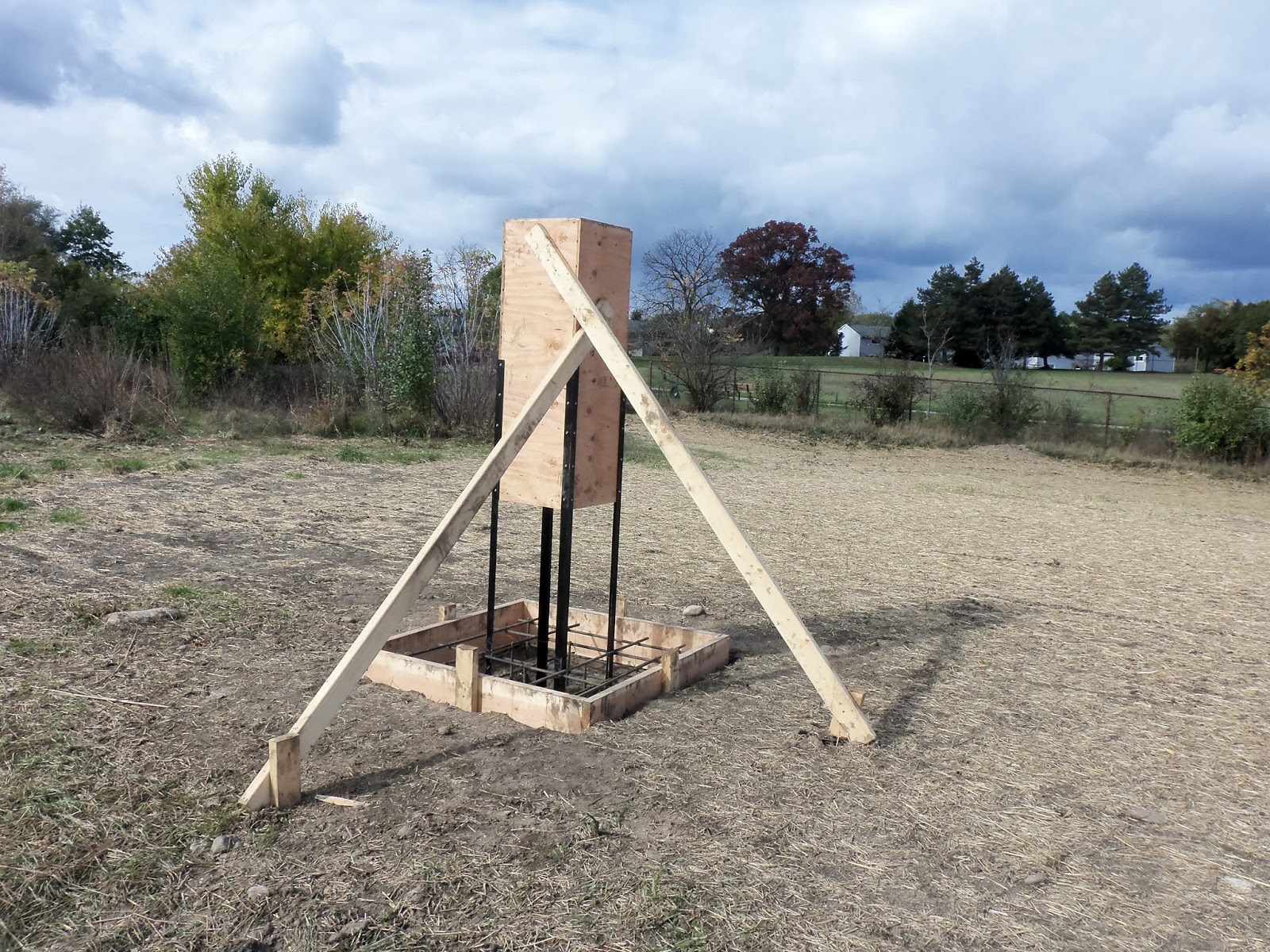
The base of the tower.

The base is about to be set in concrete. 

After the concrete is cured, the rest of the construction is completed.

You can see the completed tower from the clubhouse.  It is the white line in the upper center of the picture.

The completed tower as seen from #14 tee. It is about 14 feet tall and 18 inches on a side.


The sign on the tower explains about chimney swifts and what the tower does.

A closer view of the sign.