Showing posts with label cherry trees. Show all posts

Monday, June 6, 2016

Dr. Leslie's Orchard (Revisited)

Note: This is an blog post I first published in 2012 and again in 2014. It has been updated, but I also feel like it is good information to keep putting out there.


Before Doctor Leslie donated the land for Leslie Park Golf Course, he and his wife had been running the land as a farm. On this farm, he planted wheat, corn and other annual crops, but a large portion of the land was devoted to orchards. They had cherries, pears and apples, as well as blueberries and raspberries.  The area where 5, 6, 7 and 8 are now located was predominately pears, apples and cherries. A small portion of this orchard was retained when the course was built. It was originally a 12 row by 12 row section, with a few trees outside of this square. That would have been 144 trees.

The Orchard looking toward #8 green from #6 fairway.


When I started with the City of Ann Arbor, there were less than 100 of these trees left. Through the previous 40 plus years, the trees naturally died out. Since the purpose of Leslie Park was to be a golf course and not an orchard, this was not a priority. The life expectancy of these trees is not overly long, and since they were planted around the time of World War II or before, it became clear to me that if nothing was done, we would lose the entire orchard. Since this was an integral part of the strategy for playing holes 6 and 8, as well as an homage to the former use of the land, we decided to start replanting the orchard.

Planting trees in 2012.


The first step was to decide what to plant. The "holes" in the orchard were filled in with a mixture of Bartlett pears, Comice pears, Honeycrisp apples and Red Delicious apples. The apples were added to bring about some of the historical feel to the orchard, even though this part did not have any apples. We started slowly on the 8 fairway side. This was to get a feel for how to proceed and give us some experience with the different trees. In 2010, we planted 16 apple and pear trees. We soon discovered that the deer love the apple trees but leave the pears pretty much alone. We started to experiment with deer deterrents and finally settled on cages. The following year, we planted another 18 pears and apples, along with 12 cherry trees.

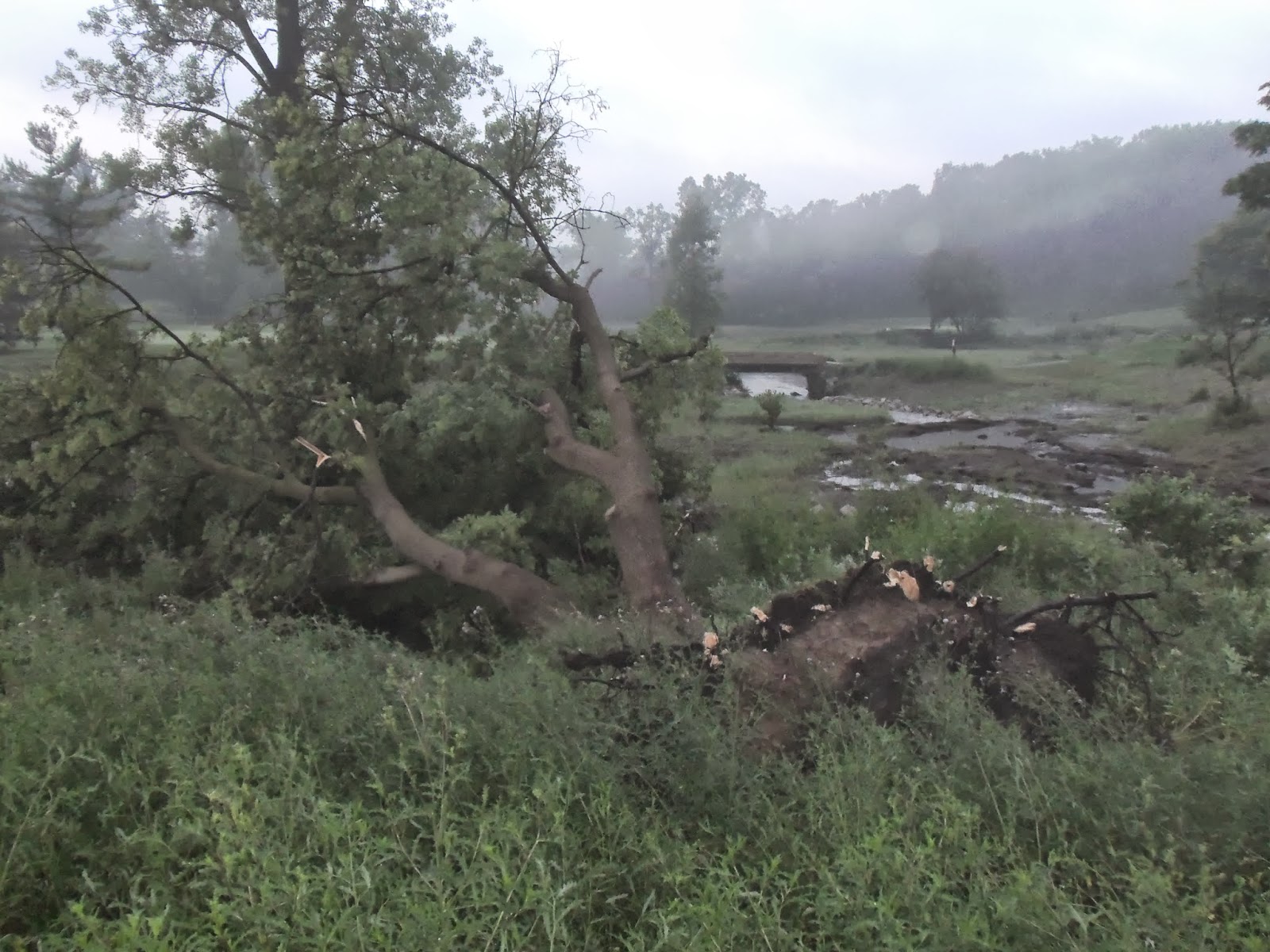
The cherry trees are added to the northern section of the orchard, near #7 green. In 2009, there were 6 cherries here and stumps for 30 more. Over the past seven years, four of these old cherries have died. Unfortunately, the last two do not appear to have survived the harsh winter. Then, this spring, one of them fell over.

The two old cherry trees still do not have leaves.

Only one original cherry tree remains.


This pear has seen better days.


This is an apple tree we planted in 2014.

Since 2009, we have planted 48 apple and pear trees, as well as some cherry trees. Only 71 of the original pear trees are still alive. The gaps in the old  orchard are now almost filled. When that happens, we will only be replacing the old trees when they die.
As a golf course manager, you have to stay one step ahead. As an ancient Chinese proverb says, "The best time to plant a tree is twenty years ago. The second best time is right now."


Friday, June 20, 2014

Dr. Leslie's Orchard

Before Doctor Leslie donated the land for Leslie Park Golf Course, he and his wife had been running the land as a farm. On this farm, he planted wheat, corn and other annual crops, but a large portion of the land was devoted to orchards. They had cherries, pears and apples, as well as blueberries and raspberries.  The area where 5, 6, 7 and 8 are now located was predominately pears, apples and cherries. A small portion of this orchard was retained when the course was built. It was originally a 12 row by 12 row section, with a few trees outside of this square. That would have been 144 trees.

The Orchard looking toward #8 green from #6 fairway.


When I started with the City of Ann Arbor, there were less than 100 of these trees left. Through the previous 40 plus years, the trees naturally died out. Since the purpose of Leslie Park was to be a golf course and not an orchard, this was not a priority. The life expectancy of these trees is not overly long, and since they were planted around the time of World War II or before, it became clear to me that if nothing was done, we would lose the entire orchard. Since this was an integral part of the strategy for playing holes 6 and 8, as well as an homage to the former use of the land, we decided to start replanting the orchard.

Planting trees in 2012.


The first step was to decide what to plant. The "holes" in the orchard were filled in with a mixture of Bartlett pears, Comice pears, Honeycrisp apples and Red Delicious apples. The apples were added to bring about some of the historical feel to the orchard, even though this part did not have any apples. We started slowly on the 8 fairway side. This was to get a feel for how to proceed and give us some experience with the different trees. In 2010, we planted 16 apple and pear trees. We soon discovered that the deer love the apple trees but leave the pears pretty much alone. We started to experiment with deer deterrents and finally settled on cages. The following year, we planted another 18 pears and apples, along with 12 cherry trees.

The cherry trees are added to the northern section of the orchard, near #7 green. In 2009, there were 6 cherries here and stumps for 30 more. Over the past five years, four of these old cherries have died. Unfortunately, the last two do not appear to have survived the harsh winter.

The two old cherry trees still do not have leaves.


This pear has seen better days.


This is an apple tree we planted this year.

Since 2009, we have planted 39 apple and pear trees, as well as 23 cherry trees. The gaps in the old 144 tree orchard are now almost filled. When that happens, we will only be replacing the old trees when they die.

As a golf course manager, you have to stay one step ahead. As an ancient Chinese proverb says, "The best time to plant a tree is twenty years ago. The second best time is right now."

Friday, July 12, 2013

More Storm Damage

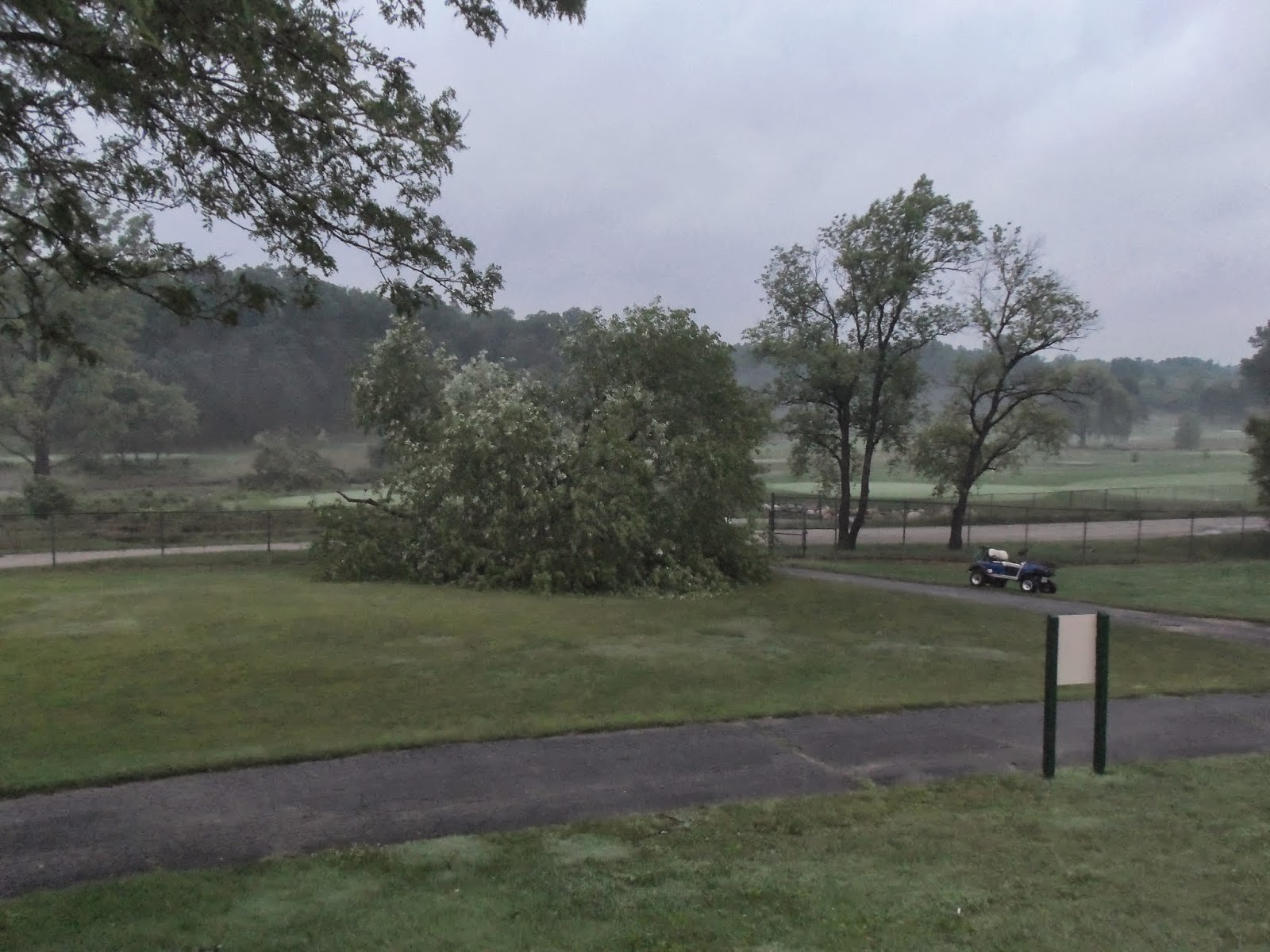
On Tuesday, July 9th, Leslie Park Golf Course experienced a rain storm that dumped 1.25 inches of rain on the course. Most of this rain came down between 5:45 PM and 6 PM. There were also some isolated wind gusts of much more than the 39 mph the weather station recorded. One of these wind gusts came from #13 tee and blew toward the clubhouse. Along this path it knocked over benches, trees, table and chairs. One of the casualties to this wind was the cherry tree next to the gate crossing Traver Road.

View from the road toward the clubhouse.

Right on the fence.

From the clubhouse.

The boxelder behind #10 tee.

Just like the cherry, the tree was tipped over due to lack of roots and saturated soil conditions.


After cleaning most of it up.


You can still see the boxelder behind #10 tee. Due to the creek conditions, this tree will be left temporarily.

We need a new fence.


Friday, April 27, 2012

Orchard Trees

Before Doctor Leslie donated the land for Leslie Park Golf Course, he and his wife had been running the land as a farm. On this farm, he planted wheat, corn and other annual crops, but a large portion of the land was devoted to orchards. They had cherries, pears and apples, as well as blueberries and raspberries.  The area where 5, 6, 7 and 8 are now located was predominately pears, apples and cherries. A small portion of this orchard was retained when the course was built. It was originally a 12 row by 12 row section, with a few trees outside of this square. That would have been 144 trees.

When I started with the City of Ann Arbor, there were less than 100 of these trees left. Through the previous 40 plus years, the trees naturally died out. Since the purpose of Leslie Park was to be a golf course and not an orchard, this was not a priority. The life expectancy of these trees is not overly long, and since they were planted around the time of World War II or before, it became clear to me that if nothing was done, we would lose the entire orchard. Since this was an integral part of the strategy for playing holes 6 and 8, as well as an homage to the former use of the land, we decided to start replanting the orchard.


The first step was to decide what to plant. the northern part of the orchard still had 6 cherry trees while the rest are Bosc and Bartlett pears.  It was decided to re-establish the northern part with cherries. The "holes" in the orchard were filled in with a mixture of Bartlett pears, Comice pears, Honeycrisp apples and Red Delicious apples. The apples were added to bring about some of the historcal feel to the orchard, even though this part did not have any apples. We started slowly on the 8 fairway side. This was to get a feel for how to proceed and give us some experience with the different trees. In 2010, we planted 16 apple and pear trees. We soon discovered that the deer love the apple trees but leave the pears pretty much alone. We started to experiment with deer deterrents and finally settled on cages. The following year, we planted another 18 pears and apples, along with 12 cherry trees. This year, we got 8 Bartlett pears, 4 Comice pears and 4 Montmorency cherries. With some failed trees, this brings the total number of new trees in the orchard to 39 pear/apples and 16 cherries. A quick count shows about 10 more "holes" in the original 12x12 square. We are also going to re-establish some pears along the cart path on #8.

A cherry tree with the wire cage around it.

Beside these orchard trees, we planted 40 White Pines (Pinus strobus) in the spring of 2009. These were donated by the City of Ann Arbor's Natural Areas Preservation Division and The Adopt-A-Park program they have spearheaded. In the fall of 2009, we brought in six maple trees. These were 2.5 inches in diameter and were about 12 feet tall when planted. In the following spring, we brought in two more maples that were 4 inches in diameter. In the fall of 2010, we replaced some dead white pines with 4 blue spruce (Picea pungens.)

As a golf course manager, you have to stay one step ahead. As an ancient Chinese proverb says, "The best time to plant a tree is twenty years ago. The second best time is right now."

Here is a satellite view of the orchard from a few years ago. You can see the gaps between the rows. These are the holes that we are trying to fill.


View Larger Map