Showing posts with label spring. Show all posts

Wednesday, April 18, 2018

A Little Behind

It is no secret that this Spring has not been very spring-like. I did some digging and found some comparisons to where we have been in the past.

Here are some photos I took on April 19th, 2010 compared to some that I took today.

The Orchard in 2010.

The Orchard in 2018.

2010

2018.

2010.

2018. Make sure to look at that freshly painted barn, not at the snow.


If you look at the links on the right side of my blog, you will see the Growing Degree Tracker. This is a very helpful tool developed by Michigan State University that models plant maturity. It takes a base temperature and subtracts it from the average temperature for the day, ignoring negative numbers. Thus, the numbers always increase. There are many things that the GDD Tracker help turfgrass managers with. One of these is calculating Crabgrass pre-emergent timing. As you can see from the below graph, now is optimum timing for putting this out on your lawn.


The next graph shows where we sat one year ago.


Last year at this time, we were approaching the end of the window to apply pre-emergant. In 2014, we were visiting by the "Polar Vortex" and we opened Leslie Park on April 11th. We officially opened Leslie on March 30th this year, but it feels like this spring was worse.

Warmer temperatures are just around the corner though, I can feel it. Happy golfing.


Wednesday, February 15, 2012

Photos in the dead of winter

Last week, I was driving around with a volunteer who helps me cut down invasive shrubs during the winter. He remarked about how green the course was, for February. Forward to today. I have been organizing the photos on my computer when I took a second look at some of the photos. It struck me just how GREEN things really are in the summer. Right now, things are kind of monochrome. Mostly brown and white. The green that we see is really a greenish-yellow. Here are some photos to brighten your day. Every day is one day closer to opening day!
#4 green, looking back toward the fairway.

#7 green, in the fall of 2011.

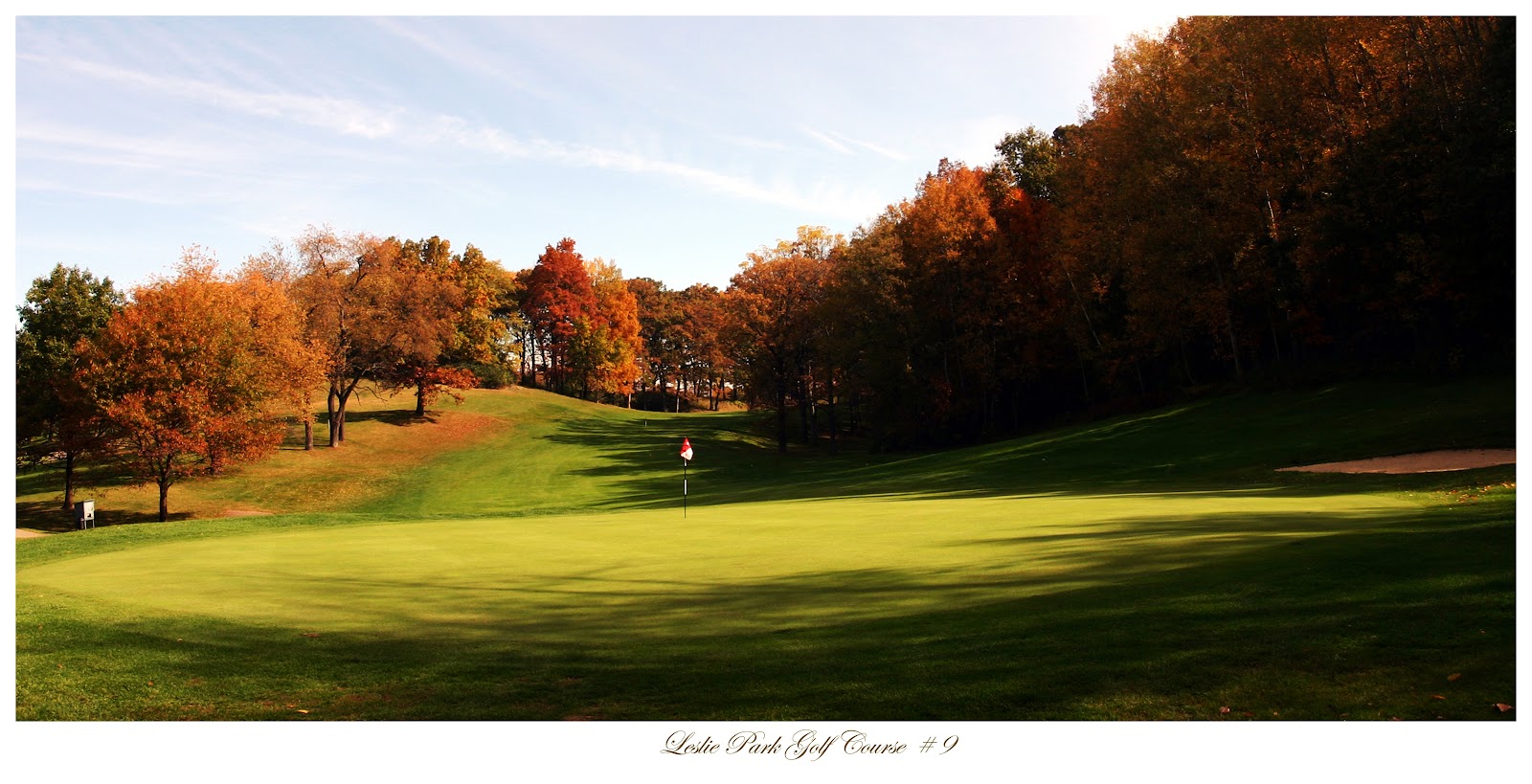
#9 fairway, early morning.

The weather station, with native indiangrass in the foreground. I love the blue sky contrasted with the green grass.

Bumble bee on some Joe-pye-weed

Blue-flag iris in the native plant garden on #12

Lilac Cherry blooms. (Thanks to reader J-Law for pointing it out.)

Cherry blooms between #6 green and #5 fairway.

Pear orchard behind #7 green. Native redbud tree in the foreground.

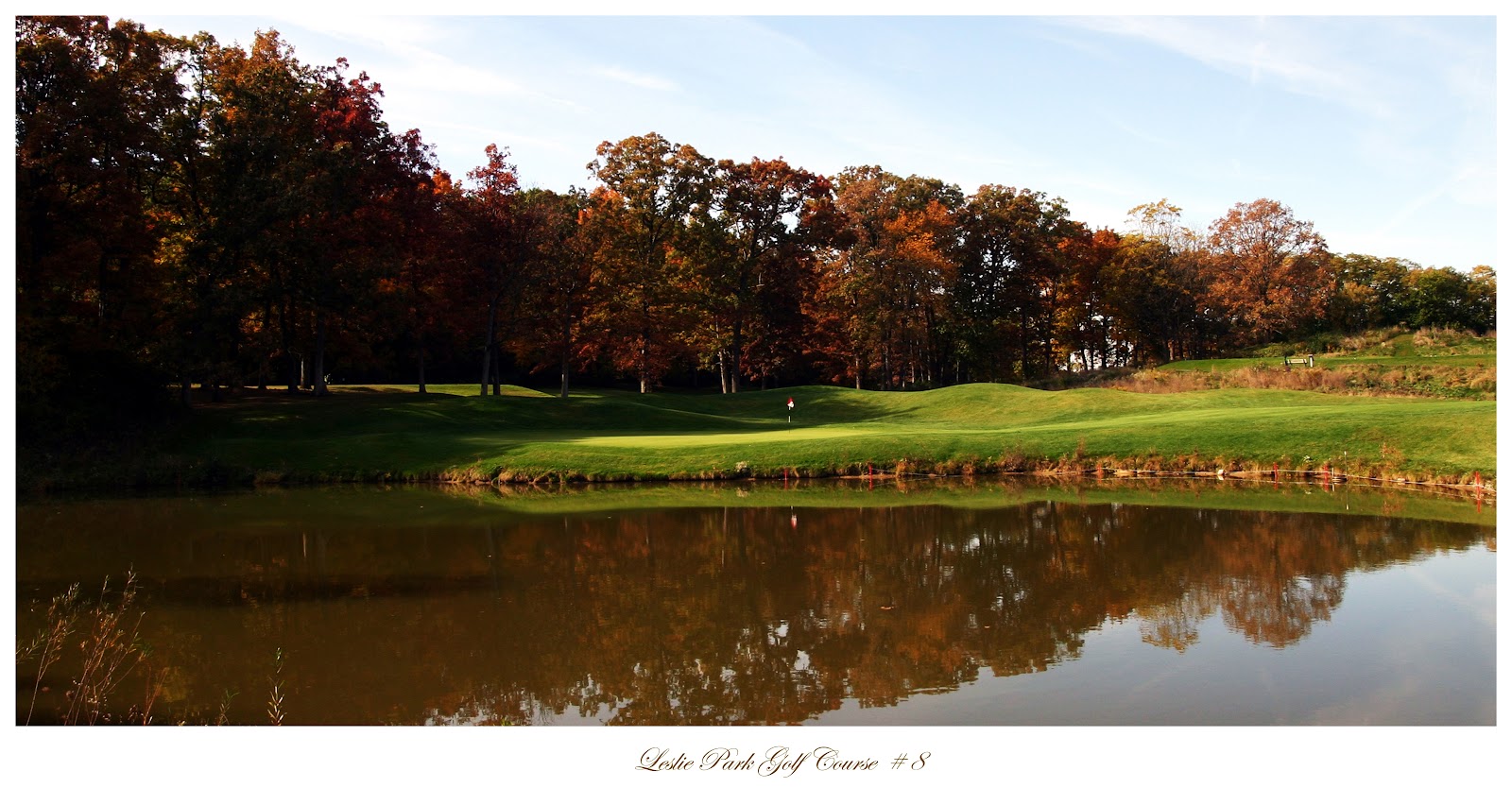
#8 green.

#13 fairway.


Monday, September 19, 2011

Months ending in "ber"


The last four months of the calender year are the beginning of the year for a golf course. I was told this by David Heroian, the Superintendent of the Myopia Hunt Club in South Hamilton, Massachusetts, where I did my internship in the summer of 1998. The thinking behind this is that everything that you do during the Autumn is in preparation for next summer. For some reason, a large portion of the golfers put away their bags after Labor Day. This may be due to football, the kids going back to school or some other reason, but play really drops in the fall. It shouldn't be the weather, because in my opinion, the fall is the best time to play golf. On many days in September and October, the high temperature will be in the upper sixties or seventies with very few clouds. If we are lucky enough to have this type of weather in April or May, golfers will be lining up to get out on the course. Of course, after a long winter, cooped up inside, I don't blame them for wanting to get outside. During the fall, this same weather will be met with open tee times and discounted rates.

This drop in play gives us an opportunity to perform some maintenance that is disruptive to golfers. The biggest one is the dreaded "aerification." When the greens are aerified, the ball roll can be slowed down and if the holes are not properly filled, the greens can be bumpy. If we can get out and aerify while the grass is still actively growing, this disruption will only be about seven to ten days. When it is put off until later in the year (mid to late October in south-east Michigan) this period can last 2 weeks or more. If the weather does not cooperate, the greens might not fully heal until the spring. Last year, we aerified greens on the 16th and 17th of September. Many times in the month of October, I was asked when we were going to aerify our greens. They had no idea that they were already done, due to us taking advantage of the warm weather.

The tees and fairways are also aerified in the fall. This presents less of a problem for golfers. On the tees, the holes do not come into play because the golfer is allowed to choose where he will hit from and will usually put the ball on a tee. The fairways have longer grass and as with greens, if the holes are filled properly, it should be fully healed in a week or so. Most of the disruption will be one the day that we actually are working on the hole. This will usually only be two or three holes, due to the large areas that we are talking about. Most of our fairways are between one and two acres in size.

Fall is also the time when the summer stress is done with for the most part and the grass will start growing roots again. In Michigan, the predominate grasses used on golf courses are "cool-season" grasses. This includes Kentucky Bluegrass, Creeping Bentgrass, Ryegrass and Fescue. These grasses grow best with the temperatures between 60 and 80 degrees. "Warm-season" grasses such as Zoysia and Bermuda (as well as Crabgrass, which isn't a turfgrass, but a weed) don't start to really grow until the temperature reaches 75 degrees and will thrive until it hits 90 or so. When the temperature gets above 80, cool-season grass begins to shut down and go dormant. This is why areas that don't get irrigation will often turn brown in July and August. When this happens, the grass is just trying to survive and often the roots start to retract. At the end of August, we are lucky to have 2 inches of roots on the greens. By the end of October, I hope to have 4-5 inches of roots. The healthier the grass is going into winter, the better it will be in the spring.  Aerification allows the roots a nice , friendly place for new roots to grow. It also allows oxygen to get down into the rootzone.

Fall is also a great time to control weeds. Most of the weeds that we have on the golf course are "winter-annuals." This means that the weeds sprout in the summer and then over-winter and really take-off in the spring and set seed for the next generation. Because of this and the fertilizer needs of the grass (the fertilizer that we put on the fairways in the spring is pretty much gone) right now is a great time for a "weed-and-feed." This is a fertilizer that is coated with a broadleaf herbicide. It makes sense from a couple of standpoints. The first is that we accomplish two goals with one application. The second is that we can save money. If I were to buy a granular herbicide, the manufacturer would have to coat something with the herbicide. This is often ground-up corncobs. If you do a weed and feed, the fertilizer is what is coated with the herbicide. As one salesman has told me, it is like you buy the herbicide and you get the fertilizer for free. Of course, you don't get anything in this world for free, but if you compare prices, if fertilizer costs $20 and herbicide costs $25, the combined product would cost $30. (I am totally making these prices up, don't quote me on any of this.)

During the early winter months, the grass stops growing and we start on preventative maintenance on our equipment. We change the engine oil, hydraulic oil, fuel and air filters on all of the mowers. We also change the oil on the golf carts, as well as check the filters and spark plugs on the carts. The tee, green and fairway mowers all have reels and bedknives that need to be ground and sharpened. The rough mowers have blades that need to be sharpened. We also clean up the shop. During the hectic summer months, it can get quite messy.


These are just a few of the reasons that, as a golf course superintendent, you cannot trust the calender. The New Year starts in September.

P.S. A big thank you to Robb Johnston for the title of this post. Robb works for the City of Ann Arbor's Natural Area Preservation Unit.  He also is a childrens author. Check out his blog for The Woodcutter and the Most Beautiful Tree


Wednesday, May 18, 2011

Poa Seed Heads

Annual bluegrass (Poa annua) is more commonly known as poa, even though one of the most important turfgrasses shares the same genus name (Kentucky bluegrass (Poa pratensis.) Poa is considered a weed by many turf managers due to many factors such as its shallow root system, tendency to die during heat, drought or cold stress and the fact that it is not a grass that is planted on purpose. Most of this stem from poa being a summer annual.

Under normal circumstances, poa germinates in the spring, grows like crazy and dies in the winter. On golf courses throughout the country, it has been so well taken care of, that it will live several years until things get really bad.

Then it will die. This usually happens in the heat of summer, but will also happen during really cold or icy winters.

To make a long story short, bentgrass is better adapted to survive on a putting green at the extreme stress periods but poa out-competes the bentgrass during normal weather. If I could get the poa out of my greens, I would. Instead, turf managers have developed strategies for maintaining the poa at times when the poa would normally die.

Also, being an annual, poa makes a lot of seed. This seed is viable at a very early stage and can persist at very low mowing heights. This can be a problem on greens where we are striving for the smoothest surface possible. Right now is the time of year when poa is producing most of it's seed. Here are a couple of pictures of the seed on a fairway.

The light yellow-green spots are poa seed heads.


A close-up shot.


Using Michigan State University's Growing Degree Days Tracker, I used a plant growth regulator called Embark to stop some of the production of the seed on the greens. This is the first time I have tried this and am hopeful that we see an 80 to 90% reduction of seed heads.

Odds and ends.

Here are some picture I have taken in the two weeks since I last wrote an entry.


Wednesday, April 27, 2011

Rain

3.68 inches!

That is the amount of rain we have had in the month of April, so far. It looks like more is on the way tonight. According to Weather Underground, 1.85 inches (ed: weather.com says 3.3 inches is normal) is normal for the month of April. What this means is that we are wet.

Some other things that have been going on:

We planted 9 cherry trees and 3 apples trees in the orchard. Most of the cherries are at the north end of the orchard, near #7 green. This is just replacing trees that have died over the last forty years since the course was built. This is one of my favorite projects out here. The orchard belonged to the original farm owned and operated by Dr. Eugene Leslie. They would sell apples, pears, cherries and raspberries to the local citizens. The orchard is a signature of holes 6 and 8, as many drives make it into the tightly packed trees. Last year we replaced 10 cherries, 8 apples and 7 pears. I have counted around 40 more spots where trees have been cut down in the past and not replaced. My plan is to fill these areas in so that there is a fruit tree every 15 feet in this section. 10- 15 trees a year should see this plan done in the next 5 years.

We had these little guys drop by for a few days.


They are Bufflehead Ducks (Bucephala albeola) They stopped by on the migration north.


This last picture is my attempt at a close up of some lilac buds getting ready to burst.

Friday, April 15, 2011

Catching Up.

Things have been busy the last week or so. Golf season is finally upon us (as evidenced by the 80 degree weather we had last Sunday, hope you got a chance to get out and play.)

Here are some of the things we have been working on.
1) New irrigation installed on the left side of #3, between #1 and #3 and the left side of #16. Below is a picture of the lines on #3.


2) We put up a bat house that we got as a gift from Wendy Nagle's 2nd and 3rd grade class at the Ann Arbor Learning Community.


3) We deep-tine aerified all of the greens and hollow tined the collars. The deep tine aerification is a solid 14 inch long tine. This breaks through any layers that develop in our greens over time. #3 green is a prime example of this layering. After many years of topdressing on the greens, we now have 3-4 inches of sand on all of our greens. Unfortunately, water doesn't move readily through the change from one layer to the next. On #3, this means that all of the water from the spring tends to sit in the top 3 inches, making it waterlogged. This is why we had #3 green closed down this spring. The channel that the deep tine punches allows water to move past the layer and drain out of the soil profile.

After aerifing, we topdressed sand onto the greens to fill in the holes and smooth the putting surface.

4)We also turned on the irrigation system. We waited until after we had the new irrigation lines installed because it makes it a lot easier to do when the lines are not filled with water.

5) I saw this green heron (Butorides virescens) near the pumphouse. I love this little bird. It is not as famous as it's larger cousin, the great blue heron, but I think it is more interesting. That might be because I don't see them as much.

Monday, April 4, 2011

Blue Winged Teal

These four ducks were out on the pond on #8 this morning. I believe they are Blue Winged Teal.


Tuesday, March 29, 2011

Burn Season is Underway!

The City of Ann Arbor's Natural Areas Preservation unit started the 2011 burn season yesterday and one of the first locations chosen was Leslie Park. These controlled burns are used to try and control the spread of invasive plant species. I will have a longer post later that will go into more detail, but here are some pictures and a video taken yesterday (March 28, 2011)


Before

After


Before


During


After