Showing posts with label Irrigation. Show all posts

Thursday, July 28, 2016

Irrigation Design Class 101

Here in the Midwest, irrigation is designed to supplement natural rainfall. It is not meant to supply all of the water that the golf course needs for a prolonged period. Unfortunately, we are in a prolonged period without a lot of natural rainfall. We are currently about three and a half inches behind the amount of rain we should have to this point of the year. Because of this, some of the deficiencies of our irrigation systems start to show.

At Huron Hills, the irrigation runs down the middle of the fairways. This is called "single-row" spacing.  We have two choices with this type of system, we can over water the middle in order to get the edges of the fairway adequate moisture. The other option is to water the center to the optimum moisture level. This leaves scallops of grass that receive much less water. As long as we still get occasional rainfall, these areas will turn brown, but they should not die.

A single row system is pictured below.
Each circle would have an irrigation head in the center. These heads are designed to throw water to the next head in the row, thus giving a more uniform spread of irrigation. The lighter green areas only get water from one head, and thus get only half the water they should get.

Most of the greens at Huron Hills have a "triangle spacing." This means that three heads cover the green. The benefit of this is redundancy, if one head is not working properly, the other two will still cover most of the green. It also evens out the edges separating the irrigated areas from the non-irrigated areas.

This is an example of triangle spacing. (Ed: I noticed that my picture has a small error. The labels on this should be: No Water, 33% Water, 67% Water and 100% Water.)
With this type of system, you need more irrigation heads as well as twice as much underground piping, but the distribution is much more even. Keep in mind that the irrigation heads we use on the golf courses throw about 70 feet, so you can have the heads on each side of the fairway and keep most of the shorter grass under the dark green area in the picture above.

Most of what we have at Leslie Park Golf Course is "square spacing." In this system, the heads are set out in a square. This gives the most even distribution in between the heads, as you can see in the illustration below.

In order to make the picture more understandable, I exaggerated the space that gets 75% water in the middle of the fairway, in general, this will give a even distribution of water between the irrigation heads. Also, this is under perfect conditions with brand new equipment. The irrigation at Leslie was put in during the 90's. In all honesty, I do not know when the irrigation at Huron Hills was put in, but it is considerably older than that. As such, we have to keep track of any problems we find and fix them as soon as they crop up. That means keeping an eye on about 600 irrigation heads at Leslie and 200 at Huron.

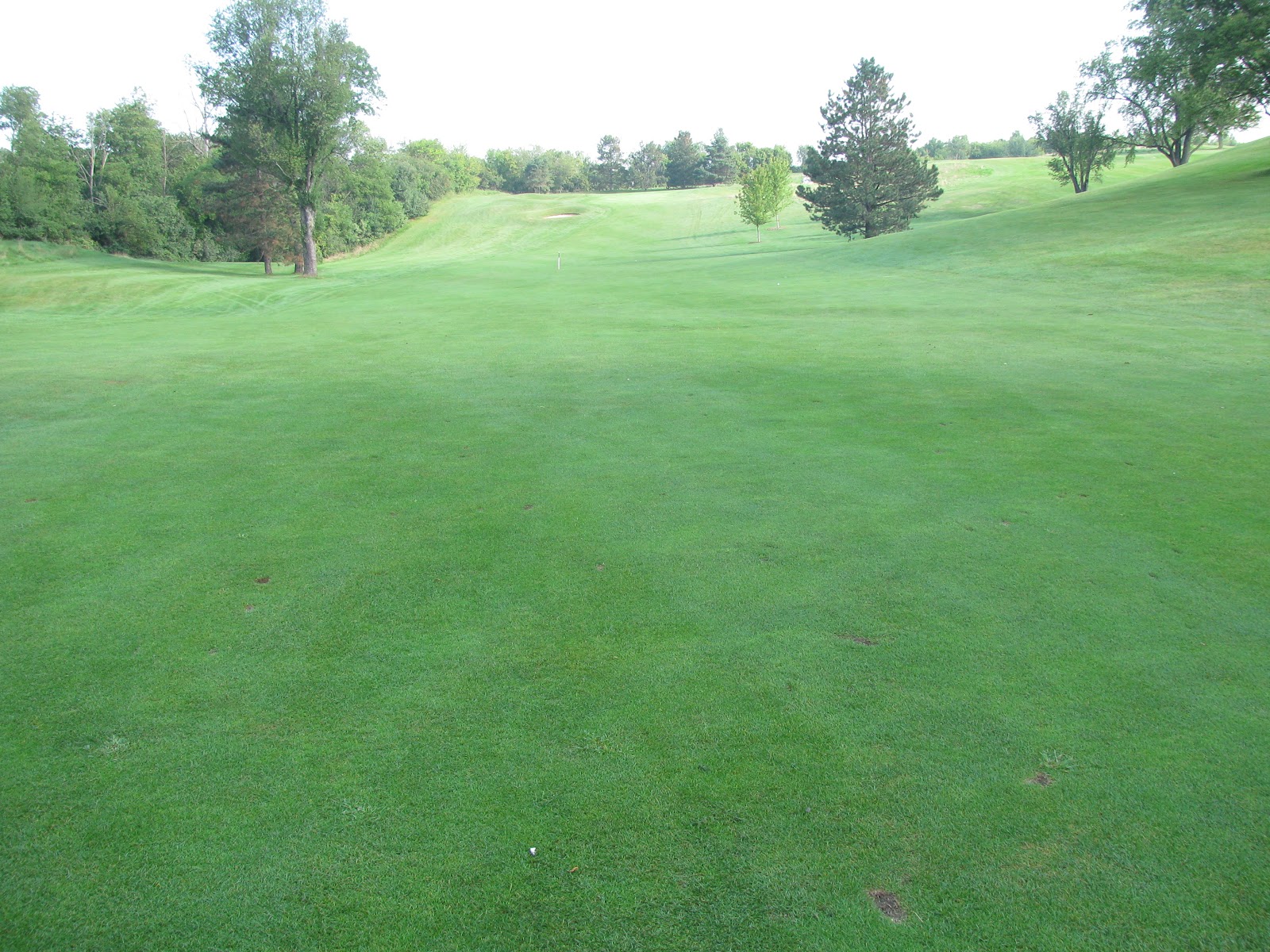
In this photo, taken in 2012 of #4 fairway at Leslie, you can see a spot in the middle of the fairway where a single head was not operating properly. The other three head covered that spot to around 75% of what the grass needed. You can also see how the rough, which is outside of the square spacing of our irrigation, has turned brown and dormant.


Tuesday, July 5, 2016

June 2016 Weather Summary

The high temperature for the month of June was 90.6 degrees, on June 11th, with the 27th also reaching 90 degrees (actually, 90.1.)The low temperature for the month was 45.1 degrees (9th.)  The average temperature for the month was 69.1 degrees.

The month of June had just  5 days of rain that totaled 2.97 inches, with the highest daily total falling on the 4th.(1.18inches) Four days saw precipitation of over a tenth of an inch. For the year, we have gotten 13.44 inches of rain. This is drier than the past three years have been up to this point, but still nearly 5 inches more precipitation than we had in 2012 to the beginning of July.

The average windspeed for the month was 1.6 mph. The highest sustained windspeed was 26 mph, on the 20th.

Here are some pictures from July of 2012 to show what we looked like then.

Looking toward #5 green from the orchard near #8 fairway.

#16 green and fairway.

The irrigation pond has since been dredged and hold significantly more water.

#4 fairway.


Tuesday, April 22, 2014

Irrigation at Huron Hills

The irritation irrigation at Huron Hills is often a challenge. Whenever we start digging, you never know what you will find. This irrigation leak near #7 green has been on the agenda for quite a while. Last year, we dug down far enough to know that the leak was at the reducing coupling where the six-inch main line went down to 2.5 inches.  This type of repair is not easy and the leak was not big, so we opted to do it in the spring before we started up the water. This gave us a couple of advantages. The first is that we did not have to drain the water out of the main line. With a 6 inch diameter main line, this would be thousands of gallons of water we would have to remove. The second advantage is that usually in the spring, the water needs of the grass is not high and a fix of this size can take a couple of days.

When we got back and started digging out the lines, what we found was a maze of pipes.
I have no idea what the thinking behind this design was.

The six inch main line runs from the lower right to the upper left in this picture.

It seems like this might have been a repair and replacement of a four way joint, or cross. These cross joints are extremely tough to replace, especially on a six inch pipe. The "solution" was to put in a tee coming out to the north and size it down to 2.5 inches. Then come out and make a 90 degree turn with an "elbow" to the east. After another 3 feet of 2.5 inch pipe, a tee was added. This matched up with the 2.5 inch pipe that headed east. The problem was in then connecting to the 2.5 inch pipe that runs west. It is on the other side of the 6 inch mainline and at the same depth. They then took another elbow and came up enough to clear the mainline and then bring it back down on the other side. 

I should mention that the mainline here is only about 18 inches below ground. This meant that the pipe coming over the mainline was less than a foot below the surface.

We decided to put in two tees off of the mainline. One for the east and one going west. 

The two tees coming off the mainline.

In order to realign the pipe, we used 45 degrees turns. This cuts down on the pressure loss that would be experienced using 90 degree elbows.

The finished product with a new quick coupler that we will be able to use on #7 green.


Monday, November 5, 2012

Traver Creek Project Update


On Monday, October 29th, LJ Construction began working at the Leslie Park Golf Course. They pumped down the north pond.


They made a diversion channel to change the flow of Traver Creek while they work on the north pond.


They started stripping topsoil from the area to the west of #14 tee and stockpiling it for use later. This is an area where spoils from the pond will be moved.


Dredging of the pond continued in week 2.

Here you can see the temporary "road" that has been built in order to get the dump trucks and excavators out into the pond.


Some trees have been cut in order to get access to the creek. They will be replaced with native trees and shrubs.


Spoils from the pond are mixed with soil in order to dry the spoils out.


Loading up the off-road dump trucks.


Mixing the spoils near old #14 tee.


Thursday, October 25, 2012

Catching Up

October has been a busy month. We have finished aerifying. We have blown out the irrigation. The leaves are falling. The Traver Creek Project begins next week. Some thoughts about what has been going on.

Last week, we had some scuff marks on #11 green one morning. As David was blowing the oak leaves off the green in preperation for mowing, he uncovered a broken deer antler. Apparently, two young bucks were working off some testosterone and one of them had a lot more than the other.

On Tuesday, we got the air compressor we use to empty the water from the irrigation lines so they don't freeze. Click here to read more about the process. This year, after we were done with the compressor, we took it over to Tony at Calderone Farms Golf Club near Grass Lake.

Here is a video I shot today on #9. The leaves on the oak leaves are falling like rain. This might give you some idea of the amount of time we spend in a day to keep the greens and tees clear of leaves. We also try to hit every fairway at least once. It can be frustrating to work for a half-an-hour to clear off a fairway, only to look back later and not tell that you have done anything. The only consolation is knowing that it would have been worse, if we had not blown it off before.


The Traver Creek Project is scheduled to begin on Monday, October 29th. The pond on #17 is being drawn down in order to facilitate dredging. It is about 2 feet below where it was during the height of this summer's drought. You can see the sediment build-up in the center of the pond.


Monday, August 13, 2012

Unexpected

When the crew came in Saturday morning, they were greeted by this.


That is the power lines that run just outside the maintenance barn. The power lines running into the barn were burning. We don't know exactly what happened, but the barn and the irrigation pumphouse had no power.
DTE came out quickly and started the repair.

By Saturday afternoon, the power was back on. This enabled us to find out that neither the irrigation pumps, nor the irrigation computer were working. After some sleuthing and guess work, we got the pumps back on, but the irrigation computer had lost it's hard drive. Thanks to a service agreement with Toro Irrigation, a new computer will be here on Tuesday morning.

For those of you wondering why the weather station is not reporting to Wunderground.com, it downloads all of it's data into the irrigation computer. The data is still there, it is just not getting sent to the internet. It should be back up and working soon.

Thankfully, no one was hurt and we got almost 1.5 inches of rain over the last couple of days, so things should be okay.


Friday, July 27, 2012

Photo Quiz

Can you guess what is going on in this picture?


Time's up. If you think that some weird disease is affecting that oak tree, you would be wrong. Here is another picture, taken from a slightly different perspective.


The orange cone behind the tree is sitting on an irrigation head.The green grass receives irrigation, while the tree blocks the brown grass from getting any water. Here is another picture.


You can see a nice green circle that extends 70 feet from the irrigation head. That is because this head stuck on one night about 2 weeks ago. Instead of running for about 10 minutes, this head ran water for about 6 hours.

While I am on the topic of water, we are still experiencing a substantial drought.While areas near Ann Arbor have been getting more rain over the past couple of days, Leslie Park has missed out, for the most part. On July 18th we got 0.08 inches of rain, while just to the south of Ann Arbor got up to 0.75 inches. On July 26th, while some areas north of Ann Arbor got over a inch of rain, we recorded 0.27 inches. I will take whatever I can get, but at this point, it is estimated that we will need between 6 and 9 inches of rain to come out of the drought. For the month, we have gotten 1.25 inches of rain. That seems like a lot, but 60% of that rain came on the 6th in about a half an hour. Most of this water ran into the streams and storm sewer system due to the speed at which it came down. For the year, we have gotten just under 10 inches of rain. In 2011, we got almost that much in July and August alone.

Here are some pictures from previous years. Compare them with pictures from this year. All pictures were taken in July.

#4 in July 2011.

#4 in July 2012.

#15 in July 2010.

#15 in July 2012.

#16 in July 2009.

#16 in July 2012.


Thursday, April 5, 2012

Irrigation Start Up

The irrigation system is charged and ready to go. This is not because I am worried about the soil moisture levels, but in preparation for aerification next Wednesday. The water is helpful in working the sand into the holes and the turf canopy.  The reason that we drain the irrigation over the winter is to prevent the pipes from freezing. We may get freezing temperatures (in fact tonight may get into the mid twenties) but it should not be cold long enough to freeze the pipes.

Speaking of freezing temperatures, the pear orchard between 6 and 8 is just starting to bloom. I took some pictures just in case the flowers get hit hard by tonight's heavy frost. Enjoy them while you can.


Wednesday, October 26, 2011

Irrigation Blowout


We blew the water out of the irrigation lines yesterday. This is to prevent the water in the lines from freezing and cracking the pipe. In order to do this, we rent an air compressor from a large equipment rental company in Detroit. About a dozen golf courses around Ann Arbor go in on this compressor together in order to cut down on costs. We rent it for 3 weeks and shuttle it from one course to the next until everybody is done with it. You may have seen lawn care companies around town blowing out home lawn irrigation systems. They will usually use a 175 cubic foot per minute (ft3/min) air compressor. The one that we get is 825 ft3/min. The pressure that we run is around 60-70 psi. This contrasts with the normal water pressure of between 108 and 118 psi.  Anything higher that 75 psi with air and the irrigation heads are at risk of breaking. Here is a picture of the compressor set up in front of the pumphouse.


Here you can see the 2 inch hose running directly into the 10 inch steel line coming out of the pumphouse.

This is the view of the pump controller.

Our two 50 horsepower, variable speed, vertical turbine pumps.

When blowing the water out, the goal is to get 90 percent of the water out. In theory, as long as 70% is out of the line, the pipe should be able to withstand water freezing. The problem is that with the pipe changing in elevation, some low areas might have 2 or 3 times the water that high spots do.

When you first turn on the irrigation head, you get out pure water.

After a few minutes, most of the water is gone.

When you have a large volume compressor, you can have up to 20 heads running at any one time.

Here is a video of the process on #5 green. I apologize for the shakiness.


I borrowed a dump truck from NAP to take the compressor to Tim Dark, Superintendent at Barton Hills Country Club.