Showing posts with label snapping turtle. Show all posts

Wednesday, June 15, 2016

Turtles and golf

When the Traver Creek Project was started, one of the most interesting parts was the turtle stipulation. In order to begin the creek renovation, a permit was submitted to the Michigan Department of Environmental Quality (MDEQ.) To satisfy the MDEQ permit of the project, turtles and other herptofauna were relocated from the two inline detention basins (AKA ponds on holes #12 and #17) on Traver Creek to the pond on #8. There are at least four large snapping turtles (Chelydra serpentina) and numerous painted turtles(Chrysemys picta) in Traver Creek and there was concern over what would happen to these turtles during and after the project was completed. To help them after the project, four sand piles were created for the turtles to use as nesting areas. 

A mother laying her eggs.


The eggs in the nest.

The eggs are marked  so that the same side remains up in the new nest.

When there is a nest located where someone doesn't want it or in a place that this young will not have a good chance for survival, NAP staff will collect the eggs and bring them to one of the nesting mounds. These eggs were taken from the bunker on #6 at Huron Hills and transplanted to the pond near #12 at Leslie. A shallow hole was excavated and the eggs placed inside. After covering the eggs with soil, a predator exclusion box was placed over the nest. This will keep raccoons and other small animals from eating them until they hatch in September.


One of the turtle nesting mounds. There was also a nest that was found on the nesting mound that was covered.


The predator exclusion box, along with an explanation of what it is and a phone number for questions.


This is a favorite place for turtles to lay eggs, as this is the third year in a row that the same spot has been used as a nest.

The turtles go into a trance when laying eggs and do not respond. Please stay away from them during this process.


Tuesday, June 2, 2015

Relocating Turtle Nests

When the Traver Creek Project was started, one of the most interesting parts was the turtle stipulation. In order to begin the creek renovation, a permit was submitted to the Michigan Department of Environmental Quality (MDEQ.) To satisfy the MDEQ permit of the project, turtles and other herptofauna were relocated from the two inline detention basins (AKA ponds on holes #12 and #17) on Traver Creek to the pond on #8. There are at least four large snapping turtles (Chelydra serpentina) and numerous painted turtles(Chrysemys picta) in Traver Creek and there was concern over what would happen to these turtles during and after the project was completed. To help them after the project, four sand piles were created for the turtles to use as nesting areas. 

The mother laying her eggs.

Last week, a City employee noticed a painted turtle laying eggs in the lawn area of an apartment complex. These eggs would have had very little chance of hatching and those eggs that hatched would have had a hard time getting to the relative safety of the water. The employee notified Natural Area Preservation (NAP) and the staff herpetologist came out to examine the nest. He determined that the eggs would not survive and removed them. He marked the eggs because they an air bubble grows at the top. If the eggs are inverted, the embryos inside will not develop. 

The eggs in the nest.

Nine eggs were marked and removed. This is a typical amount of eggs per nest.

The eggs were taken to the pond near #12 at Leslie. A shallow hole was excavated and the eggs placed inside. After covering the eggs with soil, a predator exclusion box was placed over the nest. This will keep raccoons and other small animals from eating them until they hatch in September.

One of the turtle nesting mounds.

The predator exclusion box, along with an explanation of what it is and a phone number for questions.

Over the weekend, a golfer noticed a snapping turtle doing the same thing in one of the bunkers at Huron Hills.


The turtles go into a trance when laying eggs and do not respond. Please stay away from them during this process.
These eggs were removed to another location, closer to the south pond of the Huron River.


Thursday, June 12, 2014

Turtles come back to Leslie Park

In the last couple of days, we have seen an increase in turtles. You may recall that one of the big objectives of the Traver Creek Project was to minimize the impact on turtle populations in the creek and ponds on the golf course. You can read more about this program HERE and HERE.

Here is a snapping turtle laying eggs near the creek.

Turtles have been laying eggs on this stream bank.

This turtle was laying eggs near #6 at Huron Hills.


Thursday, May 30, 2013

Snapping Turtle Migration

This morning, a large female snapping turtle was seen moving along Traver Creek. She was between the first bridges downstream from Traver Road and the #17 pond. This is great news because it means that at least some of the turtles we moved last fall for the Traver Creek Project have made it back to the areas they were relocated from. The photo above is from last fall, as I did not have my camera with me this morning. You can read more about the turtle relocation HERE, HERE, HERE or HERE.

Monday, September 24, 2012

Turtle results

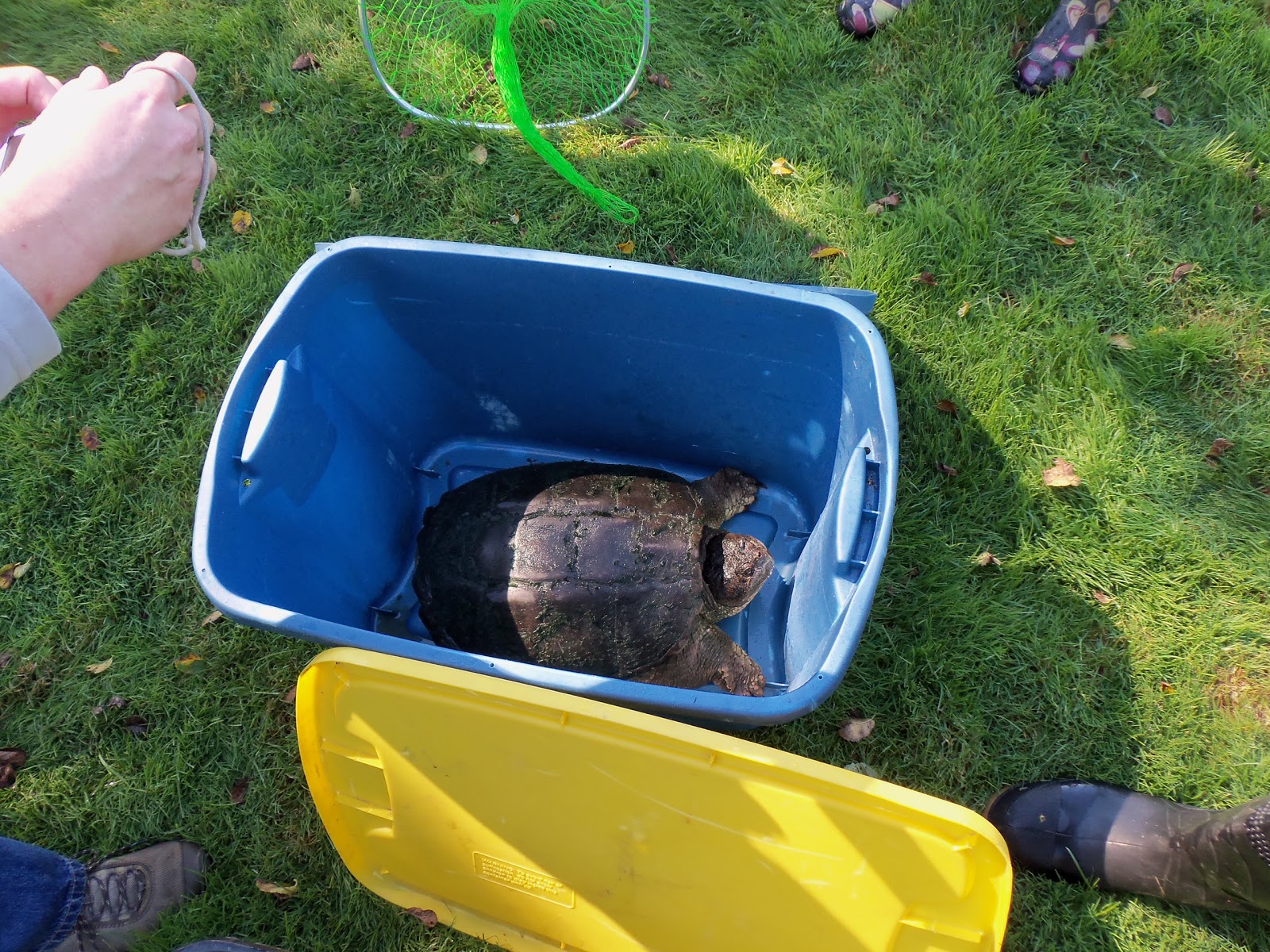
The trapping on the pond by #17 green is almost done. We were able to relocate 5 painted turtles (Chrysemys picta) and 4 large snapping turtles (Chelydra serpentina.) to the pond by #8 green.

Here are some pictures and videos.


David Mifsud, City of Ann Arbor herpetologist, taking one of the snapping turtles out of the transportation tub.

This guy was estimated to be up to 70 years old.

This smaller female was thought to be 40-50 years old.


Just to clear up some things about this project. This will be a joint undertaking between the Washtenaw County Water Resources Commision, The City of Ann Arbor and the Michigan Department of Environmental Quality. The main point of the project is not enhancement of the golf course, although that will be a secondary benefit, but to reduce phosphorus and sediment flowing into the Huron River and to minimize stream fluctuations after large rain events. 

Funding for the project will come from the City of Ann Arbor Stormwater maintenance fund, with up to 50% loan forgiveness from the State of Michigan because of environmental improvements to the storm drain (Traver Creek.) 

The permit from the MDEQ contains the following "Prior to hibernation, turtles shall be trapped from the north and south detention basins and be relocated to undisturbed sites by a qualified herpetologist."


Tuesday, September 18, 2012

Turtle Relocation


As part of the Traver Creek Restoration Project through the City of Ann Arbor owned Leslie Park Golf Course, a permit was submitted to the Michigan Department of Environmental Quality (MDEQ.) To satisfy the MDEQ permit of the project, turtles and other herptofauna will be relocated from the two inline detention basins (AKA ponds on holes #12 and #17) on Traver Creek in the Golf Course.  This week, barrier fencing was installed around the pond on hole number 8 at the LPGC to receive and retain relocated animals before the construction starts.


The City of Ann Arbor's Natural Area Preservation's (NAP) staff Herpetologist, David Mifsud, will coordinate the relocation efforts with assistance from NAP staff and volunteers. The hope is that we will be able to relocate the majority of the animals from the ponds well within the time needed for them to successfully overwinter in the relocated area.  NAP will document all collected animals and monitor the receiver area(s) in subsequent years to qualitatively assess the results of the relocation.


The turtles will be live trapped with hoop traps baited with sardines. There will be six of each of three different size traps for a total of 18 traps. Here are some pictures of the traps.

The smallest trap. Notice the yellow, foam swim toy (noodle) which will help keep the trap afloat.

Here is the largest size trap.


Putting the traps out.

The traps need to be staked out so they don't float away.

These nets will help direct turtles into the traps. They hit the net and follow it until they get to the trap.


Here is the set up with one of the large nets.

Another perspective of the traps in the water.

This is the pond on #8 where the turtles and other animals will be relocated.

The silt fence will keep the animals from trying to move back to the pond where we are trapping them.


If you have interest in helping with this project please contact Tina Roselle, the Volunteer and Outreach Coordinator for the City of Ann Arbor's Natural Area Preservation at troselle@a2gov.org or call NAP at (734) 794-6627. 

Thursday, May 24, 2012

Surprise!


There is a weir structure on the #17 pond at Leslie Park. This allows us to slightly change the level of the pond depending on the time of year. The discharge pipe comes out near the walking bridge that goes from #17 green to #18 tee. This pipe is 24 inches in diameter. While looking around 17 green the other day, I noticed that the discharge pipe was making more noise than usual. I checked the weir and, to my surprise, found a large snapping turtle (Chelydra serpentina) stuck between the boards and the reinforcement bar. Because the turtle was basically submerged, I feared it was dead and wondered how to remove it from the weir. Grabbing the bar used to change the board level, I began to lever the turtle out of it's position. I was very surprised when the fierce jaws suddenly grabbed the tool forcefully.

I was able to get the creature unstuck and he made his way to the outlet.


Once again, the outlet pipe is 24 inches around. Hours later, he had made his way back into the pond.